Consultations on North Korean POWs’ Transfer to South Korea... South Korea, Ukraine Foreign Ministers: “Respecting the Prisoners’ Free Will” (Comprehensive)
First Visit to South Korea by a High-Level Ukrainian Official Since the Inauguration of the Lee Administration
Minister Syvukha Also Visits the DMZ
The foreign ministers of South Korea and Ukraine met to discuss the issue of North Korean prisoners of war. Both ministers agreed on the need to respect the free will of the prisoners themselves and to resolve the issue in a manner consistent with international law and humanitarian principles. With two North Korean prisoners of war currently detained at a camp in Ukraine for a year and a half and reportedly expressing their wish to come to South Korea, it is expected that related procedures will be expedited.

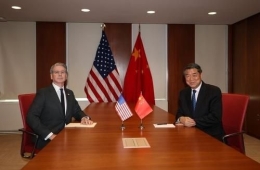
Minister of Foreign Affairs Cho Hyun (right) and Ukrainian Foreign Minister Andriy Sybiha shook hands on the afternoon of the 30th at the Ministry of Foreign Affairs annex of the Government Complex Seoul. Ministry of Foreign Affairs
View original imageOn the afternoon of the 30th, Minister of Foreign Affairs Cho Hyun held talks with Ukrainian Foreign Minister Andrii Sibiha, who is visiting South Korea, at the Ministry of Foreign Affairs annex of the Government Complex Seoul, to discuss these matters. This marks the first visit by a Ukrainian foreign minister to South Korea since the outbreak of the Russia-Ukraine war in 2022.
According to the Ministry of Foreign Affairs, Minister Cho welcomed Minister Sibiha’s visit and praised the fact that, despite the difficult circumstances since the start of the war, the two countries have maintained the momentum of cooperation through continued high-level exchanges. He also said, "Our government is closely monitoring and paying great attention to diplomatic efforts for a ceasefire," adding, "We hope the negotiations for a ceasefire will soon lead to meaningful progress." He also explained about the South Korean government’s humanitarian assistance for Ukraine’s recovery and reconstruction.
Sibiha, shortly after the talks, wrote on his X (formerly Twitter), "We discussed the issue of North Korean prisoners of war in detail," adding, "We know how to proceed according to international humanitarian law." The South Korean government has consistently emphasized that North Korean prisoners of war should be brought to South Korea in accordance with international law and humanitarian principles, and it appears that the Ukrainian side also shares this view.
Park Il, spokesperson for the Ministry of Foreign Affairs, said at a regular briefing on the same day, "The foreign ministers of both countries are engaged in constructive discussions based on the consensus that the issue should be resolved in accordance with international law and humanitarian principles," adding, "We will continue to make diplomatic efforts for progress and resolution on the North Korean POW issue." He further said, "It remains unchanged that the North Korean prisoners of war in Ukraine wish to come to South Korea," and added, "If a decision is made for their transfer to South Korea, the process will proceed in accordance with relevant domestic laws."
However, it is difficult to expect immediate and tangible results, as there have been multiple rounds of prisoner exchanges with Russia, a party to the war, and the timing of a ceasefire remains uncertain. An official from the Ministry of Foreign Affairs said, "With the cooperation of local authorities, we are providing humanitarian support to North Korean prisoners of war, including clothes and supplies."
The two ministers also discussed bilateral issues such as humanitarian aid and postwar reconstruction participation, as well as international affairs. With the Russia-Ukraine war dragging on for over five years, both sides are experiencing extreme fatigue. Ukraine has consistently requested weapons support from European and other allied countries, but the South Korean government has maintained a firm stance against military aid.
During the Yoon Suk Yeol administration, former President Yoon visited Kyiv, the capital of Ukraine, in July 2023, and just before the declaration of martial law in November 2024, a Ukrainian special envoy (the Minister of Defense) visited South Korea. Under the Lee Jaemyung administration, this is the first visit by a high-ranking Ukrainian official to South Korea. In particular, it is the first time in 11 years since 2015 that the Ukrainian foreign minister has visited South Korea. After visiting South Korea, Minister Sibiha is also expected to stop by Japan.

Andrii Sibiha, Ukrainian Foreign Minister, visiting Panmunjom in Paju, Gyeonggi Province on the 30th. Photo by Sibiha at X
View original imageMeanwhile, before the talks, Minister Sibiha visited the Panmunjom Joint Security Area in the Demilitarized Zone (DMZ) with Andrii Beshkin, Acting Ambassador of Ukraine to South Korea, and others. On his X account, he posted a photo with the caption, "Beyond this line lies a totalitarian regime (North Korea) that has actively helped Russia destroy peaceful Ukrainian cities," and continued, "Because of the dangerous actions of Pyongyang and Moscow, this historic line is now physically connected to Ukraine’s front line." This was a criticism targeting the illegal military cooperation between North Korea and Russia.
Hot Picks Today
 "Much Has Changed Since You Left, Please Come Back"... Amazon Surprises by Actively Rehiring Former Employees
- "450,000 Deaths Expected by Early Next Year"... World's Worst-Ever El Nino Forecast Spurs Global Alarm
- A Company Sweeping Up Profits Like Samsung and SK Hynix..."Thanks to Nvidia's Shift in the Power Paradigm"[Weekend Money]
- "It's Nothing to Kill You"... Seungri Caught on CCTV Swinging Soju Bottle
- "The Terror at 2:40 a.m."... Ransacked for an Hour and Fled: Bundang Chinese Restaurant Tragedy
He went on to say, "Moscow (Russia) is drawing the North Korean regime into the war, exporting instability to the Korean Peninsula," and added, "Ukraine is prepared to export security and share its expertise. We are offering mutually beneficial security partnerships to our partners in South Korea."
© The Asia Business Daily. All rights reserved. Unauthorized AI training and use prohibited.