"The Solution to the Challenges of Our Era"... Academic Conference on the 17th Anniversary of Kim Dae-jung's Passing Held in Gwangju
Kim Junhyeong: "The South Korea-U.S. alliance and inter-Korean cooperation must be strengthened"
Ham Donkyun: "We must follow DJ's example in overcoming regionalism"
On the 17th anniversary of President Kim Dae-jung's passing, an academic conference was held in Gwangju to summon "Kim Dae-jung's insight and wisdom" as a way to address rapidly changing international affairs and complex domestic political challenges.

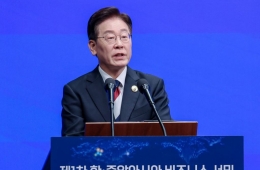
On the afternoon of the 29th, Gwangju City and the Kim Dae-jung Gwangju Memorial Project Association held an academic conference commemorating the 17th anniversary of the death of President Kim Dae-jung in the medium conference room on the 4th floor of Jeonil Building 245. Photo by Min Chanki
View original imageGwangju City and the Kim Dae-jung Gwangju Memorial Project held an academic conference commemorating the 17th anniversary of President Kim Dae-jung's passing on the afternoon of the 29th at the conference room on the 4th floor of Jeonil Building 245.
The purpose of this conference was to seek practical alternatives by drawing on the wisdom of President Kim Dae-jung, who dedicated his life to democracy and peace, amid the rapidly changing international situation and entangled political challenges.
The conference included keynote presentations followed by a comprehensive discussion. The discussion was chaired by Gong Jinseong, Professor of Political Science at Chosun University, with Lee Jaebong, Professor Emeritus of International Politics at Wonkwang University, and Jang Beomdo, former co-representative of Jeonnam Buddhist Environmental Solidarity, participating as discussants.
Moon Gijeon, President of the Kim Dae-jung Gwangju Memorial Project, stated in his opening remarks, "Today's event is an occasion to summon 'Kim Dae-jung's insight' in search of solutions to the challenges of our era," adding, "The wisdom of a president who overcame the tides of his time with unwavering faith in democracy and peace throughout his life remains the clearest compass for those of us living in an era of conflict and uncertainty."
The first keynote presenter, Assemblyman Kim Junhyeong of the Innovation Party for the Fatherland, analyzed U.S. hegemony and current global strategy, and presented a roadmap for peace on the Korean Peninsula. He stated, "In the current context of U.S. hegemony, the path to safeguarding peace on the Korean Peninsula is to simultaneously strengthen the South Korea-U.S. alliance and inter-Korean exchange and cooperation," emphasizing, "The new administration's guiding principles for the era and foreign policy must be democracy, peace, and autonomy."
Assemblyman Kim went on to point out the regression of democracy using the cases of the United States and Israel, stating, "Dictatorship is closer to war, while democracy is closer to peace," and stressed, "We must pursue progressive nationalism through the aesthetics of slowness, solidarity, and autonomy."
The second keynote presentation was delivered by Ham Donkyun, Visiting Professor at Myongji University, who assessed the frontlines of Korean politics and offered both criticism of the current Democratic Party bloc and suggestions for its future direction.
Professor Ham commented, "The first year of Lee Jaemyung's government, which began amid the upheaval in international politics symbolized by the Trump administration, was a period in which wisdom was displayed in the transition from a unipolar to a multipolar order," adding, "Domestically, the administration worked diligently to restore stability to the national system through overcoming internal strife, pursued the well-being of the people in practical terms, and made sincere efforts to restore the nation's standing."
Nonetheless, Professor Ham offered pointed criticism toward the current mainstream opposition bloc. He remarked, "Looking at Korean politics after the Moon Jae-in administration, it is difficult not to take a critical view of the current Democratic Party, where those who formed the core of the previous administration now occupy the dominant positions within the organization," emphasizing, "Above all, they were the root that enabled the political rise of the Yoon Suk Yeol martial law faction."
He further noted, "Crowd psychology that triggers religious-like conviction or trauma leads to a loss of rationality," and added, "It is necessary to evaluate the actual sense of efficacy that politics can bring to our lives."
Hot Picks Today
 "Additional 25% Mobile Bill Discount From Today" Causes Stir Online... The Truth Revealed
- "The Clothes My Dad Used to Wear"... Ralph Lauren, Beanpole, and Hazzys See Sales Surge as MZ Generation Embraces the Trend
- "So Many Inconsiderate People": Kicking and Struggling After Clothes Are Grabbed... Subway Line 2 Altercation Sparks Uproar
- "Please Take Off Your Shoes"—From Crawling onto the Bed to Changing Habits, Young Americans Lead the Shift
- "Famous Actress on KBS Is Perpetrator's Sister"... KBS Responds to 'Busan Fall Death' Family's Plea
In addition, he proposed, "We must follow President Kim Dae-jung, an innovative leader who viewed the nation not as a battleground for power struggles but from a management perspective, and who sought to overcome regionalism and establish a truly national party," and suggested, "The Lee Jaemyung administration should inherit and newly design this heritage."
© The Asia Business Daily. All rights reserved. Unauthorized AI training and use prohibited.