Physical AI to Be Fostered as a National Strategic Industry... M.AX Acceleration
National Report on Korea’s Leap Forward: The Three Major Mega Projects
The government believes that the current period, when the global market landscape is still undecided, is a critical juncture to become a leading nation in AI robotics. As such, it has established the ‘3M Strategy’ to propel Korea into the global top three in AI robotics.
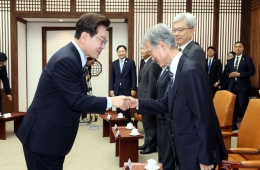
The Ministry of Trade, Industry and Energy, together with related ministries, announced on the 29th that it held the ‘National Report Meeting on Korea’s Leap Forward: The Three Major Mega Projects’ at the Blue House Guest House on June 29. At this event, the government shared large-scale investment plans for three key sectors—semiconductors, physical AI such as AI robots, and AI data centers—and discussed strategies for expanding infrastructure, including electricity and industrial sites.

President Lee Jae-myung is speaking at the 'Future New Security Innovation Enterprise Promotion Strategy' meeting held at the Blue House on the 26th. Photo by Yonhap News Agency Blue House Press Photographers Group
View original imageAI robots, epitomized by humanoids, are considered a core industry within physical AI that can bring about dramatic transformations in both industry and daily life. To maximize the synergy between Korea’s strong manufacturing sector and the robotics industry, the government decided to accelerate the Manufacturing AI Transformation (M.AX). Centered on the M.AX Alliance, Korea will develop industry-specific AI robots and deploy more than 1,000 units to workplaces every year.
The government is also working to secure competitiveness in core technologies such as AI and components. By establishing data factories across ten major sectors, Korea will secure training data necessary for AI robot learning, thereby reducing dependence on overseas foundation models for robotics. R&D investment will also be expanded for three key components with low domestic production rates—actuators, robotic hands, and sensors. Furthermore, specialized graduate schools for robotics will be designated, with the goal of nurturing 10,000 AI robotics professionals over the next five years.
To respond to the mass production of humanoids in competing countries such as China, Korea will rapidly establish a region-based mass production system. Leveraging investment from Hyundai Motor Group, a robot foundry and parts cluster will be built in Saemangeum. In addition, automotive and home appliance parts companies in the Daegu-Gyeongbuk region will receive support for technology development and demonstration to transition into robot parts manufacturers. The government will also take the lead in creating an initial market by preemptively purchasing robots for education, national defense, and disaster response. At the same time, it will support funding for new and expanded investments through vehicles such as the National Growth Fund.
The government is also pursuing plans to foster physical AI as an irreplaceable national strategic industry. With the next three years seen as a golden window that will determine global leadership in physical AI, the government aims to make bold investments and provide unprecedented comprehensive support to establish Korea as the world’s leading physical AI powerhouse by 2030. To this end, the government will build a comprehensive data management system tailored to the era of physical AI. While data that intricately combine physical laws and actions are essential for physical AI training, such data are difficult to produce at scale in real-world settings. To overcome this challenge, Korea will move away from the existing fragmented approach to data production and utilization, and instead build infrastructure to produce and aggregate data at scale to meet the needs of the physical AI ecosystem. In particular, the government will focus investment on large-scale synthetic data production systems, such as ‘world models’ that support physical AI training and decision-making by generating data based on physical laws. Inter-ministerial cooperation will also be strengthened to aggregate data.
By mobilizing large-scale investments and consolidating all capabilities across industry, academia, and research, the government plans to develop a world-class proprietary physical AI foundation model within the next three years. This will enhance the completeness of Korea’s physical AI models and lay the foundation for performing high value-added core tasks. AI data centers are the heart that powers AI, and global investment in AI data centers is projected to reach approximately USD 5.5 trillion by 2030. The government will ensure that this large-scale investment in AI infrastructure translates into growth and increased competitiveness in Korea's AI data center industry and ecosystem.
As a first step, the government will cooperate with SK, GS, and Naver to establish AI data centers with a combined capacity of 8.4 GW (SK 5 GW, GS 2.4 GW, Naver 1 GW). The three companies will invest a total of about KRW 550 trillion, which includes attracting additional investment. In addition, together with SK, a second-phase project is planned to expand the 5 GW AI data center built in phase one to 15 GW by 2035. In total, 18.4 GW of AI data center capacity is set to be established.
At the same time, the government will foster an ecosystem that enhances the global competitiveness of domestic AI data center solution providers in connection with large-scale investments. The government will support localization efforts to capture the AI inference market—centered on domestic AI semiconductors such as neural processing units (NPUs)—and to help Korean power and cooling solutions expand globally. An ‘AI Data Center Cluster’ will be established, including a large-scale testbed, and an alliance will be formed with potential client companies to jointly demonstrate and export AI data center solutions.
Hot Picks Today
 "Two Spend 500,000 Won in a Flash, Yet Wait Two Hours?" ... 'Dreamland' Shunned by Kids and Foreign Tourists
- The Era of Getting 200 Million Won After 30 Years Is Over... A Japanese Bank's "Perpetual Department Head" Who Just Clocked In Cries Out
- Spain Hit by Its Worst Tragedy... Lee Kangin, Moreno and Real Madrid Join Soccer World in Mourning
- They Said, “Make It Your Home for Life” - Then Suddenly Kicked 200 Passengers Off... What Happened to the Around-the-World Cruise?
- "130 Rice Bowls Sold Out in a Day"... 'Unfiltered Face' Adds 8 Million Won to Night Market Sales: China's Bungeunwoo
The government will also strengthen the competitiveness of core technologies needed to export AI data centers as an industry. To this end, active support will go toward securing cloud technologies such as large-scale clustering and AI development tools. A Korea-centric NPU ecosystem will also be established, enabling Korea to remain competitive as the AI semiconductor market shifts from training to inference. Through this mega project to build ultra-large AI data centers, Korea will secure the ability to produce large-scale tokens—the basic units used by AI to understand and generate text (information)—and realize a basic AI society where all citizens can benefit from chat services and agentic AI.
© The Asia Business Daily. All rights reserved. Unauthorized AI training and use prohibited.