Kim Sung-Hwan: "New Dedicated Electricity Rates for AI Data Centers... Timely Supply of Power and Water"
Minister of Climate, Energy and Environment Sung-Hwan Kim announced on the 29th that the government will introduce a region-specific electricity tariff system and a dedicated electricity rate scheme for AI data centers to strengthen competitiveness in the semiconductor and artificial intelligence (AI) industries. He also stated that power and water supply infrastructure necessary for semiconductor clusters and AI data centers will be established in a timely manner. The government plans to overhaul its power policies to ensure stable and affordable electricity supply to core infrastructure for the AI era, namely semiconductor factories and AI data centers, while also promoting investment in advanced industries across regional areas.
At the “National Report Meeting on Korea’s Great Leap Forward: Three Major Mega Projects,” jointly hosted by relevant ministries at the Blue House State Guesthouse on the same day, Minister Kim said, “For advanced industries promoted by the government to develop, water and electricity are absolutely essential,” adding, “We will actively support the supply of power and water.”

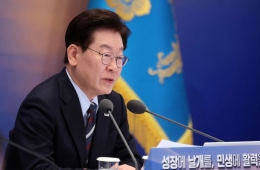
Kim Sungwhan, Minister of Climate, Energy and Environment, is announcing policies at the National Report Meeting on the 3 Major Megaprojects held on the 29th at the Blue House, chaired by President Lee Jae-myung. Photo by Yonhap News Agency
View original imageHe noted, “The introduction of a regionally differentiated electricity tariff system will enhance the competitiveness not only of traditional manufacturing sectors such as steel and petrochemicals, but also of local advanced industries like semiconductors.” He added, “To attract more AI data centers, the government will also establish a dedicated rate plan for AI data centers.” Through these measures, the government plans to reduce electricity costs for large-scale AI data centers and semiconductor clusters being developed in the Chungcheong, Yeongnam, Honam, and Gangwon regions, and further incentivize companies to invest in these local areas.
The government also presented specific plans for power and water supply. For the Southwest semiconductor cluster, it will provide 6.3 GW (gigawatts) of electricity and 650,000 tons of water per day, and proactively build related infrastructure to meet additional demand. For the Yongin semiconductor cluster, about 15 GW of electricity and 1.5 million tons of water per day will be steadily supplied.
For AI data centers, the government will supply more than 8 GW of power by 2029 to ensure seamless construction of AI infrastructure. Minister Kim stated, “Until now, the Honam region has mainly transmitted electricity generated from nuclear, solar, and wind power to the capital area, but going forward, electricity produced in Honam will be used to operate semiconductor fabs in Honam,” expressing his commitment to building a “local production, local consumption” power system where locally generated electricity is consumed within the region.
He described the AI era as the “age of electricity,” signaling a major shift in energy policy. Minister Kim said, “Semiconductors, AI data centers, and physical AI all cannot function without electricity, and now we are entering an era where semiconductor chips and electricity are at the core of national competitiveness. With the expansion of electric vehicles and the electrification of industries and buildings, power demand will inevitably surge going forward.”
He went on to say, “We must utilize all energy sources, including solar, wind, nuclear, small modular reactors (SMRs), LNG, and hydrogen.” He explained, “The power grid will shift from a unidirectional system centered on large-scale power plants to a bidirectional, distributed system based on renewable energy. We will also expand local production and consumption-based power networks, energy storage systems (ESS), and pumped-storage power to increase the flexibility of the electricity grid.”
Hot Picks Today
 A 12-Year-Old Girl Went to the Hospital After Her Blood Pressure Hit 225 and Was Stunned: "What Is This Coral Reef-Like Thing in Her Aorta?"
- "Hey, Lady, Teach Your Kids to Behave!" ... 300,000 Won in Cash and a Bodily Injury Claim Demanded Over Child's Door Ding
- Selling Like Crazy Every Year... 30-Year-Old Hetbahn Takes on a New Challenge: Tastes Better Than "Mom's Home Cooking" [On-Site Report]
- "If This Airs, I'm Dead"... Why a Restaurant Refused to Let Jeon Hyunmoo's Show Film
- "Once You Try It, You Can't Stop, but It's at Risk of Disappearing"... Young People Are Hooked on "Smoked Pickled Radish" [Delicious Stories]
Minister Kim emphasized, “The Industrial Revolution began with innovations in the steam engine and generator, and for the past 200 years, humanity has produced electricity primarily from coal and oil. Now, the Ministry of Climate, Energy and Environment is ushering in the era of an ‘electric nation,’ where semiconductor fabs, AI data centers, and physical AI are powered by clean and stable electricity from nuclear, solar, and wind sources.”
© The Asia Business Daily. All rights reserved. Unauthorized AI training and use prohibited.




![[Exclusive] Prosecution Service Overhauls Cartel "Leniency" Rules, Guarantees Reporting Firms' Legal Status from the Outset](https://cwcontent.asiae.co.kr/asiaresize/307/2026102420382172963_1792841902.jpg)