20 Trillion Won to Be Invested in Manufacturing AX by 2030... Creating 100 Trillion Won in Added Value
Government Reveals Key Points of 'Manufacturing AI 2030 Strategy'
Joint Public-Private Investment of 20 Trillion Won by 2030
From Manufacturing Data Library to AI Model Development and Deployment
Aiming for Over 100 Trillion Won in Economic Value
The government will invest approximately 20 trillion won in manufacturing AI transformation (AX), aiming to significantly enhance industrial productivity by applying artificial intelligence (AI) to the manufacturing sector. The ambition is to leverage Korea's existing manufacturing capabilities combined with AI as a springboard for a major leap forward in the industry. To this end, the government will establish a 'data library' dedicated to manufacturing AI, develop foundation models specialized for manufacturing, and promote the regional spread of AI-based manufacturing solutions.
On June 29, the government unveiled the "Path to a Great Transformation in Korean Manufacturing: Manufacturing AI 2030 Strategy" during the "Korea's Grand Leap: Three Major Mega Projects National Report Meeting."

President Lee Jae-myung is speaking at the National Report Meeting on the Three Major Mega Projects held at the Blue House on the 29th. Photo by Yonhap News Agency
View original imageThe plan is to nurture manufacturing as a core growth engine by combining Korea's manufacturing strengths in semiconductors, shipbuilding, and automobiles with AI-driven manufacturing AX. This strategy was formulated over about six months of discussions by the Ministry of Trade, Industry and Energy, the Ministry of Science and ICT, the Ministry of SMEs and Startups, and 23 private sector experts from the National AI Strategy Committee's Manufacturing Task Force, following the AI Action Plan announced in February.
Under this strategy, the government will swiftly pursue three key tasks through inter-ministerial cooperation on manufacturing AI: establishing a national-level core manufacturing data management and utilization system; developing AI models tailored for manufacturing; and expanding the adoption of manufacturing AI to local regions.
To manage the data needed to improve the quality of manufacturing AI, a "National Manufacturing Data Library" equipped with security and management systems will be built. This national data library will consolidate manufacturing data scattered across different ministries, preventing leaks while ensuring that the value of any individual company's data is not compromised when shared, all under a government-led utilization and management framework.
Using the manufacturing data and proprietary AI foundation models thus collected, the government will develop a "Manufacturing AI Foundation Model." There is also a plan to nurture the "Full-Stack AI Factory"—an intelligent factory where AI and robots collaborate in autonomous operations—into an exportable product.
Manufacturing AI will spread primarily through industrial complexes where manufacturing companies are clustered, as well as to SMEs and regional hub universities, contributing to improved workplace environments by, among other things, replacing hazardous processes with AI-driven solutions. To support this, the government plans to establish "M.AX Clusters" to transform industrial complexes into AI-powered hubs.
Building a Manufacturing Data Library... Full-Stack AI Factory to Be Established

Deputy Prime Minister and Minister of Science and ICT Baek Kong-hoon is announcing policies at the National Report Meeting on the Three Mega Projects, hosted by President Lee Jae-myung at the Blue House on the 29th. Photo by Yonhap News
View original imagePlans were also announced to implement manufacturing AI at the field level and build an ecosystem. Recognizing the challenges of understanding both manufacturing site data/knowledge and AI algorithms, the strategy will proceed in stages: foundation, advancement, diffusion, and ecosystem formation.
In the foundational stage, the focus will be on collecting manufacturing data and developing AI models and agents to lay the groundwork for the spread of manufacturing AX. High-quality manufacturing data will be gathered for the development of superior AI models and agents, including a large-scale project to convert and collect the know-how of Korea’s master craftsmen approaching retirement, transforming their expertise into data for AI applications. An additional 48 billion won has already been reflected in this year’s supplementary budget for these purposes, and a full-scale allocation is planned for next year’s main budget.
The collected high-quality manufacturing data will be accumulated in the Manufacturing AX Data Library. For secure data management, systems for standardization, encryption, and de-identification will be designed and implemented. AI models will also be developed in stages, from lightweight models targeting specific processes to large foundation models covering the entire manufacturing industry.
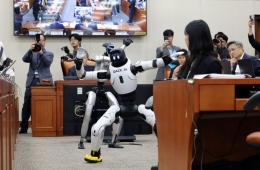
In the advancement stage, technologies for the "Full-Stack AI Factory" will be developed, integrating large manufacturing AI agents, humanoid robots, and manufacturing physical AI capabilities. The strategy includes developing large AI agents capable of overseeing the entire process from design to production and distribution, developing core components for the commercialization of manufacturing-specialized humanoids, and expanding demonstration projects. Additionally, source technologies for manufacturing physical AI will be developed, including physics-based AI models, device and robot connectivity, low-latency, high-reliability communication networks, and comprehensive convergence security technologies for models, agents, and control systems.
At the diffusion stage, "M.AX Clusters" will be established in each regional industrial complex to support the adoption of AI by local companies, building shared infrastructure such as demonstration testbeds and edge computing centers. Through mutually beneficial AI smart factory projects and large company partnerships, methodologies for manufacturing AX will be provided to SMEs, and policy support for exporting AI factories will be implemented.
To foster the manufacturing AI ecosystem, efforts will be made to expand private investment in AX, nurture specialized companies, and train talent. Tools such as funds and guarantees will be used to promote private investment, including linkage with the 150 trillion won National Growth Fund. To nurture specialized manufacturing AX companies, a "Manufacturing AX Certification" system will be introduced, alongside master's and doctoral programs and on-the-job training for key manufacturing AI technologies. Legal frameworks and cooperation with relevant organizations will also be strengthened for these purposes.
Deputy Prime Minister Paik Kyung-hoon stated, "Manufacturing AI must go beyond merely applying AI to factories; it should evolve to the stage where AI understands the physical phenomena and process flows in manufacturing sites and autonomously judges and controls equipment and robots. We will actively support the integration of core AI technologies with the manufacturing sector so that manufacturing AI becomes a technology that truly operates on the ground."
Minister of Trade, Industry and Energy Kim Junggwan emphasized, "The AI transformation of manufacturing is a critical challenge that will determine the future competitiveness and survival of our manufacturing sector. It is time for bold investment and action from both the public and private sectors. As this plan was developed through six months of intensive discussions with relevant ministries and private experts, it is vital that each ministry takes responsibility to ensure the strategy leads to real value creation in the real world, rather than remaining a mere report."
Hot Picks Today
 "Expensive, Smelly and Scary"... What's Happened to the "Honeymooners' Paradise" Tourists Have Abandoned?
- Women Who Say "A Husband's Annual Salary of 100 Million Won Is a Given"... Matchmaking CEO: "They Talk About It Like It's Nothing"
- "I Want to Eat Like Koreans..." Foreigners Who Once Opened Ramen Packs Now Keep Gochujang in Their Pantries
- Concerns Arctic Route Could Violate Sanctions Against Russia... Lee: "We Will Strictly Abide by International Norms"
- "They Said Today Was the Cheapest..." "Let's Get Wedding Jewelry!" Why Did the Luxury Brand Crowds Flocked To Cut Prices by 1.08 Million Won?
No Yongseok, Vice Minister of SMEs and Startups, said, "The Ministry of SMEs and Startups will advance support policies for smart factories by promoting cooperation between large and small companies and among SMEs, thereby accelerating AX across small manufacturing sites. We will establish a support system that enables manufacturing AI-specialized companies to grow from startups and investment targets into globally competitive enterprises, while continuously strengthening the AI capabilities of SMEs through specialized workforce training."
© The Asia Business Daily. All rights reserved. Unauthorized AI training and use prohibited.