"Profit-Sharing Bonus" Ripple Hits Global Semiconductors... Kioxia in Japan Also Stirs
Calls for Increased Employee Compensation at Kioxia Shareholders' Meeting
If SK hynix Bonus Formula Is Applied,
Each Employee Could Receive About 480 Million Won
The ripple effect of SK hynix's newly implemented "10% profit-sharing bonus system" has spread beyond Korea to the global semiconductor industry. While employee discontent over bonuses is mounting at Taiwan's TSMC, at the annual shareholders' meeting of Kioxia Holdings (Kioxia) in Japan, shareholders raised concerns about talent outflow and insisted that employee compensation must be expanded to prevent it.
According to Japan's Nikkei newspaper on the 29th, during Kioxia's shareholders' meeting held on the 25th, a male shareholder in his 60s stated, "If we don't share the results with employees, they'll leave for other companies," and added, "There must be rewards for work to feel meaningful." A male shareholder in his 30s also voiced concern, saying, "At the very least, we should match the level of global competitors."

Kioxia is currently enjoying a memory semiconductor boom following the artificial intelligence (AI) surge. According to Bloomberg, the market consensus (average of estimates) for annual sales in fiscal year 2027 is projected at 9.3 trillion yen (approximately 8.85 trillion won), more than four times the expected 2.3 trillion yen (about 2.19 trillion won) for fiscal year 2026. On this day, the company's share price hovered in the low 90,000 yen range on the Tokyo Stock Exchange. Year-to-date (YTD) as of this day, it has soared by about 765%. On days when the share price hit its annual high, it surged to as much as 112,700 yen per share.
Nikkei, citing FactSet data, pointed out that if SK hynix's formula (10% of operating profit) were applied, each employee could receive around 50 million yen (about 480 million won). However, the company currently bases its compensation system on its former Toshiba business unit structure. This means it is unlikely to pay unprecedented levels of bonuses as discussed at the shareholders' meeting. For the time being, a widening wage gap with industry peers seems likely.
The changes to SK hynix's bonus system have also become an issue in Taiwan. Last month, rumors of a reduction in the 2025 bonus—scheduled to be paid in July—circulated on social networking services (SNS) used by TSMC employees, causing internal turmoil. After the company failed to quell the initial controversy, Chairman Mark Liu eventually addressed the issue during a communication event, stating, "The rumors are not true. The first-quarter bonus this year increased by 30% compared to the same period last year." Only after this clarification was the internal suspicion resolved.
Some voices even called for taking aggressive strike action, as seen with Korean labor unions. TSMC employees, observing the process by which Samsung Electronics' labor and management reached a "tentative wage agreement for 2026" on the 27th of last month, shared posts such as "We don't have a union" and "Now is the time to strike." Until now, TSMC has adhered to a no-union management policy according to the founder's principles.
Hot Picks Today
 "Let’s Give Korea a Spending Spree": Over 10 Million Foreign Tourists Flock In, Credit Card Spending Exceeds 10 Trillion Won
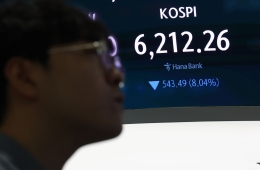
- "KOSPI Plunges 8% as Samsung and SK hynix Reel from 'Unexpected' Chinese Memory Onslaught"
- All They Did Was Set Up a Camping Chair... "Stop Interfering and Leave," Family Forced Out
- Is the Stock Market Decline Just Beginning? "An Even Bigger Crisis Is Coming," Warns Rich Dad Author
- "Prettier Than Idols?" "Tight Outfits Stir Debate"... Why the Virtual Female Weathercaster Is Causing a Stir
However, this trend is not being welcomed unconditionally. The Korean Shareholders' Activism Group signaled legal action, declaring the agreement reached by Samsung Electronics' labor and management—which allocates 10.5% of business results as bonus funds—unacceptable. The group argues that allocating company profits as bonuses is not a matter for labor and management alone, but must go through the board of directors and the shareholders' meeting. On the 26th, the group held a protest rally in front of the Blue House. They are also reportedly preparing a lawsuit to confirm the invalidity of the Samsung Electronics bonus agreement and an injunction to suspend its effect.
© The Asia Business Daily. All rights reserved. Unauthorized AI training and use prohibited.