Hong Ikpyo: "Lee-Moon Meeting, Political Unity Within Democratic Camp Is Also a Key Task"
Lee Jaemyung and Moon Jaein to Meet at Blue House on July 1
On Ryu Sihmin's "Reconstruction Theory": "In addition to extension and reconstruction, redevelopment is also an option... The people will decide"
On Declining Approval Ratings: "It
With the meeting between President Lee Jaemyung and former President Moon Jae-in scheduled for July 1, the Blue House has stated that while sharing wisdom on national issues, political integration within the democratic camp will also be a very important task. Additionally, as the conflict between pro-Lee and pro-Moon factions—referred to as the so-called “Myeong-Cheong War”—intensifies ahead of the party convention, the Blue House commented on author Ryu Si-min’s so-called “reconstruction theory,” stating, “Besides expansion and reconstruction, there is also redevelopment. The decision is to be made not by politicians, but by the people.”

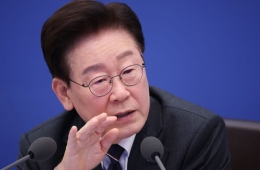
Hong Ik-pyo, Senior Secretary for Political Affairs, is briefing on the establishment of the Blue House Emergency Economic Situation Room at the Blue House Chunqygwan on March 25, 2026. Photo by Yonhap News.
View original imageOn June 29, Hong Ik-pyo, Senior Secretary for Political Affairs at the Blue House, appeared on SBS Radio’s “Kim Taehyun’s Political Show” and explained the background to the meeting between President Lee and former President Moon: “It cannot be seen as something hastily arranged in response to recent events. The meeting between the two has been prepared and planned over multiple occasions.” Hong continued, “Former President Moon is a senior statesman in the Democratic Party and, as a former president, is one of the few politicians who can share experience and wisdom with President Lee.”
Regarding the agenda for the meeting, Senior Secretary Hong said that national matters would take priority. He stated, “If the Republic of Korea has moved toward normalization and recovery by overcoming civil strife, it is now a time for challenge and leap forward to create an ‘irreplaceable Korea.’ In that regard, sharing wisdom with a former president is the first priority.”
He also indirectly revealed that party unity is an intention. Hong said, “Social integration—and, if necessary, political integration within the democratic camp—are also very important tasks. Unnecessary ridicule and pejorative nicknames toward former President Moon are wrong, and President Lee has also been the target of such mockery and contempt. Since both presidents have experienced this together, they likely share the belief that such things should not be repeated.” Earlier this month, President Lee had pointed out at a press conference, “We must be careful with the language we use among comrades,” and added, “We should not act as if we will never see each other again through mocking or insulting language. We are supposed to compete, not wage war.”
Regarding author Ryu Si-min’s so-called “reconstruction theory” raised within the broader ruling bloc, Hong dismissed it, saying it is for the people to decide which approach to take. In a YouTube broadcast released on June 26, Ryu commented on President Lee’s policy of integration and expansion, saying, “Supporters wanted expansion, but it seems the President tried to pursue reconstruction. I wonder if he was overconfident.”
In response, Senior Secretary Hong said, “While Mr. Ryu’s remarks are influential, it is difficult to respond to every individual comment. While the terms expansion and reconstruction have been mentioned, I believe redevelopment should also be considered.” He added, “Deciding that is up to the people, not politicians. While it appears that politicians are the ones conducting politics, it is actually the people who do so—that is the President’s view.”
When asked whether he agreed with Mr. Ryu’s claims, Hong replied, “Rather than disparaging or mocking specific individuals or attacking them, we should discuss what the future of the Republic of Korea should look like and what choices and changes the Democratic Party should make in that process. If necessary, we can pursue expansion, reconstruction, and even redevelopment.”
Regarding the recent decline in the President’s approval rating, he diagnosed that support has fallen among both core supporters and moderate voters, attributing it to a combination of post-local election aftereffects, the shortage of ballot papers at the National Election Commission, and internal party conflict. However, Hong added, “While we must take these trends seriously, policy should not be swayed back and forth based solely on approval ratings.”
On the issue of abolishing the supplementary investigation authority—a key point in prosecution reform—Hong dismissed any suggestion that the President’s position is at odds with that of the government. He said, “The President’s basic principles are the separation of investigation and indictment, minimizing any side effects from abolishing supplementary investigation authority, and protecting citizens’ rights and preventing harm. While the President thought that retaining part of the supplementary investigation authority might benefit the public, if there are concerns within the political sphere, he is also open to abolishing the authority first and then addressing any issues that arise.”
Hot Picks Today
![[Exclusive] "Forecasts of Over 10 Billion, but Only 100 Million Earned"... 95% Followed This Pattern: Why Are KOSDAQ Special Exception IPOs Inflated? [KOSDAQ Inflated IPOs]①](https://cwcontent.asiae.co.kr/asiaresize/93/2026100609060151026_1791245160.jpg) [Exclusive] "Forecasts of Over 10 Billion, but Only 100 Million Earned"... 95% Followed This Pattern: Why Are KOSDAQ Special Exception IPOs Inflated? [KOSDAQ Inflated IPOs]①
[Exclusive] "Forecasts of Over 10 Billion, but Only 100 Million Earned"... 95% Followed This Pattern: Why Are KOSDAQ Special Exception IPOs Inflated? [KOSDAQ Inflated IPOs]①
- Financial Sector Hacking Prompts Financial Authorities to Postpone Second Phase of Network Separation Regulation Easing Selection
- "My Debt Is 73 Million Won"... Sharing Every Repayment Led to an Unexpected Turn
- "Drinking This in the Morning Is Like Drinking Alcohol"..."Doctors Warn: Never Consume It"
- Is 'KOGUMA' Coming Too?... "Japan in Serious Trouble" - Archipelago on High Alert Ahead of Holidays
Meanwhile, regarding the opposition’s criticism of the “Honam semiconductor investment” in connection with the “Korea Grand Leap Forward: Three Mega Projects National Briefing” scheduled for later this afternoon, Hong strongly refuted the claims. He said, “Approaching this as an issue between Yeongnam and Honam misses the point. The plan is not to take investment from Yongin and move it to Honam, but to continue investing in Yongin as is and respond to additional demand with large-scale investments in the Honam and southwestern regions.” He further argued, “Global conglomerates do not simply go wherever they are told. It is an excessive interpretation to say that the government, with only four years left, could twist arms to direct investments in semiconductor projects that take decades to plan.”
© The Asia Business Daily. All rights reserved. Unauthorized AI training and use prohibited.