Kim Yongbum: "Semiconductor Clusters Outside the Capital... Once-in-a-Lifetime Opportunity Could Be Lost Amid Political Strife"
Semiconductors Are Essential to Discussing the Nation's Future Strategy
"Semiconductor Clusters Outside the Capital Region: Core Industrial, Macroeconomic, and Social Policy"
Kim Repeatedly Rebuts Opposition Attacks Ahead of "Korea Grand Leap Fo
Kim Yongbum, policy chief at the Blue House, stated on June 28 that it is impossible to discuss South Korea’s national strategy in the era of artificial intelligence (AI) without addressing semiconductors. He emphasized that semiconductors are not merely a specific industry, but a core variable that penetrates the economy, national security, youth employment, regional development, finance, and real estate. He argued that establishing a large-scale semiconductor fab cluster outside the Seoul metropolitan area should become an industrial policy, a macroeconomic policy, and a social policy at the national level. However, he warned that if unproductive debates—such as value-based arguments, political strife, or endless procedures—hinder progress, South Korea may lose a once-in-a-lifetime opportunity.

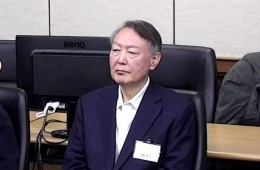
Kim Yongbum, policy chief, attends the K-Ship Future Vision Meeting chaired by President Lee Jae-myung held at Hotel Hyundai by Lahan Ulsan on May 13, 2026. Photo by Yonhap News.
View original imageWith President Lee Jaemyung scheduled to unveil strategies for fostering advanced industries such as semiconductors and AI at the “National Briefing on Korea’s Three Major Leap Forward Mega-Projects” at the Blue House State Guest House on June 29, political opposition from the People Power Party and other parties has continued. Following President Lee, Chief Kim is also actively engaging in the battle for public opinion via social networking services (SNS).
In a post on Facebook that day, Chief Kim described the current moment as “the most extraordinary period since Dangun,” stating, “Encountering numbers like these during policy work is something that might happen once in a lifetime, once in a generation, or perhaps even just once in a century—a truly historic moment.”
Chief Kim particularly emphasized that the AI revolution should not be viewed as a single industrial change, but as a structural transformation that is rewriting the world economic order and determining the rise and fall of nations. He said, “Ideological debates, value-based arguments, and endless political disputes have their place, but what Korea must debate most fiercely right now is how our people will make a living in the future.” He added, “The first issue the Korean public forum must address is semiconductors.”
He went on to say, “Semiconductors are no longer just the concern of a particular industry. They are the key variable of our time, connecting the economy and security, education and youth, the metropolitan area and the provinces, finance and real estate. Today, AI and semiconductors are the fundamental infrastructure.”
Accordingly, Chief Kim argued that policy tasks going forward must focus on production capacity, liquidity, and youth. “Victory in the AI era ultimately depends on how many cutting-edge semiconductors we can produce, and how quickly we can do so,” he said. “The world wants AI chips, but if there are not enough production facilities, there is only one answer: we need to build more fabs, and we need to do it faster.” He sees expanding semiconductor production capacity as the core of national competitiveness, and warned against missing opportunities due to procedural delays or unproductive arguments.
He also identified the flow of excess liquidity generated by a semiconductor boom as another key issue. “A special boom in semiconductors will create enormous wealth,” Kim said, “but if that money starts to flow into real estate in the Seoul metropolitan area, we might win industrially, but fail as a society.” He warned that rising asset prices, deepening polarization, and growing anxiety over youth housing could result, and argued that policy must not only create wealth, but must also design where that money flows.
Lastly, Kim addressed the issue of youth. He noted, “AI will not make everyone wealthy together. Industries and jobs with high productivity will reap enormous wealth, but those that do not will face greater pressure.” He stressed that if young people despair during a boom, it is not a failure of the market but a failure of the state, and called for national-level education, retraining, and industrial transition programs.
Chief Kim believes that these three challenges cannot be solved in isolation. “While increasing production, we must also channel excess liquidity into productive areas and create new opportunities for young people,” he said. “This cannot be done with conventional approaches; it requires a special, national-level strategy.” Specifically, he advocated for boldly building more fabs, dispersing surplus liquidity through overseas investments and future response funds, and ensuring any remaining domestic capital is used not for apartments in the capital area, but for building new industries and cities.
From this perspective, Chief Kim assessed the creation of large-scale semiconductor fab clusters outside the Seoul metropolitan area as “a very powerful national strategy.” He clarified, “This is not a regional balance development policy,” but “an industrial policy to enhance production capacity in the AI era.” He further explained that it is “a macroeconomic policy that channels excess liquidity from the semiconductor boom into factories, power grids, water infrastructure, research facilities, equipment industries, and new cities, rather than into real estate,” and “a social policy that creates hundreds of thousands of quality jobs and provides a ladder for young people to rise into new industries.”
This message from Chief Kim also serves as a policy rebuttal from the Presidential Office regarding recent political controversies over semiconductor and AI investment plans in non-capital regions such as Honam and Chungcheong. He argues that disputes over site feasibility or the background of corporate investments should be viewed not as regional allocation issues, but within the broader framework of securing national production capacity in the AI era, managing liquidity, and creating youth jobs.
Chief Kim also suggested criteria for future economic policy evaluation: policies should be considered good if they can answer “yes” to whether they enhance production capacity, direct excess liquidity to productive uses, and create new opportunities for youth. “Korea is now standing at the threshold of a special boom,” he said. “The real contest is not about how much money we make, but about where that money flows and whose future it is used to build. That will determine the next 30 years for Korea.”
Hot Picks Today
![[Exclusive] SK hynix Plans New Headquarters at Le Meridien Hotel Site in Gangnam, Establishing Central Seoul Base](https://cwcontent.asiae.co.kr/asiaresize/93/2022123100091569866_1672412955.png) [Exclusive] SK hynix Plans New Headquarters at Le Meridien Hotel Site in Gangnam, Establishing Central Seoul Base
[Exclusive] SK hynix Plans New Headquarters at Le Meridien Hotel Site in Gangnam, Establishing Central Seoul Base
- "After Dominating 80% of the Global Market... China’s Solar Industry Hit with 3 Trillion Won Losses"
- Closing Gap with Samsung and SK hynix: "Shares Surge Fivefold on Debut" as China's DRAM Giant CXMT Sweeps Up 14 Trillion Won
- It Was a Sensation in Korea Too..."Can't Live Without It" - Japanese Elementary Students Also Obsessed With This
- "Prettier Than an Idol" "The Outfits Are a Problem"... Why the AI Female Weathercaster Is Causing a Stir
He added, “Solving the issue of people’s livelihoods is the reason politics and policy exist,” and emphasized, “In the AI era, the essence of the livelihood issue is a semiconductor strategy that connects production, liquidity, and youth.”
© The Asia Business Daily. All rights reserved. Unauthorized AI training and use prohibited.