Kim Yongbum: "We Must Foster Korean Versions of Palantir and Anduril... A New Milestone for the Defense Industry Begins"
Full-Scale Effort to Foster New Security Innovation Companies
Discovering New Players in AI, Drones, Space, and Cybersecurity
Goal of Five Trillion-Won Companies by 2030
"Our Reliable Asset, Our Young People, Will Make It Happen"
The Lee Jaemyung administration has launched a full-scale new security industry strategy aimed at fostering Korean versions of Palantir and Anduril in the fields of artificial intelligence (AI), drones, aerospace, and cyber security. The initiative seeks to go beyond the existing defense industry, which has traditionally focused on hardware such as tanks, self-propelled artillery, and missiles, by cultivating innovative companies equipped with AI software, unmanned systems, and space and cyber technologies at a national level—technologies that will determine victory or defeat on future battlefields.

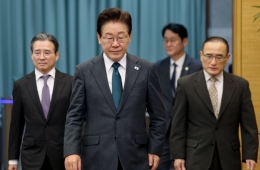
Kim Yongbum, policy chief of the Presidential Secretariat, is delivering opening remarks at the Kwanhoon Forum held at the Press Center in Jung-gu, Seoul on the 24th. Photo by Yonhap News, June 24, 2026.
View original imageKim Yongbum, policy chief of the Presidential Secretariat, introduced the previous day's “Future New Security Innovation Companies Strategy Meeting” presided over by President Lee Jaemyung in a Facebook post on the 27th. He stated, “We must nurture our own Palantir and Anduril,” and added, “We are now about to begin a new milestone in the Republic of Korea’s defense industry.” At the meeting, President Lee set a goal of fostering five companies with a corporate value exceeding 1 trillion won and fifty companies with annual sales of over 100 billion won in the new security sector by 2030.
Kim assessed that the nature of modern warfare has fundamentally changed since the war in Ukraine. He explained, “A tank worth billions of won can be destroyed by a drone costing tens of millions of won,” emphasizing that the center of gravity in warfare is shifting from simple firepower and armor to data and AI capabilities that connect detection, decision-making, and strike. He also highlighted that technology companies—not traditional defense firms—such as Palantir, Anduril, SpaceX, and Germany’s Helsing, are emerging as new leaders in the military and security domains.
The government has decided to place the Ministry of SMEs and Startups at the center of fostering new security innovation companies. The intention is to move away from a policy framework dominated by defense and defense industry ministries, instead connecting the startup and venture ecosystem with the security industry. Han Seongsook, the minister of SMEs and Startups and nominee for prime minister, proposed establishing a Korean-style strategic investment agency similar to In-Q-Tel, the strategic investment arm of the CIA, and suggested focusing investments on companies in the fields of drones, robotics, AI semiconductors, aerospace, and cyber security.
Kim stated, “I proposed that the Ministry of SMEs and Startups should play a central role in fostering new security innovation companies,” and added, “The very fact that the defense industry would be led by a startup-oriented ministry is, in itself, already an innovation.” He continued, “Minister Han Seongsook, now the prime minister nominee, also strongly agreed with this perspective,” before noting, “Above all, we have a reliable asset—our young people.”
The Ministry of National Defense and the Defense Acquisition Program Administration will revise the defense acquisition system to rapidly apply advanced technologies to the military, while the Ministry of Economy and Finance is pursuing amendments to the National Contract Act to introduce a more flexible procurement system for new security companies. The Presidential Office announced that it will establish a new acquisition system to enable the initial deployment of advanced weapon systems within one year in the defense sector.
Hot Picks Today
!["Why Securities Analysts Expect the KOSPI to Hit 9,500 Next Week [Weekend Money]"](https://cwcontent.asiae.co.kr/asiaresize/93/2026062409233021342_1782260609.jpg) "Why Securities Analysts Expect the KOSPI to Hit 9,500 Next Week [Weekend Money]"
"Why Securities Analysts Expect the KOSPI to Hit 9,500 Next Week [Weekend Money]"
- Even Record Earnings from Samsung and SK Hynix Can't Strengthen the Won... How High Will the Soaring Exchange Rate Go? [Weekend Money]
- Coach Hong Myung-Bo, Who Vowed "Final Contribution," Faces Controversy Over Estimated 3.8 Billion Won Salary
- NPS Moves the KOSPI: How Much Will It Need to Sell If the Index Surpasses 9,000? [Weekend Money]
- Two Typhoons Make Landfall Simultaneously, Earthquake Risk Looms... Record 250mm Per Hour Downpour Hits Japan
This strategy signals an intention to shift the focus of Korea’s defense industry from being a “country that excels at manufacturing weapons” to a “technology security nation that designs the battlefields of the future.” Kim stated, “Innovations that change the way wars are fought usually begin outside the existing order,” adding, “We are now about to begin a new milestone in the Republic of Korea’s defense industry.”
© The Asia Business Daily. All rights reserved. Unauthorized AI training and use prohibited.