Small Commercial Buildings Hit by Apartment Market Boom... Even 3 Billion Won from Stocks Won't Tempt Buyers
Concerns Over Negative Cash Flow Due to Regulations and High Interest Rates
"U.S. Dollars Over Buildings" — Even Wealthy Millennials and Gen Z Are Turning Away
While money from stock sales is rapidly flowing into the housing market, the so-called "Kkomabuilding" (small and medium-sized commercial property) market is facing the exact opposite situation. Once considered an essential route for asset growth, Kkomabuildings have now become properties that only accumulate for sale, with hardly any buyers. Even newly wealthy individuals in their 20s and 30s, who have significant capital, are turning away from the market. As a result, experts now assess that this downturn is not a temporary correction but rather a firmly established phase.

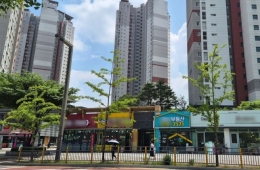
Vacant stores line a commercial area densely packed with shops in Sinchon, Seoul. Photo by Cho Jongjun
View original imageSmall and medium-sized commercial properties in major areas of Seoul are hardly selling. On June 29, Eunsang Jung, head of NAI Korea Research Center, said, "The number of small and medium-sized buildings for sale around Hongdae Entrance Station and the restaurant district in Yeoksam-dong has increased significantly." He added, "The supply of properties, which had already been growing over the past two years, has further accelerated recently."
The main reason transactions are not materializing, even when properties are listed, is the increasingly complex real estate policies. With more factors to consider—such as regulations on owners with multiple homes and stricter requirements for actual residence—investors simply do not have the capacity to think about buying buildings. An official at a commercial real estate brokerage said, "The conditions for investing in apartments have become more intricate, with many more things to check. It's not the time to even consider Kkomabuildings."
Recently, higher interest rates have also made people hesitate to invest in buildings. The CEO of a commercial real estate consulting firm explained, "There are Kkomabuildings with yields as low as 1.8%, while loan interest rates are in the 4% range even for those with good credit, and can go up to 4.8–5% if conditions are unfavorable. The moment you buy with a loan, the interest payments can easily exceed monthly rental income, resulting in negative cash flow." As a result, what used to be seen as stable income-generating assets have now turned into liabilities that owners must endure monthly losses on, with expectations for capital gains having vanished.
Market capital is flowing into so-called "smart single-unit" residential properties, rather than commercial real estate. Priority is now given to high-end residential areas with proven living environments, such as Gangnam, Seocho, Songpa, Pangyo, Dongtan, and Suji. With the price of a single luxury apartment in Seoul reaching between 5 billion and 7 billion won, funds that would previously have gone into Kkomabuildings are now being absorbed by high-quality residential assets.

The participation of the younger generation, who have amassed billions of won in assets through stocks and cryptocurrencies, has also changed the market landscape. Unlike larger-scale properties, Kkomabuildings lack professional management companies or operational systems, requiring individual owners to directly manage tenants and maintain facilities. Especially for buildings 20 to 30 years old, continuous repairs to plumbing, leakage, restrooms, elevators, and heating/cooling systems are necessary, and vacancies mean new tenants must be found. The CEO of a commercial real estate consulting company said, "Even if people in their 20s and 30s make 2 billion to 3 billion won through stocks or crypto, they won't take out loans to buy a building with only a 1.5% yield. Instead of locking away hard-earned money in aging buildings, they prefer to invest in liquid financial assets or choose high-quality, high-end apartments with proven living environments."
As a result, there are growing expectations that more properties will come onto the market through inheritance. Analysts note that the inheritance and gifting cycle has arrived for the older generation born between 1955 and 1959, who make up a significant portion of Kkomabuilding owners. Due to the characteristics of small buildings, where location and road access determine class, old buildings need remodeling or reconstruction, but owners in their 60s and older are reluctant to take on such projects themselves. The next generation, who would inherit these properties, also refuses to operate them. Many in the 20s and 30s generation have studied abroad and are familiar with financial investments, but have neither the experience nor the desire to collect rent or manage buildings. Rather than directly owning aging buildings, they prefer to quickly sell and convert to cash assets like U.S. dollars during times of high exchange rates, leading to a surge in properties on the market.
Despite the growing number of properties for sale, prices are not falling easily, resulting in a supply-demand imbalance. Prices of mid-to-upper tier Kkomabuildings have dropped by around 15–20% from their peaks, but buyers are waiting for prices to fall back to pre-2019–2021 levels before making a move. On the other hand, long-term owners who have held their properties for more than five years bought them cheaply before interest rates rose, and have already benefited from rental income and capital gains, so they are unwilling to sell at steep discounts even if vacancies occur. The rising cost of construction, which makes it difficult to profit from demolishing or remodeling old buildings, is another factor weakening buyer demand.
Hot Picks Today
 "How Did the Top Company Fall? Stock Price Halved Since Early This Year... Shaken by Owner Risk"
- What Will Happen to Retail Investors... Was the "Become a Building Owner for 1,000 Won" Boom Just an Illusion?
- "Arriving Three Hours Early at Airports? Not Enough" ... Six-Hour Delays at European Airports Explained
- "Welcome, Hong Myung-bo"... Where Is the Place That Put Up a 'Welcome' Sign?
- "Please Let Us Buy"... K-Beauty Products Slip Away Despite Eager Global Customers [Global Payment War] ①
Wealthy individuals, who are not under financial pressure, continue to hold out for prices reminiscent of the boom years, meaning that only urgent, distressed sales are actually being transacted, while most listings remain unsold. Eunsang Jung, head of the research center, commented, "The younger generation is more interested in crypto or U.S. dollars than in Kkomabuildings these days. The main question in the market now is 'How long will this situation last?' but I believe we have already entered a phase where this trend is firmly established."
© The Asia Business Daily. All rights reserved. Unauthorized AI training and use prohibited.