Military to Secure Over 20,000 Drones Including Loitering Munitions
Operational Deployment of Korean-Style Loitering Munition Drones
Pursuit of Low-Cost Drone Capabilities
Drone Operations Command to Be Reorganized as Non-Operational Defense Drone Headquarters
The South Korean military will deploy the domestically developed long-range loitering munition drone, known as K-LUCAS. The Drone Operations Command will be reorganized into the Defense Drone Headquarters, a policy-oriented organization responsible for drone and counter-drone combat development and acquisition support, rather than having direct operational authority.

The Air Force Missile Defense Command announced on the 24th that it conducted its first training exercise to respond to swarm drone infiltration at the West Sea training ground on the 23rd. The photo shows the interception of low-altitude approaching swarm drones using Vulcan phalanx gunfire. Photo by the Air Force. Yonhap News Agency
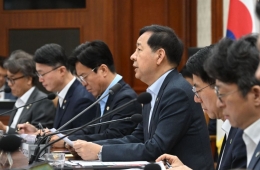
View original imageOn June 26, at the Ministry of National Defense in Seoul, Minister of National Defense Ahn Kyu-baek held a briefing announcing the new drone and counter-drone development policy. The Ministry of National Defense stated that, in order to address the evolving nature of warfare, it will rapidly pursue the deployment of the so-called K-LUCAS (K-Low-cost Uncrewed Combat Attack System)—a Korean long-range loitering munition drone system for strategic strikes and the neutralization of enemy air defenses. This concept is similar to the U.S. LUCAS (Low-cost Unmanned Combat Attack System), which is reverse-engineered from Iran’s Shahed drones and was deployed in combat during the Iran conflict.
Furthermore, the ministry announced its plan to swiftly acquire over 20,000 low-cost, expendable drones, such as short-range reconnaissance drones and small loitering munitions. In parallel, it will secure next-generation drone capabilities—including swarm drones equipped with artificial intelligence (AI) technology—to prepare for future battlefields. In the short term, counter-drone systems will be deployed in frontline areas and contact zones, as well as small UAV response systems, with plans to immediately field proven commercial equipment next year. Additionally, the ministry stated, “In the mid-to-long term, we will develop and deploy advanced technology weapons such as lasers and high-power microwave directed energy weapons, while also securing a range of early-response options including low-cost interceptor drones to counter the threat of inexpensive drones.”
Recent conflicts, such as the war in Ukraine and the U.S.-Iran conflict, have clearly demonstrated that low-cost drones are being used as highly cost-effective weapon systems to deplete expensive enemy air defenses. There have been calls for a more flexible acquisition system to effectively respond to these changes in the battlespace.
In this regard, the Ministry of National Defense announced, “We will pursue legislation to secure advanced capabilities flexibly and rapidly,” signaling an innovation in the acquisition system. Specifically, the plan is to establish a differentiated drone ‘rapid acquisition system’ by swiftly adopting civilian technologies after military validation and integrating commercial drones for military use through a dedicated certification system.
The Drone Operations Command, established in 2023 under the Yoon Suk Yeol administration, will be reorganized as the Defense Drone Headquarters. The command was at the center of controversy following the so-called ‘Pyongyang UAV incident’ in October 2024. Currently, the Drone Operations Command Headquarters is responsible for formulating and implementing operational plans, similar to the staff departments of regular units.
The Ministry of National Defense plans to transfer the operational functions of the Drone Operations Command to each branch of the armed forces, while transforming the Defense Drone Headquarters into a specialized organization responsible for drone and counter-drone concept development and requirements identification, acquisition support in coordination with each service branch, and collaboration with industry and various institutions. The Defense Drone Headquarters will be organized as a direct unit under the Ministry of National Defense and headed by a general officer.
The ministry explained, “We will improve the current system, where certain drone capabilities are concentrated in specific units, so that each branch can conduct integrated surveillance, reconnaissance, and strike operations.” The Army, Navy, Air Force, and Marine Corps will be encouraged to develop drone operation concepts and tactics tailored to their characteristics and missions.

Additionally, the ministry reaffirmed its goal of training ‘500,000 drone warriors’ so that every service member can utilize drones as a ‘second personal weapon.’ The military also plans to acquire approximately 60,000 domestically produced commercial drones for training purposes.
© The Asia Business Daily. All rights reserved. Unauthorized AI training and use prohibited.