"Apple Raises Prices Too"...Wave of IT Device Price Hikes Including Game Consoles and Laptops Amid Memory Crisis
iPad and Mac Prices Rise Amid Memory Shortage
Game Console Prices Also Increasing
The ongoing memory shortage is causing a chain reaction of price increases for information technology (IT) devices. The rise in memory prices driven by the expansion of artificial intelligence (AI) data centers is translating into higher costs for consumer devices.

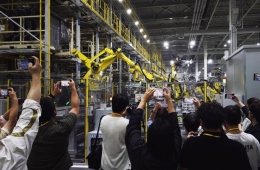
On the 20th, when Apple's first artificial intelligence (AI) smartphone 'iPhone 16' was released in Korea, buyers lined up at the Apple Store in Myeongdong, Jung-gu, Seoul. Photo by Jinhyung Kang aymsdream@
View original imageAccording to the industry on June 26, Apple has raised the prices of its MacBook, iPad, HomePod, and Apple TV set-top box. Prices for Apple's flagship products such as the iPhone, Apple Watch, and AirPods remain unchanged. Based on price information from Apple's website, MacBook prices have increased by 100 to 300 dollars, iPad prices by 100 to 200 dollars, HomePod by 30 to 50 dollars, and the Apple TV set-top box by 70 dollars.
Notably, the MacBook Neo (256GB), which Apple launched in March as its most affordable laptop, rose from 599 dollars to 699 dollars. As a result, it has lost its price advantage and is now more expensive than Dell’s XPS 13 laptop (699 dollars), as well as Chromebooks from Lenovo and Asus.
The MacBook Air (512GB) increased from 1,099 dollars to 1,299 dollars, while the MacBook Pro (1TB) went from 1,699 dollars to 1,999 dollars. The iPad Air (128GB) rose from 599 dollars to 749 dollars, and the iPad Pro (256GB) increased from 999 dollars to 1,199 dollars.
Apple stated, "There has been an abnormal surge in demand for memory and storage devices due to the rapid expansion of AI data centers," adding, "We have never seen component prices rise this fast or by this much before." The company also noted, "Until now, we have not passed on price increases to customers, but the time has come to raise prices for several products, including the iPad and Mac." Tim Cook, Apple's Chief Executive Officer (CEO), previously described the steep rise in component prices, including memory, as a "once-in-a-century flood," foreshadowing the price hikes.
The increase in component prices is also affecting the game console market.

Microsoft is set to raise the price of its Xbox consoles by 100 to 150 dollars starting in August and will discontinue production of the 2TB model. This comes after two price hikes last year to cope with cost pressures from tariffs and uncertainty in spending. Last month, Nintendo also raised the suggested retail price of the Japanese version of the Nintendo Switch 2 by 10,000 yen, from 49,980 yen. Nintendo Korea has also increased prices for older models such as the Nintendo Switch and Switch OLED by about 50,000 won, and has announced a price increase for the Nintendo Switch 2 coming in September.
The rise in memory prices is placing a significant burden on IT device sales this year. According to market research firm Counterpoint Research, global smartphone shipments this year are projected to reach 1.08 billion units, down 13.9% from the previous year and marking an all-time low. In particular, supply of mid-range and low-end smartphones is expected to shrink due to direct cost pressures. Global PC shipments this year are also forecast to fall by 5% year-on-year to 262 million units.
Hot Picks Today
 "Another Warning for Jeju: 'Chinese Language Everywhere—Island on the Brink of Suffocation'"
- "I Should Have Told My Mom Not to Throw Them Away"... Soared 3,821% in 20 Years, 8 Times More Than the S&P 500
- "Once the World's Best, Now Not Even in the Top 5"... The Current State of Japan's Mobile Industry That Was a Decade Ahead of the iPhone
- "Are the Elderly Expected to Stand in Line Themselves?"... 700,000 Waiting Online, Unable to Get Chuseok Train Tickets, They Head to Seoul Station
- Samsung Union Chief in 'Illegal Surveillance of 100,000 People' Case Faces Possible Dismissal if Convicted
Wang Yang, senior analyst at Counterpoint, said, "The memory chip shortage is the most severe supply-side disruption the smartphone industry has ever faced," adding, "It cannot be resolved through pricing, distribution channel adjustments, or product planning changes."
© The Asia Business Daily. All rights reserved. Unauthorized AI training and use prohibited.