[Reporter’s Notebook] Will Hyundai Motor’s Labor Union Be Able to Strike 10 Years From Now?
The labor union of Hyundai Motor Company is on the verge of a strike. On June 24, the union secured the legal right to strike with an overwhelming majority of members voting in favor. As in previous years, familiar demands such as basic salary increases and performance-based bonuses have once again heated up the Hyundai Motor Ulsan Plant.
On the same day, a completely different scene unfolded at Hyundai Motor Group’s booth during the Land, Infrastructure, and Transport Technology Fair at COEX in Seoul. Boston Dynamics, Hyundai Motor Group’s robotics subsidiary, showcased its humanoid robot ‘Atlas’ under the slogan “The Beginning of a New Everyday.” While workers were preparing to don red headbands and threaten to halt the factory, on the other side, robots were gradually entering everyday life.
![[Reporter’s Notebook] Will Hyundai Motor’s Labor Union Be Able to Strike 10 Years From Now?](http://www.asiae.co.kr/news/img_view.htm?img=2025031810215972202_1774574039.jpg)
This is precisely why this year’s wage and collective bargaining agreement (CBA) negotiations at Hyundai Motor should not be limited to a dispute over “N% performance bonuses.” Hyundai Motor Group has already announced a roadmap to gradually introduce Atlas into its production processes starting in 2028. While the union has responded firmly, stating, “The deployment of robots is absolutely unacceptable,” the core of this dispute still revolves around the size of performance-based bonuses.
The union must now take a more sober view. Even if 10 years pass after the introduction of robots—by 2036—will it still be possible to halt production lines and strike as in the present? The answer is a resounding no. Whereas strikes in the past served as a weapon to strengthen bargaining power, in the future, strikes will merely provide management with justification for a transition to robots. Each time workers stop the line, management will accelerate robot adoption, and once robots dominate most processes, the union’s bargaining power will collapse like a sandcastle.
The union’s focus should now shift from “next year’s paycheck” to “jobs for future generations.” What matters far more than a monthly salary increase of several hundred thousand won is how to secure a place for our juniors and children to work in a world where robots are replacing humans. The union must move beyond a passive defensive stance that simply opposes robot introduction.
The union should take the initiative and propose to management, “Let’s open the door to a grand compromise for the job security of future generations and the coexistence of humans and robots, rather than focusing only on immediate wage increases.” When the union leads discussions that lay the groundwork for survival in the future rather than short-term gains, its voice will gain the strongest weapon of all: national consensus.
Management, for its part, should not try to overcome the immediate crisis by resorting to temporary fixes just to avoid a strike. Automation is an inevitable choice for survival in global competition. However, without measures for displaced workers and younger generations, innovation will face intense resistance. Management should focus less on immediate profit margins and work together with the union to find fundamental solutions for the harmonious coexistence of humans and robots.
Hot Picks Today
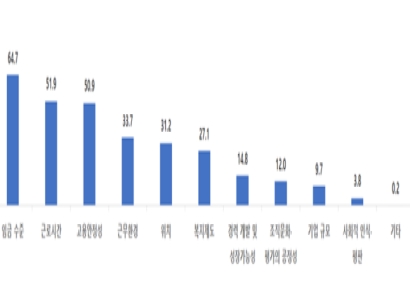 "Please Pay Me at Least 3 Million Won a Month": More Than Half of Young People Today Prioritize "Working Conditions" Over Company Size
- Selling Like Crazy Every Year... 30-Year-Old Hetbahn Takes on a New Challenge: Tastes Better Than "Mom's Home Cooking" [On-Site Report]
- He Left It in the Car and Forgot... "I Nearly Collapsed with Joy": Man Wins $1.48 Million Lottery
- Ran 18 km With 9-Year-Old Tied to Him at the Waist... "Man Banned From Competing for 3 Years"
- Beachgoer Finds 'Plastic' That Turns Out to Be Perfume Ingredient Worth More Than Twice as Much as Gold
The speed at which Atlas will transform manufacturing sites will be much faster than expected. Perhaps this year’s wage and CBA negotiations at Hyundai Motor will not be a simple wage dispute, but rather the first social contract for Korea’s manufacturing sector in the era of robots.
© The Asia Business Daily. All rights reserved. Unauthorized AI training and use prohibited.