"Multilateralism in Crisis, Minilateralism Needed"... Former and Current Leaders Voice Concerns in Unison at Jeju Forum
At the 21st Jeju Forum, concerns were raised that the rules-based international order and the major power-centered multilateral system are facing a serious crisis due to rising geopolitical tensions and the weaponization of technology and supply chains. Former and current national leaders and representatives of international organizations unanimously called for a reimagining of an "inclusive solidarity system" that embraces middle-power nations and the Global South, rather than allowing major powers to monopolize interests through hegemonic competition.

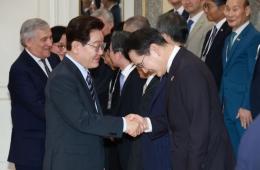
The 21st Jeju Forum for Peace and Prosperity opened on the 25th at Haevichi Hotel & Resort in Pyoseon-eup, Seogwipo-si, Jeju. Photo by Yonhap News
View original imageOn June 25, President Lee Jaemyung stated in a video address at the Jeju Forum held at Haevichi Hotel that, "The challenges facing the world today, including artificial intelligence, trade, and climate, cannot be solved by the power of one or two countries alone."
President Lee emphasized, "When countries with the capacity to solve problems form alliances and build flexible cooperation networks, they can fill the gaps in the current international order," adding, "Such alliances among nations can enable constructive cooperation with the United Nations in various fields."
Oh Younghun, Governor of Jeju Special Self-Governing Province, remarked in his opening speech, "A new framework for cooperation is needed—one that enables us to solve shared problems together, across borders, ideologies, generations, and regions." He added, "If the world is passing through an era of division, Jeju will open an era of cooperation; and if the world grows accustomed to the language of conflict, Jeju will speak the language of coexistence first."
Antonio Guterres, Secretary-General of the United Nations, expressed concern via video message that "the international order, which has supported cooperation among major powers around common norms and shared goals, is under severe pressure, and multilateralism itself is under threat." He called for the creation of a more interconnected, inclusive, and representative multilateralism. Slovenian President Nataša Pirc Musar also, through her video address, presented support for international cooperation and multilateral organizations, the use of both multilateralism and minilateralism, and the harnessing of knowledge power in the rapidly evolving governance of new technologies as solutions.
Subrahmanyam Jaishankar, India’s Minister of External Affairs, stated in his keynote speech that "some privileged major powers struggle to accept their declining competitiveness, which makes the international economy take on a zero-sum character rather than one of mutual benefit." He pointed out that "developing countries are being deprived of opportunities and capabilities for industrialization due to distorted competitiveness and restricted market access." He called for five steps to overcome these challenges: "reducing risks in the international economy and diversifying production bases and supply chains; building new consensus among major countries; adhering to international law and norms; providing more capacity and opportunities to Global South nations; and delivering global public goods through reformed multilateralism."
In the "Reimagining Cooperation in a Divided World" global leaders session, held after the opening ceremony, speakers also warned of the dangers of major power unilateralism and stressed the need for solidarity among middle-power nations. The panel, chaired by former Australian Foreign Minister Gareth Evans, included former UN Secretary-General Ban Ki-moon, former Indonesian President Susilo Bambang Yudhoyono, former Japanese Prime Minister Yukio Hatoyama, former Mongolian Prime Minister Gombojav Zandanshatar, and former German Vice Chancellor Philipp Roesler.
Former Secretary-General Ban said, "The United States is the most powerful and resource-rich nation, but no country in the world can live independently on its own," and strongly urged the U.S. to return to international organizations. Ban also called for "long-term protection of the planet through harmonious cooperation among middle-power consultative groups such as MIKTA—comprising Mexico, Indonesia, Korea, Turkey, and Australia—or organizations like ASEAN and ASEM."
Former Japanese Prime Minister Yukio Hatoyama cited the massacre in Gaza, Russia's war in Ukraine, and Iran's attack on the U.S. and Israel as examples of violations of international law, and stated, "A coalition of middle-power countries with determination must be built." He proposed that "Korea, Japan, Australia, Indonesia, ASEAN, and others should unite, raise their voices, and take action to check and balance the power of the major powers, so that rivalries among them do not cross dangerous lines."
Former Mongolian Prime Minister Gombojav Zandanshatar said, "When global consensus is paralyzed by geopolitical competition, we should turn to minilateralism, where five to ten countries come together to address a single issue." He called for concrete cooperation in clean energy, critical minerals, AI governance, and diversification of supply chains.
Hot Picks Today
 "Coach Hong Myungbo's Salary Should Be Confiscated"... Entertainment Industry Erupts After Defeat to South Africa
- I Took All the Supplements for My Health... "Your Liver Could Be Damaged," Doctors Warn
- "KOSPI Headed for 15,000... Korea Remains Most Preferred Market," Says JP Morgan Report
- "More Expensive Than King Crab When Dried": The Secret of a Chinese Delicacy Discovered on a Front Lawn
- Reporters Ask Hong Myung-bo, "Did the Players Suffer Food Poisoning?" ... Disastrous Defeat After Disappointing Performance
Meanwhile, this Jeju Forum—jointly hosted by the Ministry of Foreign Affairs, Jeju Special Self-Governing Province, the Jeju Peace Institute, and the East Asia Foundation—is the largest international diplomacy and security forum in Korea. Under the main theme "Reimagining Cooperation in an Era of Division," the event runs from the previous day through June 26.
© The Asia Business Daily. All rights reserved. Unauthorized AI training and use prohibited.

!["Women Were Excluded from Promotion"... A Bombshell Aide Under a Bombshell President [World Photo]](https://cwcontent.asiae.co.kr/asiaresize/307/2026062512310523344_1782358266.png)