"I Paid for This Game, but It Was Made with AI?"... Hallucinations and Resistance Remain Challenges [K-Game Triple Whammy] ③
8 Out of 10 Users View AI Utilization Negatively
"AI Use Increasing in Gaming Industry... Efforts Underway to Improve Perception"
Game companies are leveraging artificial intelligence (AI) in game development to enhance competitiveness and productivity, but market reactions remain lukewarm. Many users hold a strong negative perception that using AI for development is "sloppy work," especially since games are paid products.

Pearl Abyss's game "Crimson Desert" was suspected of using generative AI after a horse's leg appeared to have three legs in in-game images. Reddit screenshot
View original imageAccording to the gaming industry on June 26, Shift Up recently faced allegations of using generative AI after issues such as broken text appeared in the trailer for "Stellar Blade: Blade Rain," which was unveiled at the Summer Game Fest. While it is unlikely that these issues will be reflected in the final release, users are paying close attention and actively searching for traces of AI.
Pearl Abyss's "Crimson Desert," which sold 5 million copies within 26 days of its release, was no exception. Controversy arose when abnormal, distorted images were discovered in the game, such as a horse in a frame appearing to have three legs. Pearl Abyss ultimately apologized to users, admitting, "We did not notify users in advance about the use of generative AI in game production."
User resistance to AI is widespread throughout the content industry, including games, and even transcends national borders. Users who value the purity of illustration have even launched boycotts. According to a survey conducted by game psychology analytics firm Quantic Foundry at the end of last year, 85% of the 1,799 gamers surveyed responded negatively to the use of generative AI.
However, game companies cannot give up on utilizing AI. According to the Korea Creative Content Agency, as of the fourth quarter of last year, the adoption rate of generative AI among domestic game companies reached 70%, an increase of about 30 percentage points in just half a year. This is more than twice the overall content industry average of 32.1%, indicating that AI is already deeply involved in game development. Globally, 36% of game developers reportedly use generative AI individually, and 52% have adopted AI tools at the studio level. According to statistics presented at the Game Developers Conference (GDC) in January of this year, 87% reported using AI agents.
!["I Paid for This Game, but It Was Made with AI?"... Hallucinations and Resistance Remain Challenges [K-Game Triple Whammy] ③](http://www.asiae.co.kr/news/img_view.htm?img=2026062515033423564_1782367414.jpg)
In fact, Lellu Games, a creative studio under Krafton, drew attention by developing an internal demo version of "Magical Girl Kawaii Lovely Zkyung Dkyung Bakyung Bkyung Luluping" within just one month, using AI with a team of only three developers in 2024. Last October, Lellu Games also released the four-player cooperative horror game "Mimesis," which was developed with AI technologies and launched on Steam Early Access after just one year of development with only 20 staff members.
The gaming industry is continuing efforts to improve perceptions of AI utilization. Companies are starting by restricting the role of AI to a supplementary tool that reduces work fatigue and ensuring that only data without copyright or other legal issues is used for AI training. At the same time, a culture of transparently disclosing the use of AI is being established. Global gaming platform Steam has changed its policy to require developers to disclose how they used AI in new game development.
Hot Picks Today
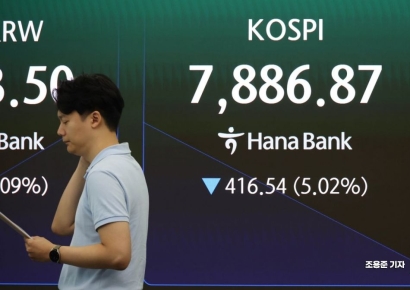 "Semiconductor Peak-Out Theory Resurfaces: Foreign Investors' KRW 3.2 Trillion Net Sell Pushes KOSPI Below 8,000"
- [Exclusive] "Tens of Billions Paid": Unregulated Bonuses for Union Presidents Spark Controversy... Ministry of Land Launches Nationwide Investigation
- Germany Faces Corruption Probe Involving Football Association amid Round of 32 Elimination Shock
- "Why Did You Call Me to the World Cup!" Jens-Hong Myung-bo Assault Video Surpasses 10 Million Views... Revealed as AI
- Suspicious Achievements of Famous 'Beauty' Policewoman Revealed to Be Handed Over by Male Colleagues... Taiwan in Shock
However, the issue of job insecurity due to AI utilization remains a challenge that the gaming industry must address in dialogue with labor unions. According to a recent survey conducted by the IT Committee of the Korean Federation of Chemical, Textile, and Food Workers' Unions targeting 1,078 employees across eight domestic game companies, 77.3% responded that they felt job insecurity due to AI adoption. A game company representative said, "We are already reducing new hires or accelerating the use of AI through organizational restructuring via voluntary resignations," adding, "We will continue to communicate with the union."
© The Asia Business Daily. All rights reserved. Unauthorized AI training and use prohibited.