[Exclusive] Lee Jaemyung Administration to Hold Southwest Advanced Industry Investment Briefing on the 30th... Unveiling 1,000 Trillion Won Project Covering Semiconductors, AI, and Robotics
Investment Plans from Major Companies Like Samsung and SK, Along with Government Support
Event Organized as a Town Hall Meeting... Investment Agreement Ceremony Planned
Key CEOs Including SK Chairman Chey Tae-won to Attend
At Least 40
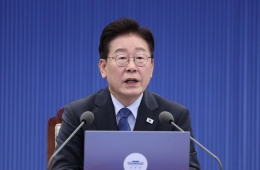
The Lee Jaemyung administration will hold an event on the 30th to directly present its Southwest Region New Industry Investment Strategy to the public. The plan is expected to unveil a large-scale public-private investment blueprint encompassing the next-generation advanced industries, including semiconductors, artificial intelligence (AI), robotics, and power grids. As investments in just the semiconductor sector alone are estimated at a minimum of 400 trillion to 500 trillion won, there are projections that the total investment over several years could exceed 1,000 trillion won.
According to business circles and the ruling party on the 25th, the Lee Jaemyung administration plans to hold a public briefing on advanced industry investment in the Southwest Region on the 30th, presenting both regional investment plans by major companies such as Samsung and SK Group, as well as government support measures. This event is being prepared in a town hall format and will reportedly be attended by key corporate chief executive officers (CEOs), including Chey Tae-won, Chairman of SK Group, who will also participate in an investment agreement ceremony. President Lee’s recent meetings with Chairman Chey, Lee Jay-yong, Chairman of Samsung Electronics, and other leading figures in the business community to coordinate regional investments and foster new industries are regarded as groundwork for this upcoming briefing.

This briefing is seen not simply as a corporate investment announcement but as a milestone to gauge the Lee administration’s 'national transformation' growth strategy in its second year in office. President Lee has consistently named balanced regional development—mitigating the dominance of the Seoul metropolitan area and fostering regional growth hubs—as a core policy priority. In particular, the Southwest Region is drawing attention as a new axis for the semiconductor and AI industries, given its significant potential to establish large-scale advanced industrial clusters in renewable energy, power grids, ports and logistics, and industrial land.
Kim Yongbeom, policy chief at the Office of the President, also noted at the Kwanhun Club forum on the 24th that the creation of regional semiconductor clusters centered on the Honam and Chungcheong regions is "in the final stages" of discussion. Kim made it clear that the existing Yongin semiconductor cluster is not being relocated to the regions, but explained that, due to surging demand for semiconductors driven by rapid AI industry growth, as well as land, power, and water supply constraints in the metropolitan area, it has become inevitable to discuss new locations. The administration’s plan to maintain the Yongin cluster while establishing a second hub for advanced industries in the Southwest—including the Honam region—is thus becoming more concrete.
![[Exclusive] Lee Jaemyung Administration to Hold Southwest Advanced Industry Investment Briefing on the 30th... Unveiling 1,000 Trillion Won Project Covering Semiconductors, AI, and Robotics](http://www.asiae.co.kr/news/img_view.htm?img=2026062513385123386_1782362331.png)
From Front-End to Back-End Semiconductor Processing... Advanced Industry Investment Could Exceed 1,000 Trillion Won
The main focus is on the scale of semiconductor investment. The business community is reportedly considering linking a semiconductor production base, an ecosystem for materials, parts, and equipment, back-end packaging facilities, AI data centers, and power infrastructure in the Southwest Region. Given that the combined investment by Samsung Electronics and SK hynix in the Yongin semiconductor cluster amounts to around 900 trillion won, the expected investment in the semiconductor sector alone is projected to be several hundred trillion won. When including AI data centers, robotics, power grids, and hydrogen and renewable energy infrastructure, as well as additional government support, the total amount invested over the long term is said to surpass 1,000 trillion won.
Currently, the Southwest Region semiconductor cluster is being discussed as a 'mega-cluster' that includes both front-end fabs (production lines) and back-end packaging plants. In this case, the scale could be even larger than the Yongin cluster, which focuses on front-end fabs and an ecosystem for materials, parts, equipment, and fabless companies. According to a Boston Consulting Group (BCG) report on 'Semiconductor Cost Competitiveness,' a next-generation sub-2nm logic fab in the United States, scheduled for completion in 2026, would require an initial capital investment of 25 to 30 billion dollars (about 38 trillion to 46 trillion won) for construction and equipment, with total ownership costs, including 10 years of operating expenses, reaching 35 to 43 billion dollars (about 53 trillion to 66 trillion won).
![[Exclusive] Lee Jaemyung Administration to Hold Southwest Advanced Industry Investment Briefing on the 30th... Unveiling 1,000 Trillion Won Project Covering Semiconductors, AI, and Robotics](http://www.asiae.co.kr/news/img_view.htm?img=2026062511293723282_1782354592.png)
Considering that SK hynix’s first-phase fab investment in the Yongin cluster—excluding equipment costs—already exceeds 30 trillion won, if Samsung Electronics and SK hynix each establish 4 to 6 front-end fabs in the Southwest and add back-end facilities, the semiconductor investment could match or even exceed the Yongin cluster, reaching around 1,000 trillion won. In simple terms, initial capital investment for 8 to 12 front-end fabs alone would amount to 300 trillion to 550 trillion won, and total ownership costs over 10 years would increase to 400 trillion to 800 trillion won. Factoring in investment in back-end packaging, testing facilities, and supporting infrastructure such as power and water supply, total investment in the semiconductor cluster could surpass 1,000 trillion won.
This event is reportedly being prepared to not only highlight corporate investment but also present the government’s institutional and infrastructure support. Investment in advanced industries cannot be realized by securing factory sites alone. It requires simultaneous support for stable power supply, transmission network expansion, water supply, expedited permits and approvals, tax incentives, talent development, and improvements to local living conditions. In particular, as the AI and semiconductor industries require massive amounts of power, plans for power grid construction are expected to be a central pillar of the briefing.
Potential locations under consideration include the Gwangju and Jeonnam regions and the Chungcheong region, with additional investment also mentioned for the Advanced District 3, which spans Buk-gu and Gwangsan-gu in Gwangju and Jangseong-gun in Jeonnam, as well as Samsung Electronics’ advanced packaging facilities in Onyang and Cheonan, South Chungcheong Province. As the cluster includes semiconductor facilities, the construction period is expected to exceed 10 years.
From Semiconductors to AI and Robotics
![[Exclusive] Lee Jaemyung Administration to Hold Southwest Advanced Industry Investment Briefing on the 30th... Unveiling 1,000 Trillion Won Project Covering Semiconductors, AI, and Robotics](http://www.asiae.co.kr/news/img_view.htm?img=2026062511301823283_1782354631.png)
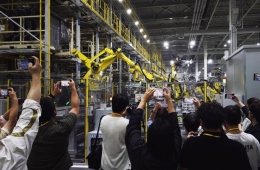
The Southwest Region is being discussed as a potential new demonstration hub for robotics and AI industries because it can leverage hydrogen and renewable energy, industrial land, and port and logistics infrastructure. Hyundai Motor Group has already announced plans to develop Saemangeum in North Jeolla Province as a global hub for hydrogen, robotics, and AI, leading to speculation that other AI and robotics companies may follow suit by expanding their investments in production, research, and demonstration facilities in the Southwest Region to form a cluster.
If the semiconductor cluster and robotics/AI investments are pursued simultaneously, the Southwest Region’s industrial blueprint could expand beyond building a mere manufacturing base to creating a comprehensive industrial belt connecting AI semiconductors, data centers, power infrastructure, and robotics manufacturing and demonstration. Large-scale power demand would be generated by AI data centers and semiconductor production bases, which could then be used by robotics and mobility companies for manufacturing and service demonstrations. The government’s attempt to align its balanced regional development strategy with its new industry promotion strategy appears to be aimed at building this kind of industrial ecosystem.
If realized, this plan would transform the Southwest Region development strategy from simple 'regional investment attraction' to an initiative that reshapes the national industrial landscape. The goal is to expand the semiconductor and AI industries, currently concentrated in the Seoul metropolitan area, into the Southwest, combining them with robotics, energy, and data center industries to create a new growth axis. Among industry observers, key points of interest include SK’s AI and semiconductor investments, the potential expansion of Samsung’s semiconductor ecosystem, and whether major energy and robotics companies will participate.
Hot Picks Today
!["Don't Use Chinese-Made Products": One U.S. Warning Triggers a 5 Trillion Won Jackpot for Korean Batteries [Weekend Money]](https://cwcontent.asiae.co.kr/asiaresize/93/2025121709393659037_1765931975.jpg) "Don't Use Chinese-Made Products": One U.S. Warning Triggers a 5 Trillion Won Jackpot for Korean Batteries [Weekend Money]
"Don't Use Chinese-Made Products": One U.S. Warning Triggers a 5 Trillion Won Jackpot for Korean Batteries [Weekend Money]
- "Dividend Payouts of 40 Million Won Before Their First Birthday"...'Baby Shareholders' Put Ordinary Workers at a Disadvantage
- Men in Their 20s and 30s Who Struggled with Dating Are Heading to Japan: "Virtual Matchmaking First, Then Start Dating"
- "Planning a Trip to Japan?"... Accelerating Yen Strength [Weekend Money]
- "Foreigners Weep as They Leave, Lavishing Praise: 'Other Countries Should Learn from Korea' [K-Holic]"
However, given the massive investment scale, the actual feasibility and pace of execution remain separate challenges. Large-scale investments are likely to be finalized in stages depending on companies’ mid-to-long-term management plans, the global semiconductor market, power supply and demand, and the preparedness of local governments in terms of land and permits. Even if the government presents a large total investment figure at the announcement stage, some maintain that the timing and scale of each project, as well as the boundaries between private sector burden and public support, need to be clearly defined.
© The Asia Business Daily. All rights reserved. Unauthorized AI training and use prohibited.


![[Breaking] Party and Government Consider Renaming 'Judiciary Control Division' to 'Non-Indictment Case Review Division'](https://cwcontent.asiae.co.kr/asiaresize/307/2026091316513726167_1789285898.jpg)