A Robot Dog Carrying an Oxygen Tank, Apartment Floors Built in a Day... Kim Yoon-duk Says "The Ministry Is Leading Korea's Future" [Reportage]
'Land, Infrastructure and Transport Technology Exhibition'
Opens at COEX from the 24th

On the 24th, at COEX in Gangnam-gu, Seoul, an elementary school student visitor is experiencing drone piloting at the '2026 Land, Infrastructure and Transport Technology Expo.' Photo by Seo-yoon Choi
View original imageOn June 24, at Hall D in COEX, Gangnam-gu, Seoul, the exhibition hall bustled with visitors eager to see cutting-edge technologies up close. Highlights included the four-legged walking robot 'Spot', a next-generation high-speed train model capable of speeds up to 370 km/h, and a hydrogen electric tram that requires neither wheels nor overhead wires on its roof.
In front of the Hyundai Motor Group booth, a fifth-grade elementary school student, Miss Lee (12), gazed at 'Spot' for a while. The yellow-bodied 'Spot' was bending and stretching its four leg joints in place and nodding its head as if dancing. "I saw it at a museum in the United States before, but I’m happy to see it again here," she said.
Master Kim (10), a third-grade elementary school student visiting from Sejong, said, "I'm very interested in trains, so the hydrogen electric tram was the most memorable for me," adding, "I also tried piloting a drone, which was harder than I expected, but fun."

On the 24th, Boston Dynamics' quadruped robot 'Spot' is being demonstrated at the Hyundai Motor Group exhibition hall during the '2026 Land, Infrastructure and Transport Technology Expo.' In the background, the humanoid robot 'Atlas' is on display, and on the right, the small mobility platform 'Mobed' is climbing a slope. Photo by Choi Seoyoon
View original imageThe event that day was the '2026 Land, Infrastructure and Transport Technology Exhibition', showcasing advanced technology and research achievements in the land and transport sector. The exhibition hall, covering 7,281 square meters (about 2,200 pyeong), was filled with 409 booths set up by 81 organizations. It is the only event in Korea where visitors can experience future technologies and research results in fields such as autonomous driving, aerospace, smart construction, and AI cities. Now in its 15th year, this year's exhibition saw a significant increase in participation by large corporations such as Hyundai Motor Group, Hyundai Rotem, and Korean Air—all of which set up their own independent booths for the first time this year. With this, opportunities for visitors to experience new technologies related to land and transport have also increased. On that day alone, more than 9,200 people visited the exhibition hall.
Hyundai Rotem unveiled a model of its next-generation high-speed train, the 'EMU-370'. It travels at 370 km/h, 50 km/h faster than the current fastest KTX-Cheongryong (320 km/h). Once commercialized, the Seoul-Busan section travel time will be reduced from the current 2 hours and 30 minutes to approximately 1 hour and 50 minutes. Increasing speed typically raises noise and power consumption, but Hyundai Rotem explained they streamlined the protruding equipment under the train to reduce air resistance by 10% compared to the Cheongryong and reinforced soundproofing materials on the car body to address noise issues. The Ministry of Land, Infrastructure and Transport plans to order 16 initial train cars in the first half of next year, aiming for commercial operation by 2031.

On the 24th, a scaled-down model of a prefabricated concrete (PC) modular apartment unit (36㎡ type) was exhibited at the '2026 National Land and Transport Technology Exhibition.' This assembly method involves joining two modules, pre-manufactured at the factory, on-site to complete a single living space. Photo by Choi Seoyoon
View original imageThe 'prefabricated concrete (PC) modular housing' booth, which has emerged as an alternative to housing supply issues, also caught the attention of visitors. This technology involves pre-manufacturing key parts of a building, such as rooms and living rooms, at a factory using concrete, and then assembling one floor per day on-site. It resolves the inter-floor noise and vibration problems of conventional steel modular construction using familiar concrete material, while also shortening the overall construction period by about 30%. The project is a result of a national R&D initiative led by a Hanyang University research team and participated in by 17 organizations. Professor Chanwoo Jeong of Hanyang University, whom we met at the site, said, "The goal is to build one floor per day," and added, "By reducing on-site casting and curing processes, we can shorten the construction period."
The area around the Korean Air booth's aircraft exterior inspection automation system was also crowded with visitors. Four drones and two ground robots photograph the entire aircraft, and AI detects even minute defects as small as 1mm in just 50 minutes. This technology safely and quickly replaces the high-risk, high-altitude maintenance work that mechanics previously had to do for over 10 hours.

On the 24th, a quadruped rescue robot for underground station fire response is being demonstrated at the Korail booth at the '2026 Land, Infrastructure and Transport Technology Expo.' Photo by Seo-yoon Choi
View original imageKorail focused on 'transport accessibility' and 'safety'. Instead of the 300 kg manual lift that staff used to struggle to push, it introduced the world's first 'electric wheelchair lift.' The lift can be moved effortlessly in any direction with a single joystick, and LiDAR sensors detect obstacles and stop automatically. The steep boarding ramp was also significantly reduced from 13 degrees to 6.8 degrees, well within the legal standard of 7.2 degrees, lowering the risk of falling. This device received favorable reviews during its pilot operation at Seoul Station, and about 90 units are planned to be deployed at stations nationwide this year.
A quadruped rescue robot for emergencies such as underground station fires was also introduced. When a fire breaks out at a station, the control center immediately dispatches the robot. Equipped with an oxygen tank on its back, the robot pushes through toxic smoke and uses its robotic arm to fit an oxygen mask directly onto a collapsed victim, securing the critical 'golden hour'. Unlike simple quadruped patrol robots, this is Korail's own patented technology for life-saving rescue by fitting breathing apparatus. Passengers who are able to move on their own can hold the mask to their face and follow the robot's guidance to evacuate to a safe area. This robot is expected to be commercialized after field testing around 2028.

Minister of Land, Infrastructure and Transport Yoonduk Kim is listening to an exhibition hall explanation at the "2026 Land, Infrastructure and Transport Technology Fair" on the 24th. To the minister's right is Minwoo Park, President and Head of Hyundai Motor and Kia Advanced Vehicle Platform Division, and to his left is Jonghee Kim, President of the Land, Infrastructure and Transport Science and Technology Promotion Institute. Photo by Seoyun Choi
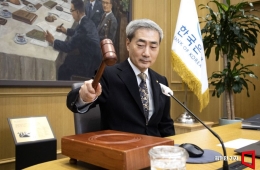
View original imageThe opening ceremony was attended by key figures, including Minister of Land, Infrastructure and Transport Kim Yoon-duk. In his congratulatory speech, Minister Kim stated, "While handling real estate issues, preventing railway accidents, and progressing construction projects is important, I want the public to know that we devote much more energy and time to the development of advanced technology and pioneering Korea’s future," and added, "This technology expo is an opportunity to share our commitment and reaffirm that the Ministry of Land, Infrastructure and Transport is at the forefront of illuminating Korea's future."
Immediately after the opening ceremony, Minister Kim, along with the heads of affiliated agencies and CEOs of companies—about 50 people in total—visited seven major booths, including Korea Land and Housing Corporation (LH), to observe technology demonstrations.
Hot Picks Today
 "The Transfer Failed, but 'Ding Dong' Money Came In"... 32.5 Billion Won Financial Incident at Toss Bank
- "Those with Money Have Already Moved Their Gold"... Holdings Surge 16-Fold as Wealthy Investors Flock to 'This Country'
- "Baek Jongwon Had Been Quiet, Then Hit It Big"... Waits in the 100s in U.S. Despite KRW 46,000 Pork Belly
- Kim Minseok: "I lean toward Oh Sehoon's conviction being upheld on appeal... I'm preparing for a Seoul mayoral election"
- 'Hangover Legend' Returns After 11 Years... Lee Sunmin Hyung's 'Captain Q' Sells Out
This event runs until the 26th.
© The Asia Business Daily. All rights reserved. Unauthorized AI training and use prohibited.