Hyundai Motor Union Approves Strike Vote... Countdown to Securing Right to Strike
Legal Right to Strike Secured if Central Labor Relations Commission Ends Mediation
Union Demands 30% of Net Profit as Performance Bonus and 149,600-Won Base Salary Increase
The Hyundai Motor Labor Union (Hyundai Motor Branch of the Korean Metal Workers' Union) is on the verge of securing the legal right to strike, as the vote on industrial action in response to the breakdown of this year's wage and collective bargaining negotiations has passed.
According to the Hyundai Motor Labor Union on June 24, out of a total of 39,668 eligible members, 37,348 participated in the industrial action vote, recording a turnout of 94.15%.

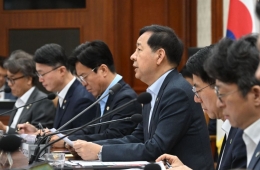
On the 10th, participants are shouting slogans at the rally of 10,000 executives of the Korean Metal Workers' Union held near Gwanghwamun Square in Jongno-gu, Seoul. Photo by Yonhap News.
View original imageOf those who voted, 34,371 were in favor, accounting for 92.03% of participants and 86.65% of all eligible union members. Meanwhile, 2,977 were opposed, or 7.97% of those who voted.
Earlier, as this year's wage and collective bargaining talks with management stalled, the union applied to the Central Labor Relations Commission for mediation of the labor dispute. The union is demanding a base wage increase, expanded performance bonuses, and an extension of the retirement age; however, it is reported that significant differences remain between the union and management.
Since a majority of union members voted in favor, if the Central Labor Relations Commission decides to suspend mediation on the union's application, the union will be able to launch a legal strike.
The commission is scheduled to decide whether to suspend mediation on June 25.
If the union secures the right to strike, it is expected to hold an inaugural ceremony for the Central Dispute Countermeasures Committee on June 30 to discuss the strike's schedule and direction.
If the union actually goes on strike, this would mark the second consecutive year following last year. During last year's negotiations, the union staged three partial strikes.
In line with the guidelines of its parent organization, the Korean Metal Workers' Union, this year the union demanded a monthly base wage increase of 149,600 won (excluding seniority raises), a performance bonus equivalent to 30% of last year's net profit, and guarantees of employment and working conditions related to artificial intelligence (AI).
Additionally, the union's demands include full implementation of a monthly wage system, an increase in bonuses from 750% to 800%, a reduction in working hours without increasing work intensity, an extension of the retirement age (up to 65) linked to the start of national pension benefits, and the hiring of new personnel.
Furthermore, in this year’s negotiations, the union seeks the introduction of a full monthly wage system to ensure employment and income stability in the era of Physical AI.
Currently, Hyundai Motor production (technical) workers receive monthly wages calculated primarily on an hourly wage basis, but by transitioning to a full monthly wage system, the union aims to increase the portion of fixed pay members receive each month regardless of working hours.
This is interpreted as a move to prevent wage decreases that could occur if work hours are reduced due to the future introduction of humanoid robots such as 'Atlas' into production sites, by implementing a full monthly wage system.
Since the initial meeting for this year's wage negotiations on May 6, labor and management have held 11 rounds of talks but have failed to achieve concrete results.
However, the passage of the industrial action vote does not necessarily mean an immediate strike. In many cases, even after the union has secured the right to industrial action during annual negotiations, Hyundai Motor labor and management have reached tentative agreements through additional rounds of negotiation.
Hot Picks Today
![South Korea's Hopes for Round of 32 Diminish... Sweden Becomes First Third-Place Team to Advance After Draw with Japan [2026 World Cup]](https://cwcontent.asiae.co.kr/asiaresize/93/2026062610054924490_1782435949.jpg) South Korea's Hopes for Round of 32 Diminish... Sweden Becomes First Third-Place Team to Advance After Draw with Japan [2026 World Cup]
South Korea's Hopes for Round of 32 Diminish... Sweden Becomes First Third-Place Team to Advance After Draw with Japan [2026 World Cup]
- "Samsung Electronics and SK hynix Still Undervalued... Plenty of Upside Potential Compared to Global Peers"
- Chey Taewon and Noh Soyoung 'Property Division' Retrial Verdict Set for July 24 (Comprehensive)
- "Who Would Leave?"... SK hynix's Voluntary Turnover Rate at Just 0.5% with Starting Salary of 4.5 Million Won for New Hires
- "‘Hong Myungbo Banned from Entry’ Posted on Convenience Store Door... Headquarters Investigating Store Location"
Industry observers believe that, with the union having secured strong support for industrial action, it is likely to increase pressure on management in future negotiations. On the other hand, the company is expected to maintain a cautious stance regarding increased costs, citing global economic uncertainty and expanding investments in electrification as reasons.
© The Asia Business Daily. All rights reserved. Unauthorized AI training and use prohibited.

!["Women Were Excluded from Promotion"... A Bombshell Aide Under a Bombshell President [World Photo]](https://cwcontent.asiae.co.kr/asiaresize/307/2026062512310523344_1782358266.png)