[Inflation Hits the Table]② Excluding the Top 3 Exporters... Food Companies See Negative Growth in Q2
Negative Growth for Food Companies Excluding the Top Three Exporters
Triple Burden of Packaging, Raw Materials, and Exchange Rates
Possibility of Price Increases in the Second Half
The domestic food industry is expected to report results for the second quarter of this year that fall short of expectations. While companies managed to endure the first half of the year thanks to the effects of last year's price hikes and cost-cutting measures, it is anticipated that cost pressures will intensify in the second half, raising concerns that further product price increases may spread.
According to financial information provider FnGuide on June 24, the combined second-quarter sales of ten major food companies are projected to reach 17.0325 trillion won, up 1.6% from the same period last year (16.7625 trillion won). Operating profit is expected to be 992.1 billion won, a modest increase of only 2.2% compared to the previous year (970.7 billion won).

On the 10th, a view of the Naedong Food sales counter inside a large supermarket in Seoul.
View original imageExcluding the Three Companies with High Export Ratios, the Others Are in Decline
When excluding Nongshim, Orion, and Samyang Foods—companies with high export shares—the second-quarter sales of the remaining seven companies are estimated at 14.4935 trillion won, representing a 0.5% decrease from the same period last year. Their combined operating profit is expected to fall by 8.5% to 630 billion won.
CJ CheilJedang is projected to record 6.914 trillion won in sales and 272.2 billion won in operating profit for the second quarter. These figures represent decreases of 4.5% and 22.9%, respectively, compared to the same period last year. This is attributed to a slowdown in the domestic processed food segment, compounded by sluggish performance in the bio business.
Similarly, Ottogi's sales are expected to rise by only 0.9% to 894.2 billion won, while its operating profit is forecast to drop by 23% to 58.6 billion won. Daesang's operating profit is estimated to decrease by 2.9% to 39.6 billion won. Lotte Chilsung Beverage is projected to see a 2.9% increase in sales to 1.1186 trillion won, but its operating profit is expected to remain virtually flat at 62.2 billion won. Dongwon Industries is also expected to achieve a 5% increase in sales, but its operating profit is anticipated to fall slightly to 127.3 billion won.
In contrast, companies with a high proportion of overseas business continued to grow. Samyang Foods is projected to record 746 billion won in sales and 175.8 billion won in operating profit, up 34.9% and 46.4%, respectively. This is attributed to increased sales of Buldak Bokkeummyeon, especially in the U.S. and Europe. Orion is also expected to deliver sales growth of 11.9% and an operating profit increase of 13.2%, driven by strong performance in its China, Vietnam, and Russia subsidiaries. Nongshim is likewise anticipated to see a 21.6% increase in operating profit, thanks to expanded overseas sales.
![[Inflation Hits the Table]② Excluding the Top 3 Exporters... Food Companies See Negative Growth in Q2](http://www.asiae.co.kr/news/img_view.htm?img=2026062408051621037_1782255916.jpg)
The major concern for the food industry is the rising cost burden in the second half of the year. This is particularly significant for ramen and beverage companies, where packaging materials make up a large proportion of costs. According to LS Securities, packaging accounts for about 10% to 15% of ramen production costs. For beverages, packaging material costs comprise roughly 30% of total production costs.
Hot Picks Today
 He Left It in the Car and Forgot... "I Nearly Collapsed with Joy": Man Wins $1.48 Million Lottery
- "Maybe I'll just go to Japan," they'll say... Why are foreign visitors to Korea "flooding with complaints"? [2026 National Assembly Audit]
- "Everyone else is retiring"... People who say they'll work until 74: What's going on? [Pension Asset Polarization] 1
- "Stockpile 9L of Bottled Water and Three Days' Worth of Food"... Unusual Advice for Everyone: What's Happening in the UK?
- Beachgoer Finds 'Plastic' That Turns Out to Be Perfume Ingredient Worth More Than Twice as Much as Gold
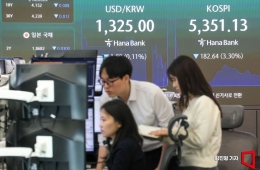
The won-dollar exchange rate is another key variable. Given that the food industry relies heavily on imports for key raw materials such as wheat, sugar, palm oil, and cocoa, any increase in the exchange rate directly translates into higher production costs. Industry insiders expect that inventory and contract volumes of raw materials, which were secured at high prices in the first half of the year, will be reflected in production costs in the second half, further increasing the cost burden. A source in the food industry stated, "With raw materials, packaging costs, and exchange rate pressures all compounding, the business environment in the second half is expected to be even more challenging than in the first half. It's difficult to raise prices, but leaving them unchanged will only worsen profitability."
© The Asia Business Daily. All rights reserved. Unauthorized AI training and use prohibited.