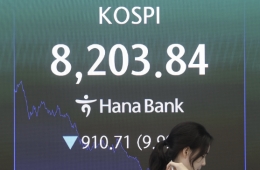
Warning Lights Flash for Leveraged ETFs as Korean AI Stocks Plunge... Concerns of Amplified Volatility
Rebalancing Demand Reaches $900 Million for Every 1% Move in Leveraged ETFs
"Korea Is an Epicenter of AI Bottleneck Trading"
Concerns are once again mounting that leveraged Exchange-Traded Funds (ETFs) are amplifying market volatility in the wake of a sharp decline in Korea’s artificial intelligence (AI) semiconductor stocks. As major AI beneficiaries such as Samsung Electronics and SK hynix experience significant turbulence, leveraged products favored by retail investors are being pointed to as a structural factor that can intensify selling pressure during market downturns.

According to Bloomberg News on June 23 (local time), concerns about leveraged ETFs—the fastest-growing retail investment products in Korea—are resurfacing as AI-related stocks come under selling pressure.
Leveraged ETFs are designed to track more than twice the daily movement of their underlying assets and have become widely used among short-term traders.
The controversy intensified after the share prices of Samsung Electronics and SK hynix swung sharply this week, and Chanjin Lee, Governor of the Financial Supervisory Service, commented on the approval of single-stock leveraged ETFs by saying, “I regret not blocking it more forcefully.”
Bloomberg reported that as the enthusiasm of retail investors for AI stocks begins to wane, there are growing concerns that leveraged ETFs could serve as a catalyst for market volatility.
According to Bloomberg’s data, the total global assets in leveraged ETFs have surpassed 290 billion dollars. Of this, the Asian market accounts for over 45 billion dollars, while the U.S. market exceeds 220 billion dollars.
The size of related products in Korea has also grown rapidly. When they were first launched in May, the combined assets of the 16 ETFs tracking Korean semiconductor companies totaled 3 billion dollars, but this figure has now increased to over 9 billion dollars. In just a few months since their launch, the assets in leveraged ETFs betting on AI semiconductor stocks have more than tripled.
Alexander Altmann, equity strategist at Barclays, estimated that over the past 10 trading days, the daily average rebalancing volume of U.S. leveraged ETFs reached 20 billion dollars—about four times the annual average.
The primary channel through which leveraged ETFs influence the market is rebalancing. To maintain the promised leverage ratio, fund managers and dealers are required to buy more shares when prices rise and to sell when prices fall. As a result, buying pressure tends to increase at the tail end of a rally, while selling pressure intensifies during downturns.
Strategists at Nomura estimate that leveraged ETFs generate approximately 9 billion dollars in rebalancing demand for every 1% move in the market. This is why, in volatile markets, traders closely monitor the flow of leveraged ETF funds alongside commodity trading advisors (CTAs) and volatility-controlled funds.
Altmann, the equity strategist, said, “Leverage within the stock market creates a highly technical backdrop for risk assets—this is a classic ‘tail wagging the dog’ scenario. Regardless of fundamental valuations, leveraged ETFs remain the largest technical risk in this market.”
Bloomberg diagnosed Korea as a market where multiple factors, including the AI semiconductor bottleneck investment theme and the expansion of leveraged ETFs, are converging. The Korea Exchange has triggered its fourth circuit breaker this year. Given that there were none last year and only one in 2024, this represents a significant increase in volatility.
Hot Picks Today
![[Exclusive] "Nurturing It to the Level of Semiconductors"... The Next Industry Chosen by the Lee Jae-myung Administration](https://cwcontent.asiae.co.kr/asiaresize/93/2026062318521220842_1782208333.jpg) [Exclusive] "Nurturing It to the Level of Semiconductors"... The Next Industry Chosen by the Lee Jae-myung Administration
[Exclusive] "Nurturing It to the Level of Semiconductors"... The Next Industry Chosen by the Lee Jae-myung Administration
- KOSPI Can't Rise Forever Every Day... Securities Firm Says "It's Actually an Opportunity"
- "Buying Stocks Even with Borrowed Money"... The Stock Market Frenzy in a Country That Soared 100% in a Year
- "Actually, I'm Married" 17 Weeks Pregnant Bride-to-Be Faces Shocking Confession... "Concealed Singlehood" Shakes Japanese Society
- "Too Hot to Travel": Tourists Flee as 40-Degree Heatwave Paralyzes Europe
Charlie McElligott, Managing Director of Cross-Asset Strategy at Nomura, stated, “Korea is one of the epicenters of AI bottleneck trading, and the market structure surrounding leveraged ETFs is amplifying these movements.” He added, “It’s like the butterfly effect—where a butterfly’s wings trigger a hurricane on the other side of the world.”
© The Asia Business Daily(www.asiae.co.kr). All rights reserved.