Minimum Wage Talks Begin for Next Year... Small Businesses Warn "We Will Cut New Hiring" Over 12,000 Won Demand
Minimum Wage Commission to Hold 8th Plenary Session on June 23
Labor Unions Propose Initial 16.3% Increase
Business Sector Cites “Limited Capacity of Small Businesses to Pay”
On June 23, the Minimum Wage Commission will begin discussions on next year's minimum wage increase. As both the labor sector's demand for "minimum wage application for subcontracted workers" and the business sector's call for "differentiated wages by industry" have already been rejected, a fierce standoff is expected between labor and management over the scale of the increase. In particular, as the labor sector has proposed an hourly wage of 12,000 won, small business owners have warned of conflict, saying, "If the minimum wage is raised, we will reduce new hires."

The Federation of Korean Trade Unions, the Korean Confederation of Trade Unions, and the Minimum Wage Movement Headquarters for All held a press conference on June 15 at the stairs of Sejong Center for the Performing Arts in Jongno-gu, Seoul, to announce the '2027 Minimum Wage Demand Proposal.' June 15, 2026. Photo by Dongju Yoon
View original imageThe Minimum Wage Commission is scheduled to hold its 8th plenary meeting at 3 p.m. today at the Government Complex Sejong to discuss the level of next year's minimum wage increase. The business sector is expected to release its initial proposal for the minimum wage for the first time today. The labor side has already made its initial demand for an hourly wage of 12,000 won, which is a 16.3% increase from this year (10,320 won), and a monthly salary of 2,508,000 won (based on 209 hours per month). The review process involves both labor and management submitting their initial proposals and then narrowing the gap through multiple rounds of revised proposals. The business sector is expected to propose a freeze or only a slight increase for next year's minimum wage.
Labor Unions Propose 12,000 Won: "Real Wages Fall Due to Inflation... Minimum Wage Should Exceed Lunch Price"
The labor sector has come up with a bold proposal, raising the initial demand rate by 1.6 percentage points compared to last year's initial demand rate (14.7%). The main reason is the decrease in real wages due to inflation. They argue that the average minimum wage increase rate over the past three years (2023–2025) was 2.37%, which falls short of the average inflation rate (2.66%) during the same period, resulting in a decrease in real wages for low-income workers. They also cited that, according to the Minimum Wage Commission's 2025 standard, the monthly cost of living is 2,754,000 won, while the monthly converted minimum wage is about 2.15 million won, making the cost-of-living coverage rate only 78.3%. Ryu Kiseop, Secretary-General and labor representative of the Federation of Korean Trade Unions, stated, "In recent years, the minimum wage increase rate has failed to keep pace with inflation, and with recent controversies over large company bonuses and soaring asset prices, the value of labor is being undervalued compared to assets, resulting in severe polarization." He added, "The minimum hourly wage should not be lower than the price of a lunch meal," urging for an increase that reflects the actual cost of living.

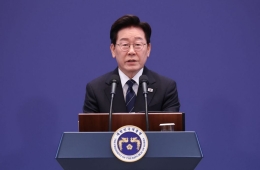
On the 9th, Ryu Kijeong, Executive Director of the Korea Employers Federation (KEF) and an employer member, is speaking at the 4th plenary meeting of the Minimum Wage Commission held at the Government Complex Sejong. Photo by Yonhap News Agency
View original imageBusiness Sector: "Higher Than G7... Limits on Payment Capacity" Small Business Owners Warn of Reduced Hiring
On the other hand, the business sector argues that further increases are difficult, given the payment capacity of small business owners and small-scale establishments. The Korea Employers Federation, in its "Analysis of Adjustment Factors for the 2027 Minimum Wage" report released on June 21, argued that, on a net basis, Korea's minimum wage is nearly 18% higher than the G7 average, calling for a slowdown. Ha Sangwoo, Director at the Korea Employers Federation, said, "In contrast, labor productivity falls short of the major economies’ average," adding, "Next year's minimum wage should be determined based on businesses that already have difficulty coping with the current minimum wage, such as accommodation and food service industries and businesses with fewer than five employees."
Small business owners have stated that they will reduce new hires if the minimum wage is raised. According to the Korea Federation of Micro Enterprises' survey on the impact of minimum wage increases, respondents most wanted a decrease in next year's minimum wage (74.9%). If the minimum wage is raised, they considered an appropriate increase rate to be less than 0.3% (43.1%), or between 0.3% and less than 0.5% (40.0%). If next year's minimum wage increases, small business owners said they would choose to "reduce new hires (70.3%)" or "cut existing staff (52.7%)." Many also believed that "existing employees' working hours will be reduced (46.0%)." Song Chiyoung, president of the Korea Federation of Micro Enterprises, lamented, "Currently, small business owners are suffering a double burden of weak consumer spending due to the economic downturn and labor costs exceeding 10,000 won."
According to the Minimum Wage Act, next year's minimum wage must be decided within 90 days of the Ministry of Employment and Labor's request for review. This year, the statutory deadline is June 29. With less than a week remaining, it appears that, as in previous years, the minimum wage decision will pass the deadline. As Minister of Employment and Labor Kim Younghun must officially announce the minimum wage by August 5, a final plan should be reached by mid-July.
Hot Picks Today
!["How Little Do Koreans Read? Who Will Acquire Munhakdongne Now on the Market [Weekend Money]"](https://cwcontent.asiae.co.kr/asiaresize/93/2026091716280432990_1789630084.jpg) "How Little Do Koreans Read? Who Will Acquire Munhakdongne Now on the Market [Weekend Money]"
"How Little Do Koreans Read? Who Will Acquire Munhakdongne Now on the Market [Weekend Money]"
- "Why Is Everyone Gathering in Front of the Office?" MZ Flock to 'Yajang' with Lines Forming Even Before Sunset
- "If You Become a Teacher, You Don't Have to Repay Student Loans"... Japan Pulls Out 'Repayment Exemption' After 30 Years
- "Please Be Quiet"... China to Fine Up to 210,000 Won for Disruptive Passengers Using Speakerphones
- "Raised a Stray Kitten, but..." Scientific Community Stunned: First New Wild Cat Species Discovered in 100 Years
At previous plenary meetings of the commission, both the labor sector's proposal for minimum wage application to subcontracted workers and the business sector's proposal for differentiated wages by industry were voted down. As a result, both sides are expected to continue uncompromising discussions regarding the minimum wage itself. If repeated meetings still fail to reach an agreement, a vote will take place within the "deliberation promotion range" suggested by the public interest commissioners.
© The Asia Business Daily. All rights reserved. Unauthorized AI training and use prohibited.