"Absolutely Cannot Hire Anyone"...34% of Self-Employed Owners Earn Less Than 2.15 Million Won a Month, Less Than Their Part-Timers
KEPA Survey of 500 Self-Employed Business Owners
Retail and Food Service Sectors Hit Hard by High Oil Prices and Sluggish Domestic Demand
44.6% of Self-Employed Say "Next Year's Minimum Wage Should Be Frozen"
More than half of self-employed business owners in Korea are experiencing worsened business conditions compared to the previous year. This is attributed to increased cost burdens driven by high exchange rates and high oil prices, as well as the prolonged slump in domestic demand. In particular, the survey found that one out of three self-employed individuals is now earning less than the legal minimum wage per month. If the minimum wage is raised again next year, many are facing a dead end, forced to consider not only reducing employment but even closing their businesses altogether.

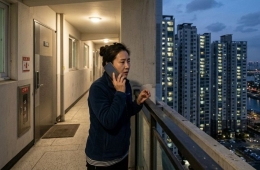
The outcry from self-employed business owners is severe. Many stores are closing one after another, saying "It's harder than during the COVID-19 pandemic," but no one is starting new businesses, so a virtuous cycle is not occurring. Even after cleaning up, tightening, and straightening things out, Hwanghak-dong Kitchen Street remains deserted as no one is coming to start a business there. Photo by Cho Yongjun
View original imageAccording to the results of the “2026 Self-Employed Business Environment Perception Survey,” commissioned by the Korea Economic Association (KEA) and conducted by the public opinion polling agency Monoresearch on 500 self-employed people nationwide, 57.0% of respondents said their business conditions have deteriorated this year compared to last year. Only 8.4% responded that conditions had improved, while 34.6% said conditions were similar to the previous year.

On the 23rd, the Korea Economic Association (KEA) commissioned Monoresearch, a public opinion polling organization, to conduct the “2026 Self-Employed Business Environment Perception Survey” targeting 500 self-employed people nationwide. Korea Economic Association
View original imageWhen looking at the proportion of respondents who said their business conditions worsened by industry, the core of neighborhood commerce—wholesale and retail—recorded 66.3%, while accommodation and food services followed closely at 65.8%, demonstrating the depth of the downturn sweeping across the self-employed sector. This was followed by arts, sports, and leisure services at 58.2%, and transportation and warehousing at 53.3%, confirming that a sense of crisis is spreading throughout the entire industry.
These business difficulties have directly led to a decline in real income for self-employed people. Among those surveyed, 34.0% said their current average monthly income does not reach the legal minimum wage of KRW 2,156,880 per month (based on a 40-hour workweek). Additionally, 19.8% reported earning between KRW 2.5 million and under KRW 3 million, 17.0% earned at least the minimum wage but under KRW 2.5 million, and 11.4% earned between KRW 3.5 million and under KRW 4 million—revealing that many self-employed individuals are barely able to maintain basic living standards.
Given that their very survival depends on the annually determined minimum wage, self-employed business owners are desperately hoping for a freeze in next year’s minimum wage. When asked about the appropriate increase rate for the minimum wage next year, the largest portion—44.6%—called for a freeze, followed by 20.6% preferring an increase of less than 1–3%, 13.0% calling for a reduction, and 12.6% supporting an increase of less than 3–6%. Notably, in the accommodation and food services sector, which has particularly weak payment capacity, 56.6% called for a freeze—well over half—while manufacturing and education/service sectors also showed strong support for a freeze at 44.4% and 44.1%, respectively.

The Korea Business Association (hereinafter KBA) commissioned Monoresearch, a public opinion polling agency, to conduct a survey of 500 self-employed people nationwide on the "2026 Self-Employed Business Environment Perception Survey" results. Korea Business Association
View original imageWith labor cost burdens reaching a critical point, it is inevitable that any further increase in the minimum wage will trigger a vicious cycle of job cuts and upward pressure on prices. Already, 59.2% of self-employed respondents flatly stated that they have no capacity to hire new employees at this time.
Ultimately, these cost pressures are translating into pressure to raise retail prices that consumers must bear. One in three self-employed individuals—37.6%—said that even at the current minimum hourly wage of KRW 10,320 applied this year, they already have plans to raise prices. In addition, 25.6% said they would consider raising prices if there is an additional increase of less than 1–3%, and 16.0% said they would do so if the increase is less than 3–6%.
The KEA analyzed, “Due to continued high oil prices stemming from the war in the Middle East, the import prices of raw materials have surged, increasing the cost burden on the self-employed. The additional operating cost burden caused by a rise in the minimum wage could drive up retail prices and fuel inflation.”

On the 23rd, the Korea Entrepreneurs Association (KEA) commissioned Monoresearch, a public opinion polling agency, to conduct the '2026 Self-Employed Business Environment Perception Survey' targeting 500 self-employed individuals nationwide. Korea Entrepreneurs Association
View original imageGiven these circumstances, a growing number of self-employed business owners at their limit are considering closing down altogether. In fact, 25.2% of self-employed respondents confessed that they have already reached the point of considering closing their business even at the current minimum wage level.
Additionally, a large majority—86.0%, or nearly eight out of ten self-employed individuals—criticized the current minimum wage decision process for not adequately reflecting the voices of small business owners and the self-employed. They identified the following as areas for improvement: restricting the rate of increase in consideration of domestic economic conditions (24.3%), applying differentiated minimum wages by industry and region (21.9%), and supplementing minimum wage decision criteria based on employer payment capacity (15.9%).
Hot Picks Today
 KOSPI Can't Rise Forever Every Day... Securities Firm Says "It's Actually an Opportunity"
- "Loans? We Pay All Cash": 60% of Buyers Show Massive Financial Power in Japan's Penthouse Market
- Prosecution Clears CIO of 'Yoon Arrest Warrant Concealment Allegations'... "No Application Filed with Central District Court"
- "Actually, I'm Married" 17 Weeks Pregnant Bride-to-Be Faces Shocking Confession... "Concealed Singlehood" Shakes Japanese Society
- "I Wouldn't Eat That"... Outrage Over 'Cake on Rice' Mockery Directed at Post by Virtuous Man Devoted for 30 Years

Lee Sangho, head of the Economic Division at the Korea Economic Association, emphasized, “With inflation driven by high exchange rates and oil prices, and the prolonged stagnation of domestic demand, business conditions for the self-employed have become significantly worse. A sharp increase in the minimum wage under these circumstances could further worsen incomes and reduce employment for self-employed business owners. It is necessary to apply the minimum wage differently by industry, and to take a cautious approach that comprehensively considers employer payment capacity, employment conditions, and the overall economic situation when determining the minimum wage.”
© The Asia Business Daily(www.asiae.co.kr). All rights reserved.

![[Breaking] First Minimum Wage Proposal: Labor Demands 12,000 Won, Management Calls for Freeze](https://cwcontent.asiae.co.kr/asiaresize/307/2026062316325920724_1782199978.jpg)