[Q&A] Lee Chan-jin: "HIRA and NHIS Also Want to Share Insurance Fraud Data with FSS"
"Governance Reform Plan Will Be Announced Before KB Financial Shortlist"
"Would Like to Link Corporate In-House Loans to DSR, But Remain Cautious"
"Opposed to Relocation, Saying It's Like Asking a Field Supervisor to Leave the Site"
Lee Chan-jin, Governor of the Financial Supervisory Service, said on the 22nd, "The Health Insurance Review & Assessment Service (HIRA) and the National Health Insurance Service (NHIS) are also positive about exchanging (medical) data with the Financial Supervisory Service in order to prevent fraudulent claims in indemnity health insurance." He explained that, in response to criticism that supervisory authorities have failed to effectively crack down on increasingly organized and sophisticated insurance fraud due to inefficient information sharing among agencies, a collaborative system is now being established with government ministries and agencies.
Governor Lee stated that the reform plan for financial company governance will be announced before the six-person shortlist is released by the KB Financial Group Chairman Candidate Recommendation Committee on July 3. He also mentioned that while he would like to link corporate in-house loans at companies such as Samsung Electronics and SK hynix to the debt service ratio (DSR) system, it is realistically difficult to do so. Regarding the possible relocation of the Financial Supervisory Service to a provincial area, he objected, saying, "The field is here (in Seoul), so where are we supposed to go?"
Governor Lee made these remarks during the monthly press conference held at the Financial Supervisory Service headquarters in Yeouido, Seoul, on the same day.

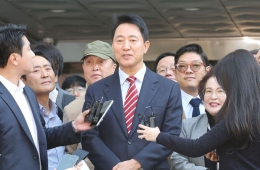
Lee Chan-jin, Governor of the Financial Supervisory Service, is speaking at the "June Press Conference" held on the 22nd at the Financial Supervisory Service headquarters in Yeouido, Seoul. Financial Supervisory Service
View original imageThe following is a Q&A with Governor Lee.
-You previously stated that the governance reform plan could be implemented around October. Is this still valid? The process for appointing the KB Financial Group Chairman has already started—if the reform plan is announced before then, would it be possible to request procedural supplementation from KB Financial Group?
▲The final plan has been reported within the government. You can expect the reform plan to be announced before the KB Financial Group shortlist is released on July 3. This has been confirmed. The Financial Services Commission will make the announcement. The legislative process for the new system is expected to proceed once the National Assembly standing committee is formed. The reason for sharing the schedule is that, in addition to the appointment of the holding company chairman, multiple bank president appointments are also scheduled. I understand that most of the practical work related to the three consecutive terms for the holding company chairman has also been completed.
-Housing prices in local areas near semiconductor companies are rising. What is the financial authorities' position on the management of corporate in-house loans?
▲There has actually been considerable thought given to whether corporate welfare can be linked to the financial DSR system. Personally, I would like to do so, but I am cautious about the practical limitations within a capitalist system. When securing collateral, there are two methods: issuing a guarantee or establishing a mortgage. In the latter case, there is some potential, at least technically, to include in-house loans in the DSR. The Financial Services Commission has been cautious. The extent of the impact of in-house loans on the market needs to be discussed with the relevant ministries. Personally, I believe there are some options available to the authorities regarding linking mortgages to the DSR. While I think a certain level of regulation may be necessary for the public good, I am not the decision-maker, so that's all I can say.
-The Financial Supervisory Service has declared its intention to serve as a universal platform to combat insurance fraud. However, there is talk of difficulties in information sharing between public institutions such as HIRA, NHIS, and private insurers. Is there a solution to these challenges?
▲Paybacks (treatment fee refunds) at long-term care hospitals account for only the tip of the iceberg in overall insurance fraud. The Financial Supervisory Service will serve as a universal platform to facilitate a rapid response system for insurance fraud and illegal private lending. Fraud cases involving the forging of indemnity insurance medical records using artificial intelligence (AI) are becoming frequent. It is necessary to cross-check data related to health insurance medical benefit payments held by healthcare institutions and hospitals, and a cooperative system has already been established with the NHIS. In fact, both HIRA and NHIS intend to exchange data with the Financial Supervisory Service. What's even more important is close cooperation with the police. We plan to expand the existing government-wide collaboration platform for voice phishing to insurance fraud, creating an integrated management system for each sector. We are currently developing related AI and designing the platform.
-The discussion on relocating public institutions to provincial areas has been reignited. The Financial Services Commission seems likely to move to Sejong. What is the situation for the Financial Supervisory Service? Is there an alternative plan, such as relocating some employees while keeping the headquarters in Seoul?
▲I do not understand why this is even a concern. If the situation arises where relocation is necessary, we will state our position at that time. Speaking as a regular citizen rather than as an FSS manager, the idea of local relocation is strange. It's like asking a construction site supervisor to leave the site—where are we supposed to go? This perception remains unchanged. I believe policy belongs in the realm of common sense.
-Are there any ongoing discussions with the Financial Services Commission to improve the efficiency of disciplinary procedures for financial companies? There must have been considerable deliberation regarding the level of sanctions on equity-linked securities (ELS) tied to the Hang Seng China Enterprises Index (HSCEI).
▲The Financial Supervisory Service submits a type of administrative disposition proposal to the Financial Services Commission. No matter how much we tried to reduce the fine, there was no way to lower it below 1.4 trillion won, as that would exceed our authority. The key issue the FSS considered was that this was the first case after the implementation of the Financial Consumer Protection Act, and there were no specific guidelines. Many of the misselling cases occurred during the guidance period, and according to a Supreme Court precedent, if efforts were made to fulfill obligations in the absence of concrete guidelines, it is difficult to view such cases as intentional or gross negligence. Taking that into account, we revised the amount to just over 600 billion won before submitting it to the Financial Services Commission. The self-initiated efforts by financial firms to address consumer damages must be sufficiently reflected in the severity of sanctions. I understand that the intent of the Financial Consumer Protection Act is to strike a balance in this regard, so I personally do not agree with interpreting subsequent actions between the FSS and the financial sector as inappropriate deals.
Hot Picks Today
 "The Transfer Failed, but 'Ding-Dong,' Money Came In"... KRW 32.5 Billion Financial Incident at Toss Bank
- "I waited all year for autumn just to eat this..." It may disappear from restaurants and supermarkets as catches plunge.
- Female YouTuber Who Disappeared During India Trip Makes Urgent "Proof of Life" Announcement: "I'm Not Being Threatened, Kidnapped or Held Captive"
- [2026 Parliamentary Audit] Shin Hyunsong: "Recent Won Strength Reflects Confidence in Korea... Still Weak on an Effective Exchange Rate Basis"
- 'Hangover Legend' Returns After 11 Years... Lee Sunmin Hyung's 'Captain Q' Sells Out
-Last year at the National Assembly audit, you agreed on the necessity of unifying the supervisory framework for mutual finance. However, there continue to be violations of internal control loan regulations in mutual finance. What areas should be examined in future supervision of mutual finance?
▲My position that the same regulations should apply has not changed at all. As you have all seen with the JR Global REITs incident, in many cases, there is little or even a hollowed-out supervisory system. I believe this issue should be reviewed at a government-wide level. As I recall, after the local elections, it was decided last year that the supervision system for credit unions would be reformed. I think the media should also pay close attention to how the government handles this matter.
© The Asia Business Daily. All rights reserved. Unauthorized AI training and use prohibited.