Lee Chanjin: "Governance Reform Plan to Be Announced Before KB Shortlist"... Calls for Regulation on Samsung's Internal Loans
Lee Chanjin, Governor of the Financial Supervisory Service, Holds Press Conference
Governance Reform Plan to Be Released Before July 3 KB Financial Shortlist
On Social Contribution Probe: "No Political Intent"
On Relocation of the FSS
Lee Chanjin, Governor of the Financial Supervisory Service, announced that the reform plan for the governance structure of financial companies will be released around the end of this month. He also expressed the view that regulations are needed regarding the ultra-low interest rate employee loans recently introduced by Samsung Electronics.

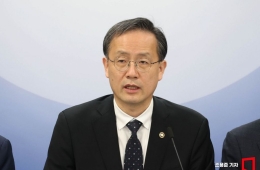
Lee Chanjin, Governor of the Financial Supervisory Service, is speaking at a press conference held on the morning of the 22nd at the Financial Supervisory Service headquarters in Yeouido, Seoul. Provided by the Financial Supervisory Service
View original imageAt a press conference held on the morning of the 22nd at the Financial Supervisory Service headquarters in Yeouido, Seoul, Governor Lee stated regarding the timing of the announcement of the reform plan for financial company governance structures, "It will be released before July 3, before the KB Financial Group (next chairman) shortlist is finalized."
He explained, "Legislation will proceed immediately after the announcement of the governance improvement plan," adding, "Not only the selection of holding company chairmen, but also the appointment procedures for major bank CEOs are scheduled, so both the best practice guidelines and the legal amendment will be presented together to ensure there are no delays in the CEO appointment schedule."
This governance reform plan is highly likely to be applied starting from the case of Yang Jonghee, Chairman of KB Financial Group, whose term expires in November. Previously, financial authorities had stated their intention to complete legislation before October. However, KB Financial Group plans to finalize its next chairman candidate by September at the latest. Among the top five commercial banks, Shin Sanghyuk, CEO of Shinhan Bank, succeeded in being reappointed at the end of 2024 and is set to complete his term at the end of 2026, while other key bank CEOs will see their first terms expire at the end of this year.
Within the financial sector, the core issue of this reform plan is expected to be whether to legislate a ban on triple consecutive terms for financial holding company chairmen.
Regarding the recent Financial Supervisory Service investigation into social contribution activities by financial holding companies, Governor Lee drew a clear line, stating, "There is no political intent." As financial authorities have stepped up pressure for governance reforms at financial holding companies and have recently expanded to reviewing social contribution expenditures, various interpretations have emerged both inside and outside the financial sector regarding the background. He explained, "During last year’s National Assembly audit, a lawmaker pointed out that advertising was being disguised as social contribution," and added, "We are reviewing whether current social contribution disclosure practices are in compliance with the system."
Regarding Samsung Electronics’ recent decision to provide employees with housing loans at an annual interest rate of 1.5% and up to 500 million won per person, he mentioned the need for regulation. Governor Lee said, "There were discussions on whether corporate welfare could be linked to the financial sector’s Debt Service Ratio (DSR) system," and continued, "After consultations with the Financial Services Commission, it appears that the mortgage registration portion could be included in the DSR, but our stance is cautious." He further said, "There are limits to regulation within a capitalist system," but added, "Although I am not a policy decision-maker, I am aware of the need for regulation."
Regarding the issue of bank fines related to the mis-selling of Hong Kong H-Index (Hang Seng China Enterprises Index, HSCEI) equity-linked securities (ELS), he reaffirmed that efforts to recover financial consumer losses should be reflected in the level of penalties. The Financial Supervisory Service initially sent a proposal to the Financial Services Commission to impose fines of 1.4 trillion won on banks, but it was rejected. The amount was then revised to just over 600 billion won and resubmitted.
Governor Lee stated, "With the authority of the Financial Supervisory Service, we could not reduce the fines below 1.4 trillion won, so we attached a note conveying that the Financial Services Commission should exercise its discretion to further reduce the amount," adding, "Since the purpose of the Financial Consumer Protection Act is not only to prevent consumer damage but also to support recovery, it is necessary to establish a virtuous cycle where the self-rescue efforts of financial companies are taken into account when determining sanctions."
Amid increasing security threats in the financial sector due to high-performance artificial intelligence (AI), he also hinted at the possibility of easing sanctions for financial companies that are proactive in investing in security. He said, "We are pursuing measures to ease network separation regulations so that the financial sector can quickly adopt AI-based defense strategies," and added, "Even if minor system errors occur during the process of utilizing AI, if the financial company has been proactive in strengthening security, we can consider reducing sanctions."
Regarding the possible relocation of the Financial Supervisory Service to a regional area, Governor Lee said, "I will express my position once the direction is set," but added, "It is strange to think about relocating the site supervisors (Financial Supervisory Service) of the construction site (financial companies). Policies must be in line with common sense," effectively expressing opposition to the relocation plan.
Regarding the recent default of a subsidiary of JoongAng Group, he stated that they are looking into whether there were any problems in the issuance process of commercial paper (CP) and corporate bonds. He said, "It has been found that CPs and corporate bonds were issued and sold to retail investors up until just before the default," and added, "We have started reviewing whether the issuance process was appropriate, and if necessary, are considering converting the review into an inspection."
Hot Picks Today
 "Is This Serious? Should I Go Back to Korea?"... New U.S. Internship Guidelines Put International Students on Edge
- "Driverless" Chinese Robotaxis to Run Freely on Seoul Roads: Up to 200 Vehicles as Early as 2028
- NPS Draws the Line on ‘Additional Payment’ Controversy: “Foreigners Who Paid Contributions Cannot Be Charged Higher Hospital Fees”
- Police Recover Additional Remains of Chinese Student Murdered by Chinese University Lecturer
- Lee Jaemyung Congratulates Yong Hyein on Birth of Child... 1990-Born Nominated as Gender Equality Minister [Profile]
Governor Lee also emphasized the need to strengthen financial education for students and military personnel. He said, "There are 6,000 career soldiers subject to debt restructuring, and in schools, financial issues are linked to gambling and illegal private lending," adding, "Financial education has traditionally been a non-mainstream area for the Financial Supervisory Service, but now it is becoming mainstream." He continued, "We are preparing, together with the lending industry, to institutionalize a ban on loan businesses targeting military personnel."
© The Asia Business Daily. All rights reserved. Unauthorized AI training and use prohibited.