Only 2 Out of 10 Americans Say End-of-War MOU Favors the U.S.
The first high-level talks between the United States and Iran to implement the end-of-war memorandum of understanding (MOU) concluded in the early hours of June 22 (local time). A recent survey shows that while Americans are hopeful for the end of the Iran war, only 2 out of 10 believe the new MOU favors the United States.
According to a poll jointly conducted by CBS News and YouGov on June 21, just 22% of respondents said the MOU between the United States and Iran is more advantageous to the United States. The survey was conducted over three days starting June 17, targeting 2,519 American adults.

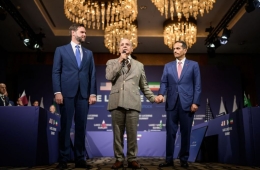
On the 21st (local time), ahead of the four-party face-to-face meeting with Iran, (from left) U.S. Vice President JD Vance, Pakistani Prime Minister Shehbaz Sharif, and Qatari Prime Minister Sheikh Mohammed bin Abdurrahman bin Jassim Al Thani held a press conference. Photo by Reuters Yonhap News
View original imageThe percentage who said the agreement favors Iran was higher, at 37%, while 41% viewed it as equally beneficial to both sides.
Notably, many Americans assessed that the United States failed to achieve its strategic goals in the war with Iran. Sixty-nine percent of respondents said the agreement would not permanently halt Iran’s nuclear program, while only 31% believed it could achieve a permanent suspension.
Sixty-eight percent predicted that the United States would not be able to block Iran’s regional threats.
Forty percent responded that Iran would continue to try to disrupt shipping through the Strait of Hormuz even after the end of the war.
The majority of Americans were also skeptical about the possibility of regime change in Iran. Seventy-nine percent predicted the agreement would not bring about a new, pro-American leadership, and 74% said it would fail to guarantee the safety and freedom of the Iranian people.
Sentiments toward the Iran war itself were also negative. Sixty-nine percent said the war was not worth the cost, and 57% said it created more problems than it solved.
However, regardless of their assessment of the agreement, Americans seem to support ending the war. Seventy-eight percent said the war should be ended with the current level of agreement. Only 22% said hostilities should continue until Iran makes further concessions. Even among Republican supporters, 60% supported the end of the war.
Hot Picks Today
 "She Comes Every Three Months to Stock Up"... Surge of Foreign Visitors Entering Korea for Olive Young Sale
- Chinese Customers Disappointed by Fake McDonald's Father's Day Set Menu Poster Promising Free Meals for Saying "I Am Your Father"
- Lost $13.8 Million on a Prediction... World Cup Prediction Markets Surpass $7 Trillion in Bets
- "Forced to Pay 500,000 Won for Team Lunches in a Week"... Company Culture Drives New Employee to Quit, Sparks Outcry
- Foods That Make Your Face Look Worse, According to a Plastic Surgeon... What Ranked Above Ham and Ramen?
Meanwhile, expectations for gasoline price stabilization following the end of the war were high. Forty-two percent said they expect gasoline prices in the United States to fall in the coming weeks, a higher percentage than those who expect prices to rise (23%) or remain the same (35%).
© The Asia Business Daily(www.asiae.co.kr). All rights reserved.