Despite Hardline Tactics by U.S. and Iran, Talks Continue... Netanyahu: "No Compromise on Stopping Iran's Nuclear Program and Responding to Hezbollah"
Discord Emerges on the First Day of Follow-Up Talks
Communication Continues via Mediator Countries
Confusion Over Reopening of the Strait of Hormuz
Nuclear Negotiations Yet to Begin
The United States and Iran clashed head-to-head during their first negotiations following the signing of the ceasefire Memorandum of Understanding (MOU). The talks appeared to be at risk of breakdown, especially after U.S. President Donald Trump mentioned the possibility of attacking Iran again. However, it has been reported that negotiations are still ongoing.

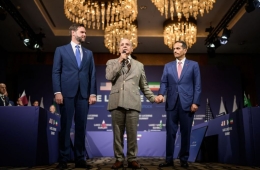
According to reports from the New York Times (NYT) and the Financial Times (FT) on June 21 (local time), delegations from the United States and Iran held their first high-level talks in Switzerland to implement the MOU. This marked the start of 60 days of negotiations aimed at maintaining the ceasefire. The negotiating venue in Switzerland was arranged through mediation by Qatar and Pakistan and was attended by U.S. Vice President JD Vance and Iranian Parliament Speaker Mohammad Bagher Ghalibaf, among others.
Strong Confrontation Between Both Sides Raises Fears of Breakdown

The negotiations encountered difficulties from the outset. According to the FT, the Iranian delegation refused to participate in a joint photo session with the U.S. side. The previous day, Iran had also stated that Israel continued to attack Lebanon's pro-Iranian militant group Hezbollah even after the MOU was agreed, and threatened to re-block the Strait of Hormuz. This move was intended to put additional pressure on President Donald Trump, who, after accepting the MOU because of the burden caused by the prolonged tension in the Strait of Hormuz, faced tremendous criticism at home. However, the U.S. Central Command countered by stating that the Strait remained open to all vessels, and commercial ship traffic was being maintained.
During the talks, President Trump posted on the social media platform Truth Social, warning that if Iran failed to stop Hezbollah, the United States would strike Iran very hard again. The Iranian side protested strongly against such remarks from the U.S. leader, and at one point, the negotiations nearly broke down. Iran’s state-run news agency IRNA reported that the talks were adjourned after just 80 minutes, and the Iranian delegation abruptly left the venue, signaling the negotiations had hit a major roadblock.
Nevertheless, both sides remained at the negotiating table. Citing an anonymous diplomatic source familiar with the situation, AFP reported that "The Iranian delegation is still participating in the talks and has not expressed any intention to withdraw to the mediating countries." Online media outlet Axios commented that "the near marathon talks, held with hardly any breaks, indicate that both sides remain engaged in dialogue despite significant disagreements."
President Trump's statements are analyzed as an attempt to gain an advantageous position in the negotiations. Amid skepticism about the MOU even within the ruling party, this could also be interpreted as keeping military options open. President Trump has repeatedly stated that if negotiations with Iran fail, the United States will take control of the Strait of Hormuz and claim 20% of the oil that passes through the strait.
Continued Discussions on the Strait of Hormuz and Other Issues

The United States is focusing its efforts on keeping the Strait of Hormuz open. According to the FT, President Trump has made the reopening of the Strait of Hormuz—which handles about one-fifth of the world's oil and gas shipments—a top priority. With rising gasoline prices in the United States due to the aftermath of the conflict with Iran, the Trump administration faces increasing political pressure ahead of the November midterm elections. President Trump has even warned that if the MOU is not honored, the United States may impose transit fees on shipping through the Strait of Hormuz.
It appears that negotiations related to Iran’s abandonment of its nuclear program have not yet taken place. Citing Iranian state media, the NYT reported that the talks in Switzerland mainly focused on the conflict in Lebanon, and the future of Iran’s nuclear program was not discussed. However, the FT predicted that nuclear negotiations will continue over the coming weeks, with the handling of Iran’s enriched uranium and major nuclear facilities emerging as core issues. Al Jazeera, quoting an Iranian negotiator, reported that the talks addressed proposals to unfreeze assets and ease oil sanctions. The NYT pointed out that the greatest variable in these negotiations is the conflict between Israel and Hezbollah. Iran is pushing to include the Lebanese front as a negotiating agenda, while Israel maintains that it cannot separate its response to Hezbollah from the issue of Iran’s nuclear program.
Hot Picks Today
 "She Comes Every Three Months to Stock Up"... Surge of Foreign Visitors Entering Korea for Olive Young Sale
- [Breaking] The Top Spot Has Changed... SK hynix Overtakes Samsung Electronics to Claim KOSPI Throne
- Wall Street on Edge as New Fed Chair Warsh Turns Out to Be a 'Hawk,' Not a 'Dove'
- "Forced to Pay 500,000 Won for Team Lunches in a Week"... Company Culture Drives New Employee to Quit, Sparks Outcry
- Foods That Make Your Face Look Worse, According to a Plastic Surgeon... What Ranked Above Ham and Ramen?
It is especially difficult for the United States to mediate this conflict. Hezbollah has argued that direct negotiations between the Lebanese government and the United States undermine Lebanon’s sovereignty and serve Israel’s interests. According to the NYT, Israeli Prime Minister Benjamin Netanyahu has maintained that Israel is not a party to the preliminary agreement between the United States and Iran and will continue to station troops in southern Lebanon as long as necessary to protect its citizens.
© The Asia Business Daily(www.asiae.co.kr). All rights reserved.