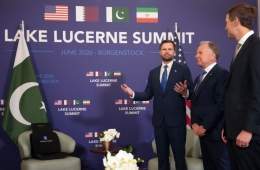
Amid Strait of Hormuz Re-blockade Crisis, U.S. and Iran to Hold Working-level Talks in Switzerland on the 21st
The United States and Iran will attend a working-level meeting for the Memorandum of Understanding (MOU) to end the conflict, which will be held in Switzerland on the 21st (local time). While Iran declared the re-closure of the Strait of Hormuz the previous day in response to Israel's airstrikes in Lebanon, the overall atmosphere remains conducive to dialogue.
JD Vance, U.S. Vice President, met with reporters at Joint Base Andrews near Washington, D.C., before departing for Switzerland for negotiations with Iran on this day. He said, "We plan to negotiate for about two days" and expressed hope for progress on the nuclear issue and a ceasefire in Lebanon.
Regarding the continued Israeli airstrikes targeting Hezbollah in Lebanon even after the MOU came into effect, he commented that "the situation is improving" and emphasized that "this is an issue that we must continue to manage to ensure the safety and stability of both Israel and Lebanon."
Previously, Steve Witkoff, the U.S. special envoy for the Middle East, and Jared Kushner, the eldest son-in-law of U.S. President Donald Trump, arrived in Switzerland ahead of the negotiations to begin preparations.
According to the Swiss Federal Department of Foreign Affairs, the Iranian negotiation delegation led by Mohammad Bagher Ghalibaf, Speaker of the Iranian Parliament, also arrived in Switzerland on the same day. The Pakistani Ministry of Foreign Affairs, which serves as the mediator for the negotiations, also announced in a statement that a face-to-face working-level meeting between the two countries would be held in Switzerland on the 21st.
In addition to key issues such as nuclear negotiations and the lifting of economic sanctions, it appears that the two countries will also discuss the blockade of the Strait of Hormuz. The Khatam al-Anbiya Central Headquarters, which commands Iran's military forces, stated on this day that, in relation to the situation in Lebanon, the United States and Israel had violated the MOU and that Iran would re-blockade the Strait of Hormuz.
Despite this, the Trump administration focused on managing the situation, emphasizing the continued passage of ships without issuing any critical statements. The U.S. Central Command stated on social network service X (formerly Twitter) that "U.S. forces remain on the ground to ensure that the agreement with Iran is observed, implemented, and remains fully effective, maintaining vigilance at all times."
Since both the U.S. and Iranian delegations are heading to Switzerland for the working-level meeting, observers believe an immediate escalation into a crisis is unlikely. However, Iran's hardline stance and the uncertainty surrounding Israel's attacks on Lebanon could still pose unexpected variables. On this day, the Iranian Ministry of Foreign Affairs stated that the main purpose of this meeting is not to commence the main negotiations, but to review violations of the MOU and to strongly urge the United States to comply with its implementation.
President Trump stated on Truth Social that "there will be no transit fees in the Strait of Hormuz during the 60-day ceasefire period, and there will be no fees after the 60 days expire, either."
However, he also wrote, "If the agreement is not finalized, an exception would be if the fee is imposed by the United States, for the United States, to compensate for the costs incurred in the past, present, and future for the services the U.S. has provided as the guardian angel of Middle Eastern countries." This suggests that if a final agreement is not reached with Iran, the United States may impose transit fees for the Strait of Hormuz.
Hot Picks Today
 Already Expensive..."I Eat Two Eggs Every Morning—This Is Too Much": Early Heatwave Sparks Egg Price Fears
- "Wow, This Is Addictive": Justin Bieber's Wife Raves About 'Ddungbaratte'... Foreign Tourists Flock to K-Convenience Stores [K-Holic]
- "Exorbitant Food Prices" Beer Costs 30,000 Won per Glass... Locals Outraged Over Record Price Gouging at the World Cup [Current Affairs Show]
- Foods That Make Your Face Less Attractive, According to a Plastic Surgeon... What Ranked Above Ham and Ramen?
- "Getting Your Hair Pulled and Kicked Is Routine... '9 Inmates Packed into 5 Pyeong' Cheongju Women's Prison, the Reality of Sweltering Heat [Reportage]"
This is interpreted as a message that the U.S. will not tolerate a situation in which Iran imposes transit fees after the ceasefire period and, if a final agreement fails, will demand compensation for its role in maintaining maritime security in the Middle East. However, some observers point out that the U.S. openly raising the possibility of imposing transit fees in an international strait could become a new source of controversy during future negotiations.

© The Asia Business Daily(www.asiae.co.kr). All rights reserved.