Kim Yongbeom Raises 'Real Estate Taxation + Alpha': "Unprecedented Boom Won't Last If Absorbed by Real Estate"
Diagnosing an Unprecedented Boom Thanks to Semiconductors
Surging Purchasing Power Could Flow Into the Real Estate Market
"Real Estate Taxation Needs Normalization... Tax Measures Alone May Not Be Enough"
"Imagination and Execution Ar
Kim Yongbeom, the policy chief at the Presidential Office, mentioned the possibility that the Korean economy could enter a double-digit nominal growth phase for the first time in over 20 years, stating, "An unprecedented boom demands imagination and execution to match." He also warned that while the semiconductor boom driven by increased investment in artificial intelligence (AI) is lifting major macroeconomic indicators such as stock prices, corporate earnings, tax revenue, and current account balance, if the resulting gains are concentrated in asset markets like real estate, economic and social imbalances may deepen.

Policy Chief Kim Yongbeom, accompanying President Lee Jae-myung on his European tour, is briefing on Korea-EU economic cooperation at the Korean Press Center set up in a hotel in Rome, Italy, on the 11th (local time). 2026.6.11 Yonhap News Agency
View original imageOn June 20, Kim highlighted on his Facebook account that the nominal growth rate in the first quarter of this year reached 17.1% compared to the same period last year, saying, "Looking at the numbers alone, it’s cause for celebration," but added, "Strangely, there is a heaviness in one corner of my mind." The last time Korea recorded a double-digit nominal growth rate was in 2002, the year the Korea-Japan World Cup was held.
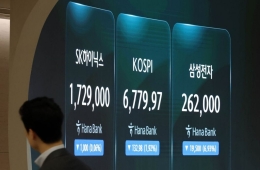
Kim asserted that the current boom is not an illusion. The global upsurge in AI investment has fueled semiconductor demand, resulting in a sharp rise in the operating profits of Samsung Electronics and SK hynix. The KOSPI has surpassed the 9,000 mark, and there is a real inflow of dollars due to the current account surplus. Increased corporate tax revenues have provided greater fiscal capacity, and the national debt ratio is expected to fall back below 50%. He also suggested that Korea could achieve a per capita national income of USD 40,000 earlier than the previously projected 2028.
However, he described this boom as "unfamiliar." He pointed out that the positive numbers stem from the semiconductor and AI sectors, not from an across-the-board improvement in the economy. While the GDP deflator has exceeded 10%, the Consumer Price Index (CPI) remains in the 3% range, and although macro indicators are strong, the business sentiment among self-employed individuals remains cold. He noted a disconnect where large corporations’ operating profits are surging, but local small businesses are worried about vacant storefronts, stating, "The average may improve, but the middle could start to shake."
He expressed concern about the delayed impact of increased purchasing power as it enters the market. Kim believes that once the performance of semiconductor companies is finalized and the scale of bonuses becomes clear in the second half of the year, consumer and investment sentiment could change. He also mentioned that as bonus payments, wage increases, and export earnings accelerate toward the end of this year and early next year, there is a possibility of a resurgence in luxury consumption and real estate purchases in preferred areas.
He said, "The Korean economy has experienced such scenes repeatedly over the past few decades," and added, "We have collectively learned where liquidity eventually flows." He warned that if the national wealth generated by semiconductors is absorbed as unearned income in real estate and the fruits of growth are concentrated among a few, this boom will not last. He also analyzed that while rational adjustments to property and capital gains taxes are necessary, tax policy alone may not be sufficient in a phase where those with cash are on the move.
He also raised the issue of interest rates. Kim said that if strong nominal growth continues, it will be difficult to maintain the current level of interest rates. However, if interest rates rise, it is not the direct beneficiaries of the semiconductor boom but rather self-employed individuals, vulnerable borrowers, and those with variable-rate loans—who are not feeling the effects of the boom—who will be hit first. He remarked, "The rewards of the boom flow upward, while the pain of tightening flows downward," warning that "the country as a whole may be doing well, but people might not actually feel happy."
Nevertheless, he emphasized that there is no need to view the current situation only pessimistically. With growing tax revenues and a sustained current account surplus, Korea is not in a position where it cannot respond due to a lack of funds, as was the case during past crises. He said the key question is "where to channel this money," stressing that the increased fiscal capacity and corporate profits should be connected to youth, vulnerable groups, and future industries.
Hot Picks Today
 "30,000 Won in Korea, 70,000 Won in Japan"—Koreans Fill Suitcases as Illegal Direct Purchases Soar
- "SK hynix Is Our Target"... Japanese Firm Bets 7 Trillion Won as Germany Competes for Investment [AIDC Era of Coexistence] ⑪
- Body Presumed to Be Jang Miran, Linked to 'False Missing Person Case Closure,' Found in Jeju
- "Is This Really Pyongyang?"... North Korea’s Economy Hit by a Windfall, What’s Happening
- "Monster That Eats Gold" Turns Out to Be Real: Uproar in China as 5-Year-Old Swallows $7,500 Gold Bar, Sparking Questions About Family's Wealth
Kim stated, "Numbers only show the direction; they do not make the choices for us," and added, "Perhaps we have become so accustomed to low growth for so long that we have forgotten how to deal with the problems that prosperity brings." He concluded, "In the face of the record prosperity that has come after more than 20 years, we are once again being called to make choices we have not faced for a long time."
© The Asia Business Daily. All rights reserved. Unauthorized AI training and use prohibited.