President Lee: "Single-Issue Constitutional Amendment for Election Commission... Presidential Proposal Also Considered" (Comprehensive)
"Ballot Paper Shortage Is Unacceptable"
"Fundamental Reform Is Needed"
Ruling and Opposition Parties Hold First Parliamentary Inquiry, But Differences Remain
President Jae Myung Lee has stated that a single-issue constitutional amendment is necessary to reform the National Election Commission, which caused the shortage of ballot papers during the local elections on June 3. President Lee also mentioned that, if necessary, he would consider the option of the president submitting a constitutional amendment proposal.
On June 19, during a briefing at the Blue House Press Hall on the results of his European tour, President Lee said, “It seems the commission has enjoyed a level of freedom bordering on irresponsibility. We need to revise the legal system as much as possible, and there must be a certain level of external oversight and checks in place.”

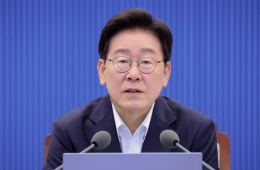
(Seoul=Yonhap News) Reporter Dohoon Kim = President Jae Myung Lee is responding to the press's questions during a briefing on the results of attending the G7 and the European tour held at the Blue House Press Hall on June 19, 2026. superdoo82@yna.co.kr (End)
View original imageIn regard to the ballot paper shortage, he criticized, “Ballot papers should be printed according to the number of eligible voters—this is what we do even when electing a class president at a school reunion. There may be excuses, but this is something that should never have happened.”
President Lee added, “Because the Constitution so clearly establishes the commission as an independent body, there is a high risk that any law or system designed for oversight, checks, or control could be ruled unconstitutional. Therefore, if the ruling and opposition parties can reach a consensus, I believe we should at least pursue a single-issue constitutional amendment regarding the commission.” He continued, “If necessary, even if it means the president must propose it, it must be done.”
He further stated, “The real issue is the sense of responsibility within the political community. It is hard to tell whether the intent is to genuinely resolve the problem, or to use it for political attacks and then withdraw. I urge the political sphere to engage in sincere discussions, and as we observe the progress, the government will determine its position accordingly.” He emphasized, “In any case, fundamental reform is certainly needed. We cannot go on like this.”
He also said, “Is it right for the Chief Justice of the Supreme Court to effectively appoint the chairperson of the commission? Perhaps there was an expectation that a Supreme Court justice would handle the role most fairly. But in the end, such an absurd situation has occurred.” He continued, “There are even reports that, because it is a non-standing position, some did not properly report to work on election day. That cannot be justified. There must be proper oversight, checks, and controls.”
According to the Constitution, the chairperson of the commission is elected from among the nine members, who are composed of three appointed by the president, three elected by the National Assembly, and three nominated by the Chief Justice of the Supreme Court. Typically, the chairperson is a justice nominated by the Chief Justice.
President Lee reiterated, “I urge the political community to engage in sincere discussions, and as we observe the ongoing debate, our government will determine its position.”
The ruling and opposition parties held their first official meeting the previous day regarding the ballot paper shortage incident, launching a parliamentary inquiry committee to investigate the infringement of citizens' voting rights and to pursue election management reform. The special committee will conduct a 45-day inquiry, until August 1, examining the National Election Commission and local commissions for any deficiencies in the printing, distribution, and storage of ballot papers, the actual management of polling stations, potential violations of voting rights, and the management of election personnel and budgets.
Hot Picks Today
![[Test Drive] The Sealion 7 Transformed by a 2 Million Won Upgrade: "Base Model Buyers Might Feel Shortchanged"](https://cwcontent.asiae.co.kr/asiaresize/93/2026080417033869589_1785830618.jpg) [Test Drive] The Sealion 7 Transformed by a 2 Million Won Upgrade: "Base Model Buyers Might Feel Shortchanged"
[Test Drive] The Sealion 7 Transformed by a 2 Million Won Upgrade: "Base Model Buyers Might Feel Shortchanged"
- 'Single-Stock Leveraged ETF Blow' Crippled KOSDAQ in July... Hopes Rise for a Turnaround in August with 11.38% Surge [Weekend Money]
- Chinese Buyers Retreat from Seoul’s Real Estate Market? Foreign Purchases Plummet by 2,000 [Real Estate AtoZ]
- "If We Don't Get Married, Let's Live Together"... Gen Z Chooses 'Co-Buying Homes with Friends' Over Romantic Partners [Gen Z Around the World]
- Kim Seontae Appears Gaunt After Leaving 'Don Seontae'... 3,000 Thumbs Up for Chungju Mayor's "Come Back" Offer
Both parties have strongly criticized the commission, but there are differences in their approaches to a solution. The ruling party argues that, following the parliamentary inquiry, further legal and institutional reforms, including a constitutional amendment, should be pursued. In contrast, the opposition People Power Party is calling for the appointment of a special prosecutor to determine responsibility.
© The Asia Business Daily. All rights reserved. Unauthorized AI training and use prohibited.


!["Even a 500 Million Won Jump Is Fine, Self-Residence Buyers Flock to Billion-Won Units"...High Winning Bids Continue for Mid- and Low-Priced Reconstruction Complexes [Real Estate AtoZ]](https://cwcontent.asiae.co.kr/asiaresize/307/2026042709001641074_1777248016.jpg)