Criteria for Negotiation Groups in Integrated Special City Council to Be Decided on the 24th... Opposition Parties Continue to Push Back
Conflict Intensifies as Democratic Party Holds 83 Seats and Non-Democratic Parties 8
Progressive Party and Party for National Innovation Protest: "Restrictions on Minority Party Activities"
Amid ongoing controversy over the criteria for forming negotiation groups in the Jeonnam Gwangju Integrated Special City Council, the finalization of these criteria has been postponed to a general assembly of all council members scheduled for June 24, 2026. The Democratic Party of Korea has set the minimum number of members required to form a negotiation group at 10, but opposition parties, including the Progressive Party and the Party for National Innovation, are pushing back, arguing that the standard blocks participation by smaller parties.
According to the local political community on June 19, the previous day, the Jeonnam Gwangju Integrated Special City Council’s agenda consultative body held a meeting at the Jeonnam Provincial Council. They discussed plans for forming standing committees and operating temporary sessions.
The consultative body agreed to establish 14 committees in total, including 11 standing committees and special committees. They decided to elect the standing committee chairs first, then assign the members. The Special Committees on Budget and Accounts will be split into two: one for the Jeonnam Gwangju Special City and one for the Jeonnam Gwangju Office of Education.
![An image illustrating the election competition for the inaugural chairperson of the Jeonnam Gwangju Integrated Special City Council and the criteria for forming negotiation groups. <br>[Graphic by ChatGPT]](http://www.asiae.co.kr/news/img_view.htm?img=2026061910133815684_1781831618.png)
An image illustrating the election competition for the inaugural chairperson of the Jeonnam Gwangju Integrated Special City Council and the criteria for forming negotiation groups.
[Graphic by ChatGPT]
The Operations Committee will have up to 13 members. Furthermore, the number of essential ordinance bills to be addressed at the first plenary session of the temporary assembly on July 1 has been scaled down from around 500 to about 200.
However, the criteria for forming negotiation groups were not included as an agenda item that day. As a result, the final decision is expected to be made at the general assembly of all council members on June 24.
Previously, the Democratic Party had set the requirement for forming a negotiation group at a minimum of 10 members. The Progressive Party and the Party for National Innovation have opposed this, arguing that it unduly restricts the legislative activities of smaller parties.
There are 91 members in the Jeonnam Gwangju Integrated Special City Council, elected through the June 3 local elections. Of these, the Democratic Party of Korea holds 83 seats. The non-Democratic parties have a combined total of eight seats: five for the Progressive Party, two for the Party for National Innovation, and one for the People Power Party. If the Democratic Party’s proposal to set the negotiation group requirement at 10 is confirmed, even if all non-Democratic party members form an alliance, they will not be able to establish a negotiation group.
Opposition from minority parties continues regarding the Democratic Party’s criteria for negotiation groups.

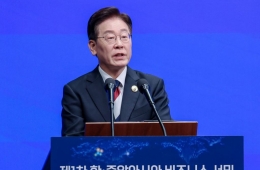
Sowang Jin, Floor Leader of the National Innovation Party, is speaking at the parliamentary meeting held at the National Assembly on the 9th. Photo by Yonhap News.
View original imageSeowangjin, head of the Gwangju City Party for the Party for National Innovation, criticized, “Even if all eight non-Democratic party members join forces, they will be unable to form a negotiation group out of 91 council seats,” and described it as “an act of arrogance by the majority party that fundamentally blocks the activities of minority parties.”
Assemblyman Seo argued, “Through this local election, many Democratic Party councilors were elected even in the Yeongnam region. If the People Power Party were to raise the negotiation group threshold in the Yeongnam regional assemblies to exclude the Democratic Party, would they remain silent? At a time when we should be creating a model of exemplary and innovative local councils starting from Honam, the principle of checks and balances is being undermined.”
He also urged that the Democratic Party-centered council operation structure should be converted to a joint governance consultative body.
Hot Picks Today
 "Additional 25% Mobile Bill Discount From Today" Causes Stir Online... The Truth Revealed
- "The Clothes My Dad Used to Wear"... Ralph Lauren, Beanpole, and Hazzys See Sales Surge as MZ Generation Embraces the Trend
- "So Many Inconsiderate People": Kicking and Struggling After Clothes Are Grabbed... Subway Line 2 Altercation Sparks Uproar
- "Please Take Off Your Shoes"—From Crawling onto the Bed to Changing Habits, Young Americans Lead the Shift
- "Famous Actress on KBS Is Perpetrator's Sister"... KBS Responds to 'Busan Fall Death' Family's Plea
The Party for National Innovation also announced plans to form alliances with other parties, including the Progressive Party, focused on basic local councils such as the Yeosu City Council and the Gwangju Nam-gu and Seo-gu Councils, in recognition of the difficulty of meeting negotiation group requirements in metropolitan councils. Through this, they aim to strengthen the function of checks and balances within local legislatures.
© The Asia Business Daily. All rights reserved. Unauthorized AI training and use prohibited.