Lee Administration’s Expansionary Fiscal Policy vs. Fiscal Rules Clash... Growing Tensions Expected Between Government and Superintendents Over Grant Reform
OECD Recommends Codifying Fiscal Rules
Clash with Lee Jaemyung Administration's Expansionary Policy
Grant Reform Expected to Escalate Tension Between Fiscal Authorities and Education Sector
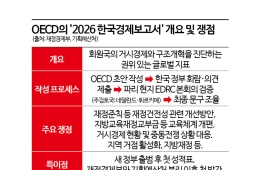
The upcoming OECD Economic Survey of Korea, set to be published in early July, highlights the necessity of introducing fiscal rules and reforming the Local Education Grant (also known as the Education Grant) system. Both of these issues have long been at the center of heated, protracted debates. The direction of each administration and the complex, conflicting interests on the ground have resulted in years of ongoing, parallel disputes without resolution.
OECD Pushes for 'Fiscal Rules,' Korean Government Responds: "No Practical Effect in Codification"

The Yoon Suk-yeol administration actively pushed for the legislation of fiscal rules such as the 'Fiscal Management Deficit Control at -3%,' but it failed to pass through the National Assembly and was abandoned. Since the current administration took office, calls for its introduction have disappeared. The photo shows a card news from the Yoon Suk-yeol administration highlighting the need for fiscal rules. Ministry of Economy and Finance.
View original imageThe task of quantifying and codifying overall fiscal indicators—referred to as 'Fiscal Rules'—has remained unresolved for more than a decade. Currently, out of all OECD member countries, only the Republic of Korea and Türkiye do not have fiscal rules in place. Successive administrations have continually pursued legislation: from the Park Geun-hye government's Fiscal Soundness Act, to the Moon Jae-in administration's "Korean-Style Fiscal Rules," and the Yoon Suk-yeol administration's "Fiscal Balance Control Plan of -3%." However, every attempt has failed to pass the National Assembly.
The OECD's recommendation for fiscal rule adoption directly clashes with the current administration’s economic policy stance. The OECD also emphasized the importance of fiscal rules for Korea in its 2024 report. At that time, the Yoon Suk-yeol administration’s commitment to fiscal soundness and its policy of curbing fiscal expenditures were evaluated positively. In contrast, the Lee Jaemyung administration is placing greater emphasis on expansionary fiscal policy, which diverges somewhat from the OECD’s perspective. Since the current administration took office, the perceived effectiveness and significance of codifying fiscal rules has diminished, while proposals to use excess tax revenue for public welfare have come to the forefront of public debate.
The government conveyed to the OECD that codifying fiscal rules into law does not necessarily guarantee practical effectiveness. The reasoning is that even advanced economies such as those in the European Union, which adopted fiscal rules preemptively, often rendered these rules meaningless by frequently invoking exceptions during economic crises. Rather than being bound by formal constraints, the government believes it is more important to operate a flexible fiscal policy—using real fiscal capacity to proactively stimulate the economy and address inequality—given the circumstances of the Korean economy.
Grant Reform: Budget Office Gains Momentum, but Backlash from Education Sector Expected to Intensify

Additionally, the OECD is expected to highlight the need to reform the Education Grant system in its report, citing the gradual decrease in the student population. The Education Grant system, established in 1971 to secure funding for compulsory education, automatically allocates 20.79% of annual domestic tax revenue to local education offices. As the system was created when Korea’s economy was smaller and the birth rate was higher, it now faces criticism as a "fiscal black hole" due to the sharp decline in the school-age population.
The OECD’s recommendation to reform the Education Grant system is expected to bolster the Budget Office’s push for spending restructuring ahead of the 2027 budget proposal, while also intensifying conflict with the education sector. Recently, three major teacher associations—including the Korean Federation of Teachers' Associations—and the 16 incoming superintendents of city and provincial education offices issued separate statements opposing the reform of the Education Grant system, arguing that reducing funding solely on the basis of a declining school-age population would undermine public education. With these groups vowing a strong response, fierce controversy is expected to continue until the budget is finalized.
Hot Picks Today
 "Bitcoin Could Surge Over 20 Times—Wall Street Heavyweight Delivers Bold Forecast: 'Don't Sell Now'"
- "Everyone Gets Rich But Me?" Impatient Retail Investors Flock In... Foreign Media Issues Warning
- Individual Investors Rush Into KOSPI 9,000 With Overdrafts: "What If the Market Crashes?" Balance Nears 43 Trillion Won This Month
- "Performance Bonus Shortfall" Spurs Samsung Employees' 'Black Attire' Protest... Labor-Labor Conflict Continues
- "50,000 Steps a Day for 90,000 Won: Why the 'Original K-Delivery' Tray Service at Namdaemun Is Coming to a Halt"
Currently, both the Budget Office and the Ministry of Education are reportedly in agreement on the need to reform the Education Grant system itself. However, there has been no concrete progress regarding the specific methods and scale of reform. Options under consideration include changing the allocation method from being linked to domestic tax revenue to being tied to the nominal growth rate, maintaining the domestic tax linkage but imposing an upper limit and diverting any excess to a fund for educational fiscal stability, and expanding the scope of the Education Grant so that it can be used not only for primary and secondary education but also for early childhood and higher education. A government official stated, “We have communicated to the OECD our intention to reach a reasonable conclusion,” and added, “We believe the final decision will be one that the public can accept.”
© The Asia Business Daily(www.asiae.co.kr). All rights reserved.