Will Kim Jong Un Smile at the "U.S.-Iran Nuclear Negotiation Model"? [Yang Nakgyu's Defence Club]
Iran Secures Regime Guarantees Without Denuclearization Measures
There is growing interest in how North Korea will interpret the "U.S.-Iran nuclear negotiation model," as it has set a precedent that economic rewards and regime guarantees can be obtained without denuclearization measures. Experts assess that this latest armistice agreement will negatively impact North Korea's denuclearization.

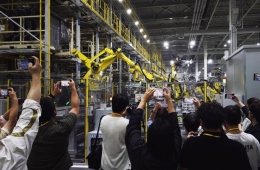
North Korean leader Kim Jong Un visited an important military munitions enterprise on the 6th to assess the production status of critical weapons for the first half of 2026, according to the Korean Central News Agency. Yonhap News
View original imageThe United States failed to achieve denuclearization results in its negotiations with Iran. The denuclearization clause (Article 8) in the U.S.-Iran War Armistice Memorandum of Understanding (MOU) merely reaffirmed the existing Nuclear Non-Proliferation Treaty (NPT) principle of "not acquiring or developing nuclear weapons." In addition, the handling of highly enriched uranium (HEU) is limited to on-site dilution under the supervision of the International Atomic Energy Agency (IAEA). In return, Iran gained a great deal. Sanctions against Iran were lifted, and the country is set to receive large-scale economic aid through a reconstruction fund.
NPT Principles Reaffirmed on Iran’s Nuclear Weapons
It appears unlikely that the U.S.-Iran nuclear negotiation model can be applied to North Korea for now, as the diplomatic and nuclear development environments are different. North Korea has increased its diplomatic leverage by intervening in the Ukraine war to draw closer to Russia, and by strengthening ties with Russia, it has also maintained exchanges with China. In terms of negotiation power, North Korea is a step above Iran. North Korea has already declared its nuclear development to the international community and, through constitutional revision, formally declared that denuclearization is not an option. This differentiates North Korea from Iran, which was still on its nuclear development journey.
In fact, Kim Yo Jong, the younger sister of North Korean leader Kim Jong Un and the director of the Workers’ Party, issued a statement on the 18th, saying, "There is nothing more foolish than sitting idly by in the face of military threats accompanied by nuclear weapons," and emphasized, "Possessing nuclear weapons is an essential core interest for us, and denuclearization is an inviolable red line that can never be crossed."
North Korea Strengthens Negotiation Power with Russia and China Amid Denuclearization Declaration
Some analysts also point out that it is uncertain whether the United States will immediately open the door to dialogue with North Korea. President Donald Trump has not lost interest in North Korea. On June 13 (local time), President Trump posted on social media a photo of himself and North Korean leader Kim Jong Un walking together at the first North Korea-U.S. summit in Singapore in June 2018, without any explanation. At the official dinner of the G7 Summit in Evian, France on the 16th (local time), President Trump also expressed his willingness to work toward resolving the North Korean issue.
Trump Focuses on Cuba Over North Korea Ahead of Midterm Elections
However, with the upcoming midterm elections in November, President Donald Trump may be more interested in Cuba than North Korea. Traditionally, domestic issues have been more influential in elections than foreign policy. The interpretation is that Cuba, located in the Caribbean near the United States, is more relevant in the election context than North Korea, which is far away in Northeast Asia. The Cuba issue is also in line with the second Trump administration's strategy of strengthening control in the Western Hemisphere, and compared to the North Korean issue—which requires consideration of the dynamics involving China and Russia—it is regarded as a relatively simple matter.
Hot Picks Today
!["Don't Use Chinese-Made Products": One U.S. Warning Triggers a 5 Trillion Won Jackpot for Korean Batteries [Weekend Money]](https://cwcontent.asiae.co.kr/asiaresize/93/2025121709393659037_1765931975.jpg) "Don't Use Chinese-Made Products": One U.S. Warning Triggers a 5 Trillion Won Jackpot for Korean Batteries [Weekend Money]
"Don't Use Chinese-Made Products": One U.S. Warning Triggers a 5 Trillion Won Jackpot for Korean Batteries [Weekend Money]
- "Dividend Payouts of 40 Million Won Before Their First Birthday"...'Baby Shareholders' Put Ordinary Workers at a Disadvantage
- 'How Bad Was the Mistreatment'... Boss Tearfully Asks for Understanding and Generosity
- "Even With Airfare and Hotel Costs, It's Cheaper": South Koreans Traveling to Japan for Mounjaro
- "Wasn't It a Huge Trend Among Millennials and Gen Z Just Recently?"... '12 Billion Bottles Inventory Bomb' Enough to Last the World for Three Years
A government official stated, "The Trump administration is likely to focus on mitigating the aftermath of the Iran agreement for the time being and will adjust the pace of direct dialogue with North Korea, which involves more complex calculations."
© The Asia Business Daily. All rights reserved. Unauthorized AI training and use prohibited.