"Jeonse Prices Expected to Rise 3.6% in Second Half, Surpassing Housing Price Growth"
Korea Research Institute for Construction Industry Presents
"2026 Second Half Construction and Real Estate Market Outlook"
There is a forecast that nationwide jeonse (long-term lease) prices will rise by 3.6% in the second half of this year, significantly outpacing the expected housing sales price growth rate of 1.5%. Experts analyze that a decrease in housing supply, demolition due to reconstruction and redevelopment, and construction delays could intensify the jeonse shortage, potentially pushing up overall housing prices.
The Korea Research Institute for Construction Industry announced these projections at the '2026 Second Half Construction and Real Estate Market Outlook Seminar' held at the Construction Center in Gangnam-gu, Seoul on June 18.

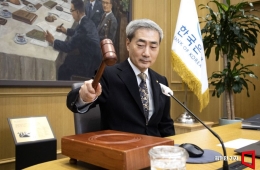
Lee Choongjae, President of the Korea Institute of Construction Industry, is delivering the opening remarks at the "2026 Second Half Construction and Real Estate Market Outlook Seminar" held at the Construction Hall in Gangnam-gu, Seoul on the 18th. Korea Institute of Construction Industry
View original imageFor the entire year, the institute expects nationwide housing sales prices to rise by 2.5%, with the greater Seoul area (Seoul metropolitan area) increasing by 4.5% and regional areas outside the capital region rising by 0.5%.
The annual growth rate for nationwide jeonse prices is projected to reach 5.0%. From January to May of this year, sales prices rose by 1.0% nationwide, while jeonse prices increased by 1.4%. This indicates that pressure on the rental market will become greater in the second half of the year.
Research fellow Kim Seonghwan pointed out that the decrease in new housing supply and the loss of existing homes due to redevelopment projects are expected to further drive up jeonse prices. Kim explained, "When houses are demolished as a result of reconstruction and redevelopment, the existing housing stock disappears, which can immediately affect the current jeonse market. As the number of demolished homes rises and new supply diminishes, this will continue to impact the market, causing jeonse prices to increase more than sales prices for the time being." He also cited that end users who find it difficult to purchase homes due to lending regulations are remaining in the jeonse market, further intensifying pressure on the rental market.
Kim further predicted that the rise in jeonse prices will eventually impact housing sales prices as well. "Since October 2022, jeonse prices have tended to move first, followed by sales prices with a time lag," he said, "and the current increase in jeonse prices could exert upward pressure on sales prices going forward."

Housing Sale and Jeonse Price Outlook by Region for the Second Half of This Year. Korea Construction Industry Research Institute
View original imageIn reality, the housing supply chain is blocked in many areas. The institute diagnosed that nationwide new move-in supply will decrease from 312,000 units last year to 199,000 units this year. In 2027, supply is still expected to be only 216,000 units, making it difficult to recover to last year's level. From January to April of this year, housing completions declined by 45.9% compared to the same period last year. There is also a growing backlog of projects that have received permits but have yet to begin construction. The institute estimated that about 300,000 homes in the greater Seoul area have obtained permits but have not started construction. This is the result of several factors occurring simultaneously: construction cost and interest rate burdens, difficulties in securing project finance (PF), and concerns about unsold units.
The construction market showed a significant gap between the increase in new contracts and the activity felt on the ground. Construction orders from January to April this year totaled 70.8 trillion won, up 32.4% from the same period last year, but actual construction performance during the same period was 44.2 trillion won, down 3.3%. This means that while orders increased, they did not translate into actual construction work. The recovery in orders was also concentrated in the greater Seoul area and large-scale projects. Last year, construction orders in the Seoul metropolitan area reached 128.4 trillion won, up 12.4% from the previous year, while regional orders fell by 5.1% to 77 trillion won. From January to April this year, order growth in the Seoul metropolitan area was 49.6%, compared to just 8.6% in regional areas.
Hot Picks Today
 Despite "Insufficient Balance" Notices, They Board Anyway... Reports of Foreign Fare Evasion Mounting
- “Can’t Pay the Tax”: Billionaire CEO Who Considered Leaving California Pledges to Stay for 8 Years
- "I Killed My Mother": Daughter in Her 40s Reports Herself to Police; Police Make Emergency Arrest
- The 'Oppa' Boss Is Gone, the 'Senior' Boss Is Here: Starting Up to Make Ends Meet... New Businesses Down 1.5%
- [Exclusive] "We Came for a KRW 140,000 Trip": Following Chinese Tourists in Korea Uncovers a 'Suspicious' Tour
The institute projected that construction orders for this year will reach 240.8 trillion won, an 8.9% increase from last year, but that recovery will be limited for small and medium-sized firms in regional areas and for private non-residential projects. Kim Kiyong, Director of Construction Policy at the Ministry of Land, Infrastructure and Transport, who participated as a panelist, stated, "Unless we resolve the supply pipeline from order intake to construction start and completion, it will be difficult to restore both the construction market and housing price stability. We will work to address bottlenecks in project starts and the polarization of order volumes through policy improvements."
© The Asia Business Daily. All rights reserved. Unauthorized AI training and use prohibited.