KOSPI Surpasses 9,000 for the First Time Ever... A New Milestone for Korea's Capital Market (Comprehensive)
Only 22 Trading Days After Breaking 8,000
Massive Influx of Investment into Semiconductor Stocks
On June 18, the KOSPI surpassed the 9,000-point mark for the first time in history. This milestone was reached just 34 days, or 22 trading days, after the index broke through 8,000 points on May 15.

Jeunboh Lee, Chairman of the Korea Exchange, along with executives, is holding a ceremony on the 18th at the PR center of the Korea Exchange headquarters in Nam-gu, Busan, to celebrate the KOSPI surpassing 9000 points. Photo by Yonhap News
View original imageThe KOSPI closed at 9,063.84, up 199.60 points (2.25%) from the previous session. Individual investors and institutions recorded net sales of 375.3 billion won and 777.9 billion won, respectively. Foreign investors made net purchases totaling 1.271 trillion won. By sector, electrical and electronics (4.63%), insurance (3.37%), and manufacturing (2.28%) advanced, while metals (-5.07%) and construction (-4.99%) declined. Among the top market capitalization stocks, Samsung Electronics (4.62%), SK hynix (6.51%), SK Square (6.52%), Samsung Electro-Mechanics (0.88%), and Samsung Electro-Mechanics (8.27%) all rose.
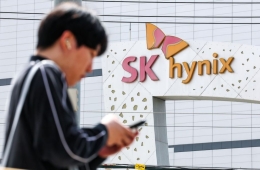
There was a strong influx of buying into semiconductor stocks. This was triggered by SK hynix announcing on this day that it had supplied samples of its next-generation artificial intelligence (AI) memory product, the seventh-generation high-bandwidth memory (HBM4E), to major clients. Jaewon Lee, a researcher at Shinhan Securities, commented, "The KOSPI reached a new all-time high, driven by a rally in semiconductor stocks, as the market digested the hawkish FOMC meeting."
The KOSPI crossed 4,000 points on October 27 last year, 5,000 on January 22 this year, 6,000 on February 25, and then 7,000 and 8,000 on May 6 and May 15, respectively. The time taken to climb each additional 1,000 points was 87 days from 4,000 to 5,000, 34 days to 6,000, 70 days to 7,000, and just 9 days to 8,000.
Securities firms believe that the KOSPI could surpass the 10,000-point threshold. Eugene Investment & Securities forecasts the KOSPI could reach up to 10,400, Hana Securities expects up to 10,380, and KB Securities sees the index climbing as high as 10,500. Global investment banks JP Morgan and Morgan Stanley each projected in their bullish scenarios that the KOSPI could hit 10,000 points.
In contrast, the KOSDAQ market fell, showing a marked divergence from the KOSPI. The KOSDAQ closed at 1,000.93, down 31.03 points (3.01%). Individual investors recorded net purchases of 392.4 billion won, while foreign investors and institutions posted net sales of 125.3 billion won and 264.6 billion won, respectively.
By sector, pharmaceuticals (-5.04%), publishing and media replication (-4.91%), transportation equipment and parts (-4.60%), finance (4.01%), and metals (4.00%) all declined.
Hot Picks Today
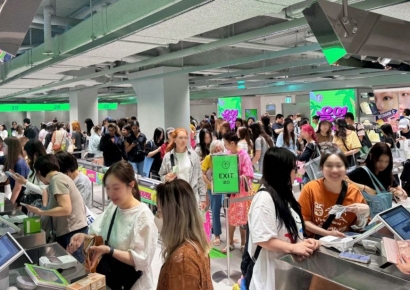 "She Comes Every Three Months to Stock Up"... Surge of Foreign Visitors Entering Korea for Olive Young Sale
- [Breaking] The Top Spot Has Changed... SK hynix Overtakes Samsung Electronics to Claim KOSPI Throne
- [Exclusive] 3 Billion Won 2045 Future Strategy Report Heads Straight to the Cabinet After Administration Change
- "Forced to Pay 500,000 Won for Team Lunches in a Week"... Company Culture Drives New Employee to Quit, Sparks Outcry
- Foods That Make Your Face Look Worse, According to a Plastic Surgeon... What Ranked Above Ham and Ramen?
Among the top market capitalization stocks, Alteogen (-0.94%), Ecopro BM (-4.28%), Ecopro (-4.32%), Rainbow Robotics (-1.60%), and Jusung Engineering (-3.41%) all posted losses.
© The Asia Business Daily(www.asiae.co.kr). All rights reserved.