"Is It Still a Good Time to Buy Samsung Electronics and SK hynix?"... Market Expert Says "Leadership Concentration Seen 30 Years Ago Too" [Weekend Money]
Leader Stock Concentration Intensifies in the Latter Stage of Bubble Rallies
Samsung Electronics and SK hynix Dominance Expected to Continue for Now
!["Is It Still a Good Time to Buy Samsung Electronics and SK hynix?"... Market Expert Says "Leadership Concentration Seen 30 Years Ago Too" [Weekend Money]](http://www.asiae.co.kr/news/img_view.htm?img=2026021011000136069_1770688800.png)
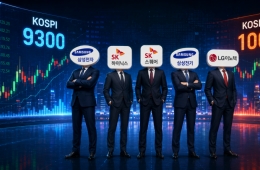
There are expectations that the concentration on Samsung Electronics and SK hynix, which has been a key driver of the Korean stock market's rise, will continue for the time being.
On June 20, Eun-Taek Lee, a researcher at KB Securities, stated in the report “Leadership Concentration as Told by History” that “historically, the phenomenon of market leadership concentration has repeatedly appeared in the late stage of bubble rallies,” and predicted, “This trend is likely to intensify going forward.”
Lee explained, “The current artificial intelligence (AI)-driven market shows a very similar pattern to the late stage of the dot-com bubble 30 years ago. From 1995 to 1998, the U.S. stock market was led by three major sectors—healthcare, finance, and IT—but in 1999, the late stage of the bubble rally, there was an extreme concentration with only ‘dot-com related stocks’ surging.”
At that time, even though the finance and healthcare sectors posted solid results, they were completely ignored by the market simply because they were not considered dot-com companies.
“This investment behavior is being reproduced exactly in the current market,” Lee noted. Although the finance and healthcare sectors, which were strong last year due to the revision of the Commercial Act and new drug development momentum, are expected to show solid earnings growth again this year, they have been left out of the recent AI rally and have experienced sluggish stock performance.
In contrast, there have been repeated instances where even just rumors of a company pursuing AI or robotics-related business have sent its stock price soaring, regardless of its actual results. Lee pointed out, “It is almost identical to what happened 30 years ago during the dot-com bubble, when Saerom Technology’s stock surged more than 100 times on expectations for free internet phone services.”
He advised investors to be cautious “when the much-anticipated ‘broadening of the rally (where various sectors rise together)’ occurs.” As seen in March 2000, just before the collapse of the dot-com bubble, the phenomenon of liquidity spreading to other stocks was not a “healthy rotation,” but rather a warning sign that the upward rally was nearing its end.
Hot Picks Today
![Samsung Electronics' "Special Dividend" Effect: Target Price for Samsung C&T Raised to 630,000 Won... Upward Revisions Continue [Weekend Money]](https://cwcontent.asiae.co.kr/asiaresize/93/2024072515415464772_1721889714.jpg) Samsung Electronics' "Special Dividend" Effect: Target Price for Samsung C&T Raised to 630,000 Won... Upward Revisions Continue [Weekend Money]
Samsung Electronics' "Special Dividend" Effect: Target Price for Samsung C&T Raised to 630,000 Won... Upward Revisions Continue [Weekend Money]
- "Am I Eligible Too?" Up to 700,000 Won Provided... Who Qualifies for Government Support for Heating and Cooling Costs? [The Essentials of Benefits]
- "Spread Rapidly": 160 Infected in 3 Weeks Sparks Alarm... U.S. Military Issues Influenza Alert
- "I Lost 700 Million Won Saved Over a Lifetime in Just One Year Through Stocks": YouTuber’s Confession
- Daejeon Cafe's "Myeolgong Latte" Faces Backlash Over Incorrect Taegeukgi in Promotion
He further suggested, “Currently, AI-related stocks have even stronger conditions for concentration because their results are backed by actual earnings, unlike during the dot-com bubble period. Since leadership concentration typically appears repeatedly in the late stages of a bubble rally, now is the time to take advantage of this trend, rather than fear it.”
© The Asia Business Daily(www.asiae.co.kr). All rights reserved.