Driven by SK hynix and Samsung Electronics Bonuses, Dongtan Apartment Prices Soar... Buying Inquiries Plummet Due to Surging Prices
Korea Real Estate Board Releases Weekly Apartment Price Trends for Third Week of June

On the morning of the 18th, in front of the licensed real estate office at Hwaseong Dongtan Station Hanwha Dream Green Prestige Apartment, Gyeonggi-do. Photo by Seongah Shim
View original imageApartment prices in Dongtan District, Hwaseong, Gyeonggi Province have surged by more than 2% in just one week, signaling clear signs of a hot market. The recent sharp upward trend has pushed the cumulative price increase to nearly 10% this year, even before half the year has passed. As speculation grows over the potential designation of new regulated real estate zones, a rush of buyers is driving up home prices even further.
According to the weekly apartment price trend data for the third week of June (as of June 15), released by the Korea Real Estate Board on June 18, apartment prices in Dongtan District rose by 2.22% compared to the previous week. Since the last week of April, when the growth rate was 0.20%, the weekly increase has steadily expanded: 0.25%, 0.35%, 0.46%, 0.49%, 0.60%, and then 1.98%.
It is highly unusual for home prices in a particular area to rise by more than 2% in just one week. The Korea Real Estate Board has been tracking weekly apartment prices since May 2012, and such steep increases in the greater Seoul area have only occurred a handful of times. For instance, in mid-November 2020, apartment prices in Gimpo rose by 2.73% in a single week. In February of that year, Suwon's Gwonseon and Paldal districts also recorded weekly increases above 2%. Nationwide, in late July 2020, apartment prices in Sejong jumped 2.95% in one week.

Industry experts believe the spike in Dongtan apartment prices is largely due to the area not being designated as a regulated zone, making transactions relatively easy, as well as the impact of recent performance bonus announcements, which have fueled buyer sentiment. However, local real estate agents report that the recent sharp rise in prices has actually led to a decline in purchase inquiries.
Agent A, a licensed realtor in Cheonggye-dong near Dongtan Station, said, "Until early this month, we had many visitors and phone calls, but now that apartment prices have soared, foot traffic has stopped," adding, "I think this situation will continue for a while." The head of another nearby real estate office, Agent B, said, "In recent weeks, it feels like nearby apartment prices have risen by 300 million to 400 million won," and "Because prices have climbed so much, inquiries from buyers have dropped sharply."
Yoon Giwon, head of Dongtan Station Yoon Captain Realty, explained, "After the performance bonus announcements from SK hynix and Samsung Electronics, transactions and prices shot up for about two weeks, but things have quieted down over the past ten days." He added, "There is typically a two to three-week lag between the price indices released by the Korea Real Estate Board and actual transaction data, because a real sale is only reported after the contract is signed and the financing plan is submitted."

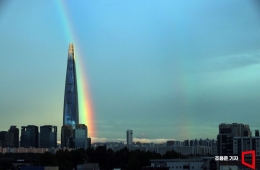
Apartments viewed from Lotte World Tower in Songpa-gu, Seoul. Photo by Yonhap News Agency
View original imageThe industry sees Dongtan, as well as areas like Guri and Giheung District in Yongin, as likely candidates for new regulatory zone designations due to the recent sharp rise in home prices. If the three-month housing price growth rate exceeds the inflation rate by 1.3 to 1.5 times, the area meets the criteria for designation as an adjustment target zone or a speculative overheating district. From March to May of this year, the consumer price inflation rate for Gyeonggi Province was 1.38%, so if home prices rose more than 1.79% to 2.06%, the criteria would be met. During this period, Dongtan home prices rose by 3.85%, Guri by 3.53%, and Giheung by 2.57%.
If an area is designated as a regulated zone, the loan-to-value ratio (LTV) for mortgage loans is tightened from the previous 70% to 40% for those without a home (including those who own one home under the condition of selling it), while those who already own homes are banned from obtaining loans altogether. The scale of mortgage loans from financial institutions is reduced to between 200 million and 600 million won, and tax policies such as capital gains tax and acquisition tax are also strengthened. Redevelopment project sites also face additional rules, such as restrictions on the transfer of membership rights. The authority to make such designations lies with the Governor of Gyeonggi Province.
Apartment prices continue to rise in Seoul as well. This week, Seoul's increase rate was 0.27%, the same as the previous week. By district, Seongbuk-gu saw the highest rise at 0.40%, followed by Guro-gu (0.39%), Dobong-gu (0.38%), and Eunpyeong-gu (0.37%), with relatively high increases in outlying areas. Gangnam-gu also rose by 0.31%, driven by reconstruction projects in Apgujeong and Yeoksam-dong, while Songpa-gu saw a 0.28% increase. In the Gyeonggi region, Bundang in Seongnam (0.49%), Suji in Yongin (0.44%), and Gwangmyeong (0.46%) posted the largest gains.

After last year's severe regulations, which designated all of Seoul and neighboring areas as regulated zones, the upward trend in home prices had somewhat subsided, but recently the market has once again been rising in some areas. Experts attribute this to a combination of persistent supply concerns, buyers entering the market due to rental shortages, a rush to purchase real estate following the sharp rise in the KOSPI and profit-taking, and heightened expectations for performance bonuses at Samsung and SK. Over the past year since President Lee Jaemyung took office, nationwide housing prices have risen by 2.08%, but Seoul saw a 7.80% increase, deepening the polarization of home prices. In particular, despite facing 'triple regulation', Gangnam apartment prices rose 9.52% in just one year.
Hot Picks Today
 “It Wasn’t Vietnam”... Average Travel Cost 1.33 Million Won, Japan Tops Chuseok Holiday Destinations
- Police Officer Urgently Arrested for Falsely Closing Jang Miran’s Missing Person Case... "Another Case Also Falsely Handled"
- Expected to Follow Japan, but Shares Plunge Despite Biggest Boom in 20 Years: Is This a Buying Opportunity for Department Store Stocks? [Weekend Money]
- "All Korean Women Use This": Olive Young Reaches Every Corner of America... K-Beauty Curation [Report]
- Venerable Myungjin, Former Head Monk of Bongeunsa Temple, Passes Away in Freediving Accident off Jeju Coast
Jeonse (long-term rental deposit) prices for apartments have also climbed significantly, especially in Dongtan and certain parts of Seoul. Dongtan apartment jeonse prices rose by 0.87% from the previous week, with Gwangmyeong up 0.49% and Sujeong District in Seongnam up 0.41%. Seongdong-gu saw a week-on-week increase of 0.53%, while Songpa-gu (0.59%), Seongbuk-gu (0.43%), and Nowon-gu (0.42%) also posted notable gains.
© The Asia Business Daily. All rights reserved. Unauthorized AI training and use prohibited.