[Interview] "Expanding into the Asian Market with Offshore Wind TPs," Says Cheongmoo Yoo, CEO of Samil CNS
After Supplying Nakwol Offshore Wind Project, Exports Transition Pieces to Japan
Actively Expanding into Asian Markets Such as Vietnam, the Philippines, and Australia
Expanding Plant Capacity; Considering Equity Investment in Gunsan Port Terminal

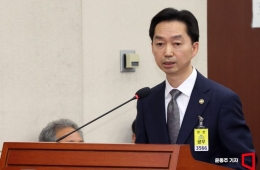
Yucheongmu, Head of Wind Power Steel Division at Samil CNS, is being interviewed by The Asia Business Daily.
View original image"Following Japan, we plan to expand the export of transition pieces (TP) to Asian markets where the offshore wind power industry is opening up, such as Vietnam, the Philippines, and Australia."
At the 'Offshore Wind Supply Chain Conference & Exhibition 2026' held in Yeosu on June 16, Cheongmoo Yoo, Head of the Wind Steel Business Division at Samil CNS, shared his ambition to expand into the Asian market based on the company's performance in Korea and Japan.
A transition piece is a foundational structure that connects the substructure, such as jackets and monopiles, with the tower in offshore wind turbines. Traditionally, companies manufacturing substructures supplied transition pieces through outsourcing, but as the scale of offshore wind projects has grown, transition pieces have become established as an independent product category. Offshore wind developers are increasingly placing separate orders for transition pieces, distinct from jackets and monopiles.
Transition pieces serve not only as structural components but also as platforms for maintenance. They house various electrical facilities, and cables that connect the electricity generated by the turbines to the offshore substations also pass through them. From a distance, they may appear as large cylinders, but they are complex structures composed of between 3,000 and 5,000 individual parts.
Samil CNS began as Daelim Concrete Industries in 1962 and changed to its current name after joining the Samil Group in 2020. Leveraging its strengths in the concrete pile and steel sectors, Samil CNS entered the offshore wind business. Yoo explained, "While considering new business opportunities, we noticed that multiple offshore wind projects were underway in regions near our Gunsan plant, which led us to enter the offshore wind market."
This strategy proved successful. As its first achievement, Samil CNS signed a contract in November 2023 to supply 64 transition pieces (worth 124 billion won) for the Nakwol Offshore Wind Project off the coast of Yeonggwang, Jeonnam. As of June, the Nakwol Offshore Wind Project has achieved a 83.5% progress rate and is scheduled for completion within the year.
The company has also been actively pursuing overseas markets based on its domestic track record. In December last year, Samil CNS signed a contract to supply 21 transition pieces (worth 76 billion won) for the Oga and Akita Katagami offshore wind projects in Japan. This was a significant achievement, won after fierce competition with major companies from Korea, China, and Japan. Samil CNS is currently working to supply transition pieces to yet another offshore wind farm in Japan.
Samil CNS’s series of successful orders is also having a trickle-down effect on its partner companies. Yoo noted, "About 30 to 40 percent of our sales flow back to our partner companies."
Following transition pieces, the company is also targeting the offshore wind tower market. Although Korean companies like CS Wind and Dongkuk S&C are already active in this sector, Samil CNS believes there is sufficient business potential as the offshore wind market continues to grow. Yoo explained, "We have firmly established ourselves as a specialized company for transition pieces, and depending on future market conditions, we are considering entering the tower market as well."
To enter the offshore wind business, Samil CNS has invested 25 billion won so far and is expanding its facilities as orders increase. The company plans to continue increasing its investment in the future. Yoo stated, "We are expanding our plant so that we can produce 70 transition pieces annually," adding, "If Gunsan Port is designated as a rear port for offshore wind, we also plan to secure a terminal through equity investment."
Yoo emphasized that Korea, with its strong manufacturing sector, can demonstrate sufficient global competitiveness in the offshore wind market, and stressed the need for active government support so that companies can achieve economies of scale.
Hot Picks Today
 "300,000 Won Grant" Shelved at Chuseok to Go to All Residents After All... This City Says It Will Pay Before Lunar New Year
- "Didn't Save This Money to Leave to Our Kids?"... Retired Couples Spend $10,000 on a Single Trip
- Friend Who Went Abroad Goes "Silent"... 617 South Koreans Out of Contact, What's Going On?
- Anthropic Files for Nasdaq IPO ... Could It Be the Largest Ever?
- "Stockpile 9 Liters of Bottled Water and Three Days' Worth of Food"... UK on Edge as Nationwide Emergency Preparedness Alert Issued
Yoo added, "Offshore wind equipment has a significant supply chain impact. When expanding production facilities for export, active government support, such as policy financing, is essential."
© The Asia Business Daily. All rights reserved. Unauthorized AI training and use prohibited.