Expansion of 4.5-Day Workweek Among SMEs: "95% of Participating Companies Reduced Weekly Hours by 2 or More"
The government announced that the “Work-Life Balance+4.5 Project,” a support initiative for small and medium-sized enterprises (SMEs) participating in labor hour reduction measures such as the 4.5-day workweek, is achieving tangible results on the ground. The government plans to expand participation among companies.
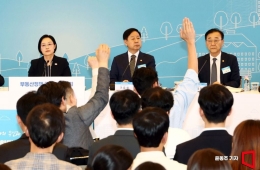
On June 18, the Ministry of Employment and Labor held an on-site roundtable at Ubion, an edtech company in Guro-gu, Seoul, together with labor and management, experts, and corporate representatives. The event was organized to share the outcomes of the Work-Life Balance+4.5 Project and to discuss strategies for the wider adoption of reduced working hours.
The Work-Life Balance+4.5 Project is a program that supports SMEs that, through labor-management agreements, introduce systems such as the 4.5-day workweek to reduce actual working hours without reducing wages. The program provides a subsidy of up to 600,000 won per month for each worker whose working hours are reduced, and up to 800,000 won per month per new hire.

Kwon Changjoon, Acting Minister of Employment and Labor, is attending and speaking at the first intergovernmental meeting on the establishment of comprehensive labor safety measures held on July 9, 2025, at the Government Seoul Office in Jongno-gu, Seoul. Photo by Jo Yongjun
View original imageAccording to the Ministry of Employment and Labor, 191 companies, or 86.8% of this year’s target of 220 participants, took part in the project during the first half of the year. Of these, 66% were workplaces with fewer than 50 employees, and companies located outside the Seoul metropolitan area accounted for 58%, a higher proportion than those in the metropolitan area. By industry, manufacturing made up the largest share at 41%, followed by services at 26%, wholesale and retail at 15%, and healthcare at 7%.
Among all participating companies, 182 (95.3%) reduced weekly working hours by at least two hours, and 44 companies cut hours by at least four hours per week. The most common method of reducing working hours was the granting of paid leave, implemented by 127 companies (66.5%), while 58 companies (30.4%) reduced prescribed working hours.
During the case presentations, Jaedam Media reported that after introducing a 35-hour workweek in March, employees experienced improved work-life balance and greater work efficiency. IonM Solution, based in Busan, explained that after implementing a four-hour paid leave every other Friday, employee turnover decreased while business performance was maintained. Ubion highlighted that it minimizes work disruptions by operating a two-hour early leave system every Friday, utilizing artificial intelligence (AI), and redesigning work roles.
Hot Picks Today
 Is the Stock Market Decline Just Beginning? "An Even Bigger Crisis Is Coming," Warns Rich Dad Author
- [Exclusive] SK hynix to Build Headquarters in Central Seoul... Plans New Office on Former Le Meridien Gangnam Site
- "With My Young Daughter Present": Active Police Officer Goes Shirtless and Verbally Abuses Parent... Police "Fact-Finding Underway"
- It Was a Sensation in Korea Too..."Can't Live Without It" - Japanese Elementary Students Also Obsessed With This
- "Prettier Than Idols?" "Tight Outfits Stir Debate"... Why the Virtual Female Weathercaster Is Causing a Stir
Vice Minister of Employment and Labor Kwon Changjoon stated, “The reduction of actual working hours, such as the introduction of the 4.5-day workweek, is a critical task for improving workers’ quality of life, achieving work-life balance, and ensuring the sustainable growth of businesses.” He added, “We will actively support the expansion of the Work-Life Balance+4.5 Project and other initiatives to address the gap in working hours between the metropolitan area and other regions, as well as between large corporations and SMEs.” He continued, “Together with the Productivity Enhancement Support Team, we will support technological innovation and changes in work processes so that reduced working hours translate into positive business outcomes.”
© The Asia Business Daily. All rights reserved. Unauthorized AI training and use prohibited.