How High Can '2.6 Million-nix' Go... KOSPI Breaks All-Time Record
SK hynix Hits Record High, Lifting KOSPI
Driven by U.S. ADR Listing and Shareholder Return Expectations
U.S. Policy Tightening Concerns... Koo Yooncheol: "Reviewing Support Measures for Vulnerable Borrowers"

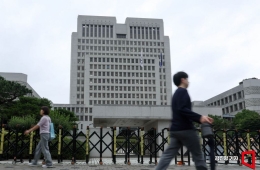
On the 18th, when the KOSPI index surpassed its all-time intraday high, the electronic display board in the dealing room at the Hana Bank headquarters in Jung-gu, Seoul showed the current status of the domestic stock market. 2026.6.18 Photo by Kang Jinhyung
View original imageThe KOSPI index set a new intraday record, continuing its upward trend amid expectations for strong memory semiconductor performance and shareholder returns. SK hynix drove the index higher by surpassing 2.6 million won for the first time in its history. However, with the possibility of a U.S. benchmark interest rate hike increasing, the government announced it would actively monitor potential risks going forward.
SK hynix Surges to Record High, Lifting KOSPI
On June 18, the KOSPI opened at 8,884.92, up 0.23% from the previous trading day, and hit a new all-time intraday high of 8,975.52 in early trading. The previous intraday all-time high was 8,933.62, set on June 2. After narrowing its gains, the index was trading up 0.47% at 8,906.10 as of 10:06 a.m.
The KOSDAQ started the session down 0.21% at 1,029.81, and extended its losses to trade at 1,006.89, down 2.43%, as of 10:07 a.m. The won-dollar exchange rate opened at 1,525.0 won, up 11.6 won from the previous session, and remained at a similar level.
Despite a decline in the U.S. stock market overnight after the Federal Reserve kept its benchmark rate unchanged while signaling a possible rate hike later this year, the KOSPI extended its winning streak to a sixth session.
SK hynix was the main driver of the KOSPI’s gains on this day. As of 10:08 a.m., SK hynix was up 3.13% at 2.6 million won, marking a record high. Analysts attribute the continued rise in the stock price to expectations for the listing of its American Depositary Receipts (ADR) as early as next month, as well as anticipation of large-scale shareholder returns in the second half of the year.
Samsung Electronics was also trading up 0.87% at 349,500 won. Among large-cap stocks, Samsung Electro-Mechanics (up 7.58%), SK Square (up 3.70%), and Samsung Life Insurance (up 2.80%) were showing strength. Individual investors net bought more than 900 billion won, helping to push the KOSPI higher. Foreign and institutional investors were net sellers.
U.S. Policy Tightening Concerns... Koo Yooncheol: "Reviewing Support Measures for Vulnerable Borrowers"
With major economies, including the United States, shifting toward tighter monetary policy, the government announced plans to ease the burden on vulnerable sectors from rising domestic interest rates and to prepare support measures for at-risk borrowers.
Koo Yooncheol, Deputy Prime Minister of Economy and Minister of Economy and Finance, said at an expanded macroeconomic and financial meeting on the morning of June 18, "As financial market conditions change and the interconnection between sectors increases, we will fully activate an integrated risk monitoring system that covers not only the stock, bond, and foreign exchange markets but also the real estate market. We will systematically monitor and respond to risks and their spillover effects by sector."
The meeting was attended by Bank of Korea Governor Shin Hyunsong, Financial Services Commission Chairman Lee Eogwon, and Financial Supervisory Service Governor Lee Chanjin. Discussions covered the Federal Open Market Committee (FOMC) decision to hold rates steady, as well as financial and foreign exchange market trends and response strategies in light of the Middle East war.
The U.S. FOMC, which met overnight, kept its benchmark interest rate unchanged at 3.50-3.75%, as expected. This marked the fourth consecutive hold since December last year. However, the Fed reversed its policy path for this year, shifting from a forecast of rate cuts to rate hikes in response to inflation. While the global financial markets saw the Fed's rate decision as in line with expectations, they also noted changes in Fed projections, including lower growth forecasts and higher inflation expectations. As a result, U.S. Treasury yields surged, especially for 1-2 year maturities, and the dollar strengthened.
Hot Picks Today
 Despite "Insufficient Balance" Notices, They Board Anyway... Reports of Foreign Fare Evasion Mounting
- "If It Helps My Child's Studies, It's Worth Every Penny"... U.S. Parents Open Their Wallets for $10,000 Tests
- [Exclusive] "We Came for a KRW 140,000 Trip": Following Chinese Tourists in Korea Uncovers a 'Suspicious' Tour
- "I'm paying to stay, and you want me to do the laundry and dishes too?" ... Airbnb bans excessive cleaning demands
- "Baek Jongwon Had Been Quiet, Then Hit It Big"... Waits in the 100s in U.S. Despite KRW 46,000 Pork Belly
Participants agreed that the emphasis on price stability by new Fed Chair Kevin Warsh at his first meeting signaled that U.S. monetary policy could become even more restrictive going forward. They also noted that major central banks, including the Bank of Japan and the European Central Bank, raised their benchmark rates ahead of the FOMC, prompting the need for close analysis of the macroeconomic and financial market impacts of these global rate hikes.
© The Asia Business Daily. All rights reserved. Unauthorized AI training and use prohibited.