President Lee Asks Trump to Play a Role in Korean Peninsula Peace... Wraps Up G7 Summit Diplomacy
Two-Hour Conversation at Official Dinner: Trump Says "I Will Play a Necessary Role"
Discussions on Middle East, Hormuz, and Shipbuilding Cooperation
Energy Supply Chain Initiative Proposed at G7 Summit
President Lee Jae-myung used the occasion of the Group of Seven (G7) summit in Evian, France, to discuss a broad range of issues—including peace on the Korean Peninsula, the situation in the Middle East, and matters concerning the South Korea-U.S. alliance—with U.S. President Donald Trump. Although it was not an official bilateral meeting, the two leaders built mutual trust by sitting together for about two hours and conversing during a dinner hosted by French President Emmanuel Macron and the First Lady.

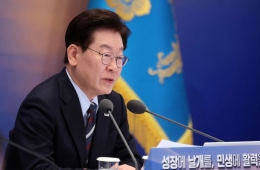
President Lee Jae-myung is attending the second session of the expanded Group of Seven (G7) and invited countries summit held in Evian-les-Bains, France, on June 17, 2026. Photo by Yonhap News
View original imageOh Hyunjoo, the third deputy director of the National Security Office, stated during a briefing on June 17 (local time) that “During the official dinner hosted by President Macron and the First Lady on June 16, President Lee exchanged close opinions with President Trump on issues including the South Korea-U.S. alliance, the situation in the Middle East, the Korean Peninsula, as well as regional and global challenges.”
President Lee first welcomed the agreement reached in the U.S.-Iran end-of-war negotiations and congratulated President Trump on the timing of the agreement coinciding with Trump’s birthday. He went on to praise President Trump’s efforts to secure lasting peace in the Middle East and resolve the Iranian nuclear issue. Both leaders agreed on the importance of free and safe navigation through the Strait of Hormuz, and shared the expectation that stability in the Middle East could lead to stable oil prices and global economic recovery.
President Lee raised the issue of the Korean Peninsula, stating, “Following the progress in the Middle East, I hope for your attention and engagement so that sustainable peace can also be established on the Korean Peninsula.” In response, President Trump expressed interest in the geopolitical history of the peninsula and the current state of inter-Korean relations, affirming his strong commitment to playing the necessary role in advancing the Korean Peninsula issue, according to Deputy Director Oh. President Trump also indicated that he would work closely with President Lee to explore ways to contribute to peace on the peninsula.
The two leaders also discussed mutually beneficial cooperation, including in the shipbuilding sector. When asked whether cooperation in shipbuilding was specifically linked to discussions on building nuclear submarines, a key Blue House official clarified, “Specific cooperation measures were not discussed in detail.” However, the official added, “There is deep trust and a basic consensus between the two leaders regarding the implementation of agreed investments between South Korea and the United States, including in the shipbuilding field.”
The importance of trilateral cooperation among South Korea, the United States, and Japan also came up during the talks. Deputy Director Oh noted, “Both leaders agreed on the importance of South Korea-U.S.-Japan cooperation based on the strong South Korea-U.S. alliance,” and added, “President Trump described President Lee as a ‘strong leader’ and expressed the expectation that the two leaders could work together to contribute to peace and security on the Korean Peninsula and in the region.”
In addition to the official G7 dinner, the two leaders interacted on several other occasions during the summit. According to the Blue House, they had informal conversations after the commemorative photo session at the welcome event for invited countries, during transfers between meeting venues, and after the conclusion of a concert.
During this G7 summit, President Lee also held separate bilateral meetings with the leaders of Germany, Canada, and Kenya. The Blue House described this summit as an opportunity to solidify South Korea’s status as a globally responsible nation aiming for a “G7 Plus.” South Korea participated as an invited country at the G7 summit for the second consecutive year, following last year’s invitation.
The main agenda items at this year’s summit included building new partnerships, achieving balanced and inclusive economic growth, and the safe, rapid, and efficient adoption of artificial intelligence (AI). In the development cooperation session, President Lee emphasized the need for recipient and donor countries to move beyond a one-sided aid relationship and establish mutually beneficial partnerships. During the economic growth session, he stressed that global imbalances should not be approached as a matter of assigning blame, but rather resolved through solidarity and dialogue.
In particular, President Lee pointed out that the recent Middle East situation could lead to disruptions in oil supply and increase inflationary pressures, and he proposed building a cooperative system among energy-importing countries in the Asia-Pacific region. His vision extends beyond responses at the individual country level, suggesting joint efforts for information sharing, early warning, emergency cooperation, and stabilization of oil and petroleum product supply chains. The government plans to utilize the existing energy security system centered on the International Energy Agency (IEA) and support the IEA’s Singapore Regional Cooperation Center to serve as a hub for energy security cooperation in Asia.
At the working luncheon, discussions focused on growth, resilience, cybersecurity, protection of minors, and safeguarding democracy during the adoption of AI. Not only leaders of G7 member and invited countries but also CEOs of major AI and digital companies attended to discuss ways to enhance cooperation between the public and private sectors.

President Lee Jae-myung is seen conversing with participants during the second session of the expanded G7 and guest countries summit held in Evian-les-Bains, France, on June 17, 2026. Photo by Yonhap News.
View original imageThe Blue House announced that a total of eight outcome documents are expected to be adopted at this summit. Three documents—on development, Ebola, and cancer eradication—were adopted the previous day, with the remainder to be finalized after the summit concludes. Deputy Director Oh stated, “South Korea plans to participate in most of the G7 summit’s outcome documents,” and added, “We will continue to strengthen policy cooperation with the G7 in a wide range of areas, including development, health, and digital policy.”
Hot Picks Today
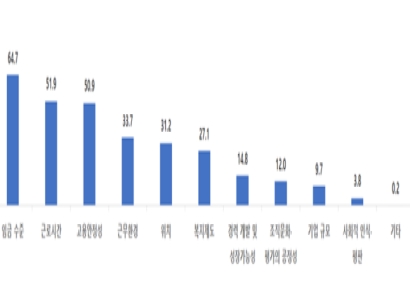 "Please Pay Me at Least 3 Million Won a Month": More Than Half of Young People Today Prioritize "Working Conditions" Over Company Size
- Selling Like Crazy Every Year... 30-Year-Old Hetbahn Takes on a New Challenge: Tastes Better Than "Mom's Home Cooking" [On-Site Report]
- "Americans Would Be Amazed If They Came": Wide-Eyed at a Sight They've Never Seen Before... Foreigners Also Fall for K-Baseball [K-Holic]
- "Hey, Lady, Teach Your Kids to Behave!" ... 300,000 Won in Cash and a Bodily Injury Claim Demanded Over Child's Door Ding
- Beachgoer Finds 'Plastic' That Turns Out to Be Perfume Ingredient Worth More Than Twice as Much as Gold
With the conclusion of the G7 agenda, President Lee wraps up his first multilateral diplomatic tour in Europe in his second year in office. The Blue House laid out plans to expand South Korea’s multilateral diplomatic role by linking last year’s APEC chairmanship, two consecutive years of G7 participation, and the upcoming G20 presidency in 2028. A senior Blue House official commented, “G7 Plus is less a fixed goal at a specific moment and more a process of strengthening Korea’s global diplomatic capabilities,” adding, “Attending the G7 summit again this year, following last year, is itself the result of these efforts.”
© The Asia Business Daily. All rights reserved. Unauthorized AI training and use prohibited.