President Lee to Discuss Energy and Critical Mineral Supply Chain Resilience at Second G7 Expanded Session
Theme: "Restoring Balanced, Inclusive, and Sustainable Economic Growth for All"
Discussing Cooperation Measures to Alleviate Global Economic Imbalances
Plans to Express Commitment to Active International Cooperation
President Lee Jae-myung attended the second session of the expanded summit of the Group of Seven (G7) leaders held in Evian, France, on the 17th (local time), where he discussed ways to strengthen international cooperation to alleviate global economic imbalances and restore sustainable growth.

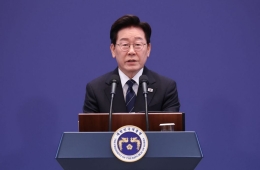
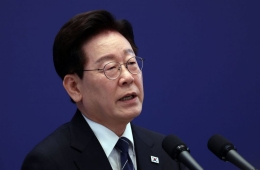
President Lee Jae-myung is speaking at the expanded summit of the Group of Seven (G7) leaders held in Evian-les-Bains, France, on the 16th (local time). June 17, 2026 Yonhap News Agency
View original imageThe theme of this session is "Restoring Balanced, Inclusive, and Sustainable Economic Growth for All." The meeting brought together the heads of the G7 member states, leaders from five invited countries, Kristalina Georgieva, Managing Director of the International Monetary Fund (IMF), and Mathias Cormann, Secretary-General of the Organisation for Economic Co-operation and Development (OECD).
During the meeting, President Lee is expected to define the issue of unbalanced global economic growth as a shared challenge and emphasize that countries should seek solutions through harmonious and friendly approaches, rather than through conflict and confrontation. His message is that, in a situation where protectionism, supply chain restructuring, and regional growth disparities are intertwined, the international community must restore the framework for cooperation.
President Lee will also raise the vulnerability of East Asia's energy supply chain—exposed by recent developments in the Middle East and the Strait of Hormuz—as a key agenda item. The Strait of Hormuz is a strategic maritime route directly linked to crude oil and gas imports for East Asian countries, including Korea. The government believes that, beyond short-term crisis response, a mid- to long-term response system is needed for energy supply stability and supply chain diversification.
Strengthening the resilience of critical mineral supply chains will also be on the agenda. President Lee plans to introduce the Korean government's ongoing efforts to stabilize supply chains for critical minerals—key to advanced industries such as batteries, semiconductors, and electric vehicles—and to express Korea's commitment to active participation in related international cooperation.
Hot Picks Today
 "If You Become a Teacher, You Don't Have to Repay Student Loans"... Japan Pulls Out 'Repayment Exemption' After 30 Years
- "How Little Do Koreans Read? Who Will Acquire Munhakdongne Now on the Market [Weekend Money]"
- "I'll Pay Cash for This Home"... Cash Purchases Rise and Loan Share Falls as Sub-1 Billion Won Listings Increase in China
- "If You Go Late, There Are No Seats; Crowds Gather Before Sunset"... The 'Yajang' Hotspots Drawing 20-Somethings These Days
- "Raised a Stray Kitten, but..." Scientific Community Stunned: First New Wild Cat Species Discovered in 100 Years
The Presidential Office views this session as significant because it addresses both global growth recovery and energy and resource security. Previously, in the first expanded G7 session, President Lee had emphasized strengthening self-reliance through development cooperation and the inclusive spread of AI benefits. In the second session, by linking the issues of economic growth and supply chain resilience, Korea's practical diplomacy is expected to be highlighted.
© The Asia Business Daily. All rights reserved. Unauthorized AI training and use prohibited.