DP Urges Restoration of Election Trust... Academia: "Reform of Election Commission Must Focus on Capacity and Accountability"
Forum for the Protection of Citizens' Suffrage and Institutional Reform
On June 17, the Democratic Party of Korea held a forum at the National Assembly titled "Forum for the Protection of Citizens' Suffrage and Institutional Reform," where participants discussed recent controversies surrounding the National Election Commission and explored ways to improve the election management system.

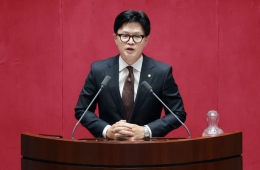
Byungdo Han, Floor Leader of the Democratic Party of Korea, is greeting lawmakers and panelists as he enters the National Assembly Hall on the 17th at a forum held to protect citizens' suffrage and institutional reform. Photo by Yonhap News Agency
View original imageByungdo Han, Floor Leader of the Democratic Party, stated in his opening remarks, "The starting point of democracy is ensuring that every citizen's precious vote is fully protected," emphasizing, "We must review the entire election management system and establish an environment for elections that the public can trust."
During the forum, which was hosted by the Democratic Party's "Task Force for Institutional Reform to Protect Citizens' Suffrage," participants engaged in discussions to seek directions for reforming the election management system in light of the recent ballot paper shortage and controversies regarding the operation of the National Election Commission.
Professor Jeong Taeho of Kyung Hee University Law School, who gave the keynote presentation, diagnosed that recent debates about the National Election Commission have been focused on political disputes over possible election fraud, thereby obscuring the essential issues of organizational capacity and institutional improvement at the Commission.
Professor Jeong pointed out, "The recent debate about the Election Commission has increasingly centered on the political question of whether there was election fraud, which has led to the fundamental issues—what kind of organization the Commission should be and what capabilities it should possess—being overlooked."
He noted, "It is necessary to enhance accountability and, through this, strengthen organizational capacity, but independence must not be compromised," adding, "Whenever discussing reforms, we must always seek solutions within the bounds of the Constitution."
From a comparative constitutional perspective, Professor Jeong classified election management systems into three types: administrative agency model, independent commission model, and hybrid model. He explained, "The administrative agency model is advantageous in terms of administrative efficiency and clear accountability, but it carries a high risk of election interference by the ruling power," and "The independent commission model can enhance political neutrality and public trust in election fairness, but it may be difficult to ensure accountability and may lead to a closed organizational culture."
He continued, "Our Constitution adopted the independent commission model for election management as a thorough reflection on the fraudulent election on March 15," adding, "Granting constitutional status to the Election Commission was a historical choice to prevent political power from interfering in the management of elections."
He raised concerns about the recent arguments for transferring election and vote-counting duties to administrative agencies or local governments, noting potential unconstitutionality.
Professor Jeong said, "Turning the Election Commission into a mere supervisory body and entrusting the actual execution of elections to administrative agencies poses a significant risk of conflict with the independent commission system stipulated by our Constitution," and added, "Rather than denying the independent commission system itself, the practical task is to address its limitations."
He also pointed out that discussions about reforming the Election Commission are trapped in a dichotomy between independence and accountability. Professor Jeong stated, "Independence and accountability are not the purpose of the Election Commission's existence, but means to ensure fair election management," emphasizing, "What is ultimately important is equipping the Commission with the capacity to fulfill its original mission while securing both values simultaneously."
Regarding the recent ballot paper shortage, he commented, "It is difficult to attribute the direct cause to a lack of independence or accountability," and assessed, "What was actually revealed were deficiencies in election management capacity and crisis response systems." He further explained, "Because the Election Commission focused on addressing issues such as surplus ballot papers and allegations of election fraud, it placed a lower priority on the risk that voters might not be able to exercise their suffrage due to a ballot paper shortage," adding, "The prioritization of risks in election management should be determined by the relative importance of constitutional values, but this was not the case."
He continued, "While strict management of ballot papers is important, guaranteeing voters' right to vote is a more fundamental constitutional value," stating, "This incident demonstrates that what election management bodies need is not political debate, but the organizational capacity to actually conduct elections."
Professor Jeong suggested that, rather than amending the Constitution, reforms should focus on revising relevant laws and organizational innovation. As alternatives, he proposed establishing an independent Election Management Evaluation Committee, expanding information disclosure and explanatory obligations, mandating the submission of an election management white paper after each election, and institutionalizing regular reports to the National Assembly and public hearing procedures.
He stated, "The more independent an institution is, the greater its responsibility to explain itself to the public," adding, "In the event of a major incident during the election process, the Commission should promptly explain the circumstances and publicly announce corrective measures." He continued, "Serious election incidents such as ballot paper shortages should be systematically analyzed for their causes and recurrence prevention measures should be established, similar to investigations into aviation accidents or industrial disasters," emphasizing, "An approach focused on learning and prevention, rather than punishment, is necessary."
Regarding organizational innovation at the Commission, he noted, "It is difficult to attribute this incident solely to the fact that the chairperson is not a full-time position," and pointed out, "Since there are already standing commissioners, a secretary general, and a permanent administrative structure, it is more important to build a crisis management system and operational procedures suited to the organization's characteristics, rather than making the chairperson a full-time post." He added, "It is also worth considering actively utilizing external experts who can objectively assess the organization, rather than relying primarily on internal promotions for the secretary general and standing commissioners."
Hot Picks Today
!["Wow, This Is Addictive": Justin Bieber's Wife Raves About 'Ddungbaratte'... Foreign Tourists Flock to K-Convenience Stores [K-Holic]](https://cwcontent.asiae.co.kr/asiaresize/93/2026061914114016021_1781845900.png) "Wow, This Is Addictive": Justin Bieber's Wife Raves About 'Ddungbaratte'... Foreign Tourists Flock to K-Convenience Stores [K-Holic]
"Wow, This Is Addictive": Justin Bieber's Wife Raves About 'Ddungbaratte'... Foreign Tourists Flock to K-Convenience Stores [K-Holic]
- "With 6.6 Trillion Won in Funds Secured"...'Chinese Samsung and SK Hynix' Listing Imminent, Will Chinese Semiconductors Benefit? [Weekend Money]
- "My Income Has Increased, So Why Do I Feel Worse Off?"... The Middle Class Didn't Collapse, It Moved Upward [Weekend Money]
- France Bans Street Drinking Amid 'Monster Heatwave' Alert with Temperatures Soaring to 42°C; 5,700 Deaths Last Year
- "Getting Your Hair Pulled and Kicked Is Routine... '9 Inmates Packed into 5 Pyeong' Cheongju Women's Prison, the Reality of Sweltering Heat [Reportage]"
Professor Jeong concluded, "During the authoritarian era, ensuring the independence of election management was the key issue, but now we must move in a direction that simultaneously guarantees independence, accountability, and transparency while also strengthening practical capacity," emphasizing, "The essence of election commission reform is to equip the body with both the legitimacy and practical capabilities necessary to fulfill its constitutional mission."
© The Asia Business Daily(www.asiae.co.kr). All rights reserved.