"Explaining 'I Didn't Marry Cho Min' Only Led to Lectures... Lee Junseok Takes Legal Action Against YouTube Fake News"
Rumors About Cho Min's Marriage and Lee's Academic Credentials Spread
Lee Junseok Takes Legal Action Against Spreaders of False Information
49% of Koreans Consume News via YouTube
Lee Junseok, leader of the Reform New Party, revealed that he has encountered citizens who actually believe fake news, including the claim that he married Cho Min, the daughter of former leader of the Cho Kuk Innovation Party, Cho Kuk. He announced that he is taking legal action against those spreading false information.
On the 16th, appearing on YTN Radio's "Jang Sungchul's News Myeongdang," Lee stated, "Until now, I had not taken legal action, but over the past year, I have been subjected to countless slanders and have experienced many absurd situations." According to Lee, he was recently approached by a citizen on the subway who asked, "Why did you marry Cho Min?" He explained that it was not true, but the person became angry, insisting, "I saw it on YouTube. Don't lie."

Lee Junseok, leader of the Reform New Party, appeared on Asia Business Daily AK Radio at the National Assembly on the 5th and was interviewed by So Jongsup, a specialist. 2025.8.5 Photo by Hyunmin Kim
View original imageThis claim is clearly false. Cho Min married a non-celebrity man in 2024, and Lee is currently known to be single. However, because this content has been repeatedly spread through YouTube and social networking services (SNS), some users have come to accept it as fact. This case demonstrates how fake news can lead to real-world harm, going beyond simple false information.
The fake news mentioned by Lee does not end there. He said that a supporter once told him, "It's okay even if you didn't graduate from Harvard," and that he had heard baseless claims about his family at rally sites. Lee pointed out, "When I ask where they saw it, they say, 'All the evidence is on YouTube.' If you look at YouTube, Instagram, Threads, and similar platforms, hundreds of thousands of people believe this kind of content."
In particular, Lee criticized the structure in which false information, when repeatedly consumed within certain online spaces, becomes accepted as fact among those groups. He stated, "Korean politics is going in the wrong direction," adding, "Within those spaces, it becomes a kind of truth. The country's politics should not be allowed to deteriorate like this." Lee also revealed that investigative procedures are already underway regarding individuals who repeatedly spread false allegations about his Harvard credentials, and he made it clear that he will continue to pursue legal action against fake news, addressing each case individually.
Hot Picks Today
 "Jealous of Koreans" - Now a Must-Do on Every Trip... The Place Where Foreigners Spent KRW 229.8 Billion
- [Exclusive] Piling medicines into a basket and setting them on the counter: "Ready to check out?" ... Misuse concerns mount, but the government remains in the dark.
- "'No! Dad, Run!'... Father Moved by 5-Year-Old Son Who Shielded Him from Ghost at Korean Folk Village"
- "I thought getting into a big company was the goal"... The 'position' only 1 in 121 employees reaches
- "Please Let Me Go Home"... Customers Trapped in Department Store Parking Lot for 5 Hours Vent Their Anger
Meanwhile, as Lee pointed out, the current domestic news consumption environment is heightening controversies related to fake news. According to an analysis of the "Digital News Report 2026" by the Reuters Institute for the Study of Journalism, released by the Korea Press Foundation, 49% of Korean respondents reported accessing news via YouTube in the past week, far exceeding the 31% average in 48 countries. The dependence on YouTube news was especially high among older age groups, with 59% of those in their 60s and above, and 57% of those in their 50s. The rate of experience with news creator content also reached 64%. On the other hand, 59% of respondents expressed concerns about online misinformation, highlighting that while YouTube and SNS increase news accessibility, they also amplify concerns about the reliability of information.

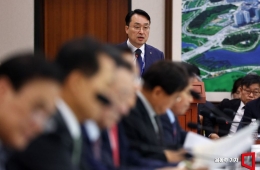
Lee Junseok, leader of the Reform New Party, and Kim Jaeseop, member of the People Power Party, are talking during the 2nd plenary session of the 436th National Assembly (extraordinary session) held at the National Assembly on the 11th. Photo by Kim Hyunmin
View original imageIn response, the government is also strengthening institutional measures to curb the spread of false and manipulated information. The amended Enforcement Decree of the Act on Promotion of Information and Communications Network Utilization and Information Protection stipulates that creators with more than 100,000 subscribers or an average monthly view count of over 100,000 in the past three months who intentionally distribute illegal or false manipulated information causing harm can be held liable for damages up to five times the amount of the damage. Additionally, if information confirmed by the court to be false is repeatedly distributed, an administrative fine of up to 1 billion won can be imposed.
© The Asia Business Daily. All rights reserved. Unauthorized AI training and use prohibited.


!["Please, Just Take Them Off" - They Made It All the Way to Bed... Then Fecal Bacteria Struck [Deep Scroll]](https://cwcontent.asiae.co.kr/asiaresize/307/2026101610053063338_1792112730.png)