"Special Forces Veterans as Teachers?" An Minseok's School Authority Protection Bureau Proposal Sparks Heated Debate
Netflix Drama "True Education" Spurs Policy Debate
Gyeonggi Provincial Office of Education Weighs New Organization
Focus Needed on Response Systems, Not Just Drama Becoming Reality
The fictional organization "School Authority Protection Bureau" from the Netflix drama "True Education" has sparked a real-world debate on education policy. Ann Minseok, the newly elected Superintendent of the Gyeonggi Provincial Office of Education, has publicly called for discussions on establishing a dedicated organization for protecting teacher authority within the Gyeonggi Provincial Office of Education. While drawing a clear line that the violent methods depicted in the drama cannot be applied in reality, Ann argued for the need for what he calls a "Gyeonggi-style School Authority Protection Bureau" or "Educational Activity Protection Bureau," capable of protecting both teacher authority and students' right to learn.

The Netflix drama "True Education" depicts a fictional setting where a supervisor from the School Authority Protection Bureau, a virtual department directly under the Minister of Education, is deployed to school sites to address violations of teacher authority, school violence, and various campus issues. Netflix
View original imageThe controversy originated from the recently released Netflix drama "True Education." The show features a fictional scenario where a supervisor from the School Authority Protection Bureau, a virtual department reporting directly to the Minister of Education, is dispatched to schools to address violations of teacher authority, school violence, and various campus issues. It immediately became a hot topic upon release and topped the global non-English series rankings, further fueling public interest.
Even Former Marines and Special Forces Teachers Mentioned... Will "Gyeonggi's Nah Hwajin" Become a Reality?
On the 16th, Ann appeared on CBS Radio's "Park Sungtae's News Show," stating, "Currently, teacher authority has collapsed in schools, leading to a comprehensive crisis in education." He continued, "Teachers can neither scold nor punish students who misbehave," identifying the restoration of teacher authority as a key task in resolving the education crisis. However, he emphasized that using physical force, as shown in the drama, is impossible, saying, "You should not hit children, not even with a flower."
A particularly noteworthy point was his mention of potential personnel. Ann explained that there are not a few teachers with military backgrounds, such as former Marines, special forces, or airborne troops, and that some have contacted him expressing their willingness to become "Gyeonggi's Nah Hwajin." He believes that a team of about 20 to 30 people could be assembled. He suggested deploying these individuals to schools facing crises or situations beyond teachers' control, aiming to change the school environment through "guidance and counsel, not violent retribution."

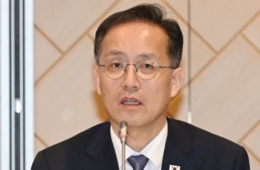
Ann Minseok, the newly elected Superintendent of Gyeonggi Provincial Office of Education, is delivering a greeting speech at the inauguration ceremony of the transition committee held at Gyeonggi Arts Center in Paldal-gu, Suwon-si, Gyeonggi-do on the 15th. Photo by Yonhap News
View original imageAnn also clarified that the name "Educational Activity Protection Bureau" might be more appropriate than the drama's "School Authority Protection Bureau." The intention is to safeguard not only teachers' rights but also the learning rights of other students whose classes may be disrupted. He stated, "Teacher authority and student rights are not in conflict; they must be respected simultaneously." He also mentioned the need to consider guidance methods that do not violate student rights, as well as implementing penalty points and detention systems.
Those in favor argue that "there are problems in today's school environment that cannot be solved by existing systems alone." Online commenters have responded, "Malicious complaints against teachers should decrease so that true education can take place," and, "The learning rights of the majority are being infringed upon by a few students." Others have pointed out, "While unfair corporal punishment was an issue in the past, now the collapse of teacher authority is the problem, so an organization to maintain balance is needed."
On the other hand, opponents are concerned that this plan could lead to students being intimidated or controlled under the guise of restoring teacher authority. The parent group "Mothers on the Move" released a statement criticizing the idea of solving the public education crisis through a drama like "True Education." They argued that the essence of education lies in growth, not punishment, and that corporal punishment or authoritarian discipline cannot be justified under any pretext. They also pointed out that setting up teachers, parents, and students as adversaries could increase conflict within the school community rather than rebuild trust.
Ann Minseok Considers an "Educational Activity Protection Bureau" Model... National Assembly Debate Scheduled for the 25th
Educational circles and observers see this debate as extending beyond the mere realization of a drama scenario, raising fundamental questions about how to redesign the response system for teacher authority, student rights, parental complaints, and students who disrupt classes. Currently, the Teacher Status Act establishes regional teacher authority protection committees within education support offices to deliberate on measures for students who infringe on educational activities, address guardians, and mediate disputes. However, there have been persistent complaints from the field that, while procedures exist, immediate response is difficult.
Ann's camp plans to hold a public debate at the National Assembly on the 25th, focusing on the establishment of a "Gyeonggi-style School Authority Protection Bureau." The debate is expected to address key issues such as the organization's name and authority, criteria for deployment in schools, measures to protect student rights, and methods for handling parental complaints. Ann has stated, "We can't rely solely on what the drama shows; we need to listen more to those on the ground," indicating that the specific operating procedures will be determined through discussion and gathering of opinions.
Hot Picks Today
 "Jealous of Koreans" - Now a Must-Do on Every Trip... The Place Where Foreigners Spent KRW 229.8 Billion
- "I Should Enjoy It After Retirement": Prices Quadruple... Memberships Over 100 Million Won Popular, but Closures Mount
- "I thought getting into a big company was the goal"... The 'position' only 1 in 121 employees reaches
- “The Strong Drink This” Goes Viral on Social Media... What China's Millennials and Gen Z Are Hooked on After Ditching Coffee and Milk Tea
- "Please Let Me Go Home"... Customers Trapped in Department Store Parking Lot for 5 Hours Vent Their Anger
Ultimately, the core of this controversy is not the name "School Authority Protection Bureau" itself, but rather who will intervene in school issues, with what authority, and under what procedures. There is considerable consensus that teachers should be protected from malicious complaints and classroom disruptions. However, if the approach gives students a sense of intimidation or is misunderstood as a return to corporal punishment, backlash is likely to intensify. In order for the discussion of a Gyeonggi-style School Authority Protection Bureau to be realized as an actual system, it has been pointed out that four tasks must be addressed simultaneously: restoration of teacher authority, protection of student rights, safeguarding learning rights, and rebuilding trust with parents.
© The Asia Business Daily. All rights reserved. Unauthorized AI training and use prohibited.