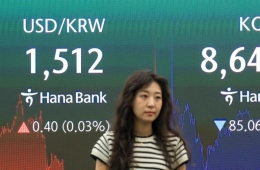
Oil Falls Below $80 After End-of-War Deal... Lowest in Three Months
Oil Prices Extend Losses on Reports of Eased Sanctions on Iranian Crude
As the United States and Iran reached an agreement to end hostilities, reports emerged that the U.S. would immediately permit Iranian oil sales, causing international oil prices to fall to their lowest level in three months on June 16 (local time).
As of 9:30 a.m. on June 17, 2026, Korea time, August delivery Brent crude oil futures were trading at around $79.46 per barrel on the ICE Futures Exchange. July delivery West Texas Intermediate (WTI) crude oil futures on the New York Mercantile Exchange were recorded at $76.57 per barrel.

This is the first time in over three months that Brent crude futures have fallen below $80 per barrel since March 2, the first trading day following the outbreak of the Iran war on February 28.
On this day, The Wall Street Journal (WSJ), citing sources, reported that the U.S. plans to take sanction waiver measures to allow Iran to export crude oil and petroleum products immediately after the signing of a memorandum of understanding (MOU) to end the conflict. The waiver reportedly covers not only oil sales but also related financial settlements, maritime transport, and insurance services. Following this news, oil prices, which had already been declining for four consecutive trading days since June 11, saw further losses.
According to the non-profit group United Against Nuclear Iran and vessel tracking service MarineTraffic, two Iranian oil tankers broke through the U.S. blockade and exited the Gulf of Oman on this day. This is interpreted as a sign that oil shipments have begun without the U.S. maritime blockade that had previously restricted Iran. U.S. President Donald Trump announced that the Strait of Hormuz would be fully reopened without any Iranian tolls starting June 19.
Goldman Sachs lowered its Brent crude forecast for the fourth quarter to $80 per barrel following the U.S.-Iran agreement, a reduction of $10 from its previous outlook. Goldman Sachs also moved up its projection for the normalization of oil exports from Persian Gulf nations to July, earlier than the previously expected late August. Morgan Stanley likewise stated that Brent crude prices are expected to stabilize at around $80 per barrel from the fourth quarter of this year.
Hot Picks Today
![NAVER Rebounds from 190,000 Won Slump to "Targeting 450,000 Won"... Revalued Through Partnership with Nvidia [Stock of the Week]](https://cwcontent.asiae.co.kr/asiaresize/93/2026060521521689771_1780663935.jpg) NAVER Rebounds from 190,000 Won Slump to "Targeting 450,000 Won"... Revalued Through Partnership with Nvidia [Stock of the Week]
NAVER Rebounds from 190,000 Won Slump to "Targeting 450,000 Won"... Revalued Through Partnership with Nvidia [Stock of the Week]
- "Stock Prices Have Risen Significantly, So Taxes Should Be Paid on Gains"…Tasks Ahead for KOSPI 10,000 [KOSPI 10,000 Era] ④
- KOSPI Target Raised Above 10,000 to 11,500 Level: "Semiconductor Supercycle"
- "It Costs as Much as a New Home to Renovate?"... Regional Apartments Left Helpless Despite Burst Pipes and Leaks [Boomerang of High-Density Apartments ③]
- Jensen Huang Praises This Car: "Excellent Value for Money" Kia PV5 Named Best Large Car
However, industry experts caution that it is still too early to be assured. Jotaro Tamura, CEO of the Japanese shipping company Mitsui O.S.K. Lines, said, "It may take several weeks for many shipowners to resume operations in the Strait of Hormuz until it is confirmed that the agreement is substantive." UBS analysts also commented, "While the market welcomes recent developments, it remains to be seen how quickly vessel operations through the strait will return to normal."
© The Asia Business Daily(www.asiae.co.kr). All rights reserved.