President Lee Attends G7, Calls for All Nations to Share AI Benefits... Proposes 'Global AI Basic Society'
Attended First Session of Expanded G7 Summit
Lee: "The Technological Gap Must Not Lead to a Growth Gap"
Lee: "Aid Should Serve as a Catalyst for Investment and Self-Reliance"... Supports Three Documents on Development Cooperation and Health Security
President Lee Jae-myung, who is attending the Group of Seven (G7) summit, stated on the 16th (local time) that it is important for all countries around the world to share the outcomes of advancements in artificial intelligence (AI) technology and grow together. He highlighted this point out of concern that, while the AI revolution is providing humanity with new opportunities for growth, many developing countries do not have sufficient access to its benefits.

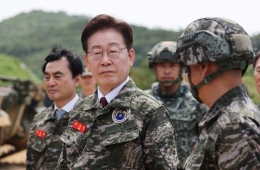
President Lee Jae-myung is speaking at the expanded meeting of the Group of Seven (G7) summit held on the 16th (local time) in Évian-les-Bains, France. 2026.6.1 Yonhap News Agency
View original imageAt the first session of the expanded meeting of the G7 summit held in Évian-les-Bains, France, President Lee said, "We must support recipient countries so that technological gaps between nations do not translate into development gaps." He went on to present the vision of a 'Global AI Basic Society,' where all humanity can benefit from advances in AI technology. The theme of the first session was 'Building New Partnerships and Rebuilding International Solidarity.' The session was attended by leaders from the G7 member countries, as well as invited leaders from Korea, India, Brazil, Kenya, and Egypt, Ajay Banga, President of the World Bank (WB), and Akinwumi Adesina, President of the African Development Bank (AfDB).
President Lee described the AI revolution as "a new challenge and a growth opportunity for humanity." However, he cautioned that if the outcomes of technological advancement are concentrated in a few advanced countries, the gap between nations could widen. Therefore, he emphasized the need for a new international partnership in which technology, systems, aid, and investment work together.
He further stated, "Despite increasing development needs, public resources are insufficient," and stressed, "A new partnership is required in which aid, investment, technology, and systems advance together." He explained that development needs are growing due to the climate crisis, conflicts, food and health crises, and debt burdens, but there are limitations to the conventional aid-centered approach.
In particular, President Lee said, "As development aid budgets for underdeveloped countries are being reduced, we must pave new paths for growth in recipient countries through private investment." He explained that public resources should play a role in facilitating the mobilization of both private investment and domestic resources in recipient countries.
He also introduced a case of support from Korea International Cooperation Agency (KOICA) to Indonesia. Over the past five years, KOICA has supported 12 local startups in agriculture, energy, and environment sectors in Indonesia, and, based on 1 million dollars in grant aid, has attracted 50 million dollars in private investment. President Lee described this as an example of an 'investment-oriented public good,' where public resources are used to spur private investment in recipient countries. He stated, "We will strive to ensure that aid leads to investment, and investment leads to self-reliance, supporting the sustainable growth of partner countries."
He also emphasized the practical impact of development cooperation. President Lee stated, "The achievements of development cooperation depend not only on the amount of resources invested but also on how much the lives of people in recipient countries actually change," and cited the 'LG-KOICA Hope Job Training School' in Ethiopia as an example. Many Ethiopian youths are learning electrical, electronic, and ICT skills at the school, and he stressed that such learning must lead to employment and entrepreneurship.
President Lee declared, "The Republic of Korea will fulfill its responsibilities and role in building international partnerships, drawing on its experience and capabilities of having grown from an aid-recipient country to an aid-donor country." He also expressed his gratitude to France, the host country, for providing this forum for discussion.

President Lee Jae-myung is speaking at the first session of the expanded meeting of the Group of Seven (G7) summit held in Evian-les-Bains, France, on the 16th (local time). 2026.6.17 Yonhap News Agency
View original imageMeanwhile, after the first session, France, as the chair country, adopted three documents: 'Mutually Beneficial International Partnership,' 'Cancer Control,' and 'Ebola Response.' Korea also expressed its support for all of these documents together with the G7. The 'Mutually Beneficial International Partnership' document addresses the need to establish new partnerships that combine official development assistance (ODA), private funding, domestic resources, and development finance to respond to the shortage of development resources and debt vulnerabilities. The 'Cancer Control' document focuses on strengthening international cooperation in health by expanding cancer prevention, early diagnosis, treatment accessibility, and data collaboration for cancer among children, adolescents, and young adults.
Hot Picks Today
 "South Koreans Are All Buying It to Take Home"... This "Drug" Costs 350,000 Won in Korea but Just 80,000 Won in Japan
- "Buy While It's Cheap"... Retail Investors Snap Up KRW 30 Billion in Bank Gold Bars as Prices Fall, Flocking In at a Frenzy
- "I Won't Be Able to See My Own Funeral When I Die"... U.S. Grandmother Holds "Living Funeral" for Her 80th Birthday
- "After Calculating Our Bonuses, It's at Least 3 Billion Won; Feels Like We've Escaped the Working Class"... Samsung Electronics DS Couple's Post
- "Bride Lee Dogyeong, Groom Lee Dogyeong"... Couple Share the Same Name and Date of Birth: "This Must Be Fate"
The 'Ebola Response' document calls for a coordinated international response to the re-emergence of Ebola in the Democratic Republic of the Congo and Uganda, including the development of vaccines, diagnostics, and therapeutics, as well as border surveillance and contact tracing. The Office of the President explained, "Through support for these documents, Korea reaffirmed its solidarity with the G7 and major partner countries in the fields of development cooperation and health security."
© The Asia Business Daily. All rights reserved. Unauthorized AI training and use prohibited.