Are Hidden Weaknesses in the U.S. Financial System Greater Than Expected?... Private Credit Could Become a Crisis Trigger
Korea Capital Market Institute Highlights Risks
One-Third of Borrowers Unable to Cover Interest Payments
Low Likelihood of Fund Bankruptcy
U.S. Banks and Life Insurers Exposed to Growing Risks
There are growing concerns about the deteriorating soundness of the U.S. private credit market and the potential for these risks to spread throughout the American financial system. Some experts argue that the scale of the U.S. private credit market is underestimated and that, in the event of defaults, risks could transfer across boundaries between different sectors of the financial industry.
Shin Boseong, Senior Research Fellow at the Korea Capital Market Institute, recently stated in his report "Soundness and Systemic Risk of the U.S. Private Credit Market" that "the entire financial system is tightly interconnected, so it would be a mistake to relax vigilance simply because private credit funds currently exhibit low leverage and a low probability of a liquidity crisis."

Deteriorating Private Credit Soundness Damages Fund Values
According to Shin, the soundness of the private credit market is indeed worsening. Private credit refers to loans provided to private and unlisted companies through funds. One notable trend is the rising interest burden for private credit borrowers. During the period of low interest rates following the COVID-19 pandemic, companies paid an average interest rate of 6%. However, due to base rate hikes, borrowing companies are now facing a doubled interest rate of 12%. The rapid advancement of artificial intelligence (AI) has also negatively impacted the profitability of information technology (IT) and software-as-a-service (SaaS) companies. Since 41% of private credit borrowers operate in the IT sector, with most of them being SaaS companies, this has had a significant effect. As a result, since 2023, about one-third of private credit borrowers have struggled to pay even the interest on their loans from their operating profits, indicating significant hardship among many borrowing companies.

The sharp increase in payment-in-kind (PIK) loans is also a warning sign. PIK loans refer to a structure where interest is not paid in cash, but rather by borrowing additional funds from the fund to pay the interest. The proportion of PIK loans jumped from 5-6% in 2022 to 12% last year, following a surge that began in 2023 during the period of rising interest rates. Shin explained, "This practice essentially defers the recognition of losses even though borrowers have effectively entered a default state, which increases the likelihood of subsequent delinquencies and bankruptcies."
As borrowing companies become distressed, the value of private credit funds has also declined. In September of last year, more than 10% of loans in private credit funds had written off over 50% of their principal. As of the end of 2025, the actual fund return based on net asset value (NAV) stands at 1.8%, which is about half the 3.7% return six months prior. The value of listed business development company (BDC) funds has also declined. The S&P BDC index as of last month had dropped 29.3% from its peak in February 2023, indicating that the actual value of many private credit funds has been significantly damaged, Shin explained. However, he noted that the funds' own debt ratio is low at 54% by BDC standards, and there are liquidity defense mechanisms such as redemption gates, so the likelihood of fund bankruptcies due to liquidity crises is low.
"U.S. Banks and Life Insurers Exposed to Risks via Fund Connections"
Instead, Shin warned that should funds actually experience liquidity crises, risks could spread throughout the financial market. He pointed out that the size of the private credit market is underestimated. About half of fund borrowers also borrow from banks, and banks have reportedly increased lending limits to companies that successfully secured fund loans. Banks have also provided loans directly to private credit funds, exposing themselves indirectly to private credit risks.

U.S. life insurance companies are also exposed to private credit risks. When private credit funds transfer loan receivables to special purpose vehicles (SPVs) and issue private asset-backed securities (ABS), life insurers have purchased a large amount of these securities. This is because the regulatory capital requirement is two to four times lower compared to investing directly in the funds. This market is valued at $849 billion (about 1,283 trillion won), more than double the entire BDC market, and accounts for 14% of all assets held by life insurers. Essentially, these are private credit assets, but since they are classified as private bonds, they are omitted from private credit statistics, making them easy to overlook. Private ABS can also amplify risks, as a single loan can be securitized and sold to investors, and the same loan can be used again as collateral for a bank credit agreement. If the underlying asset's company defaults, multiple financial contracts sharing the same asset would inevitably be affected.
Another problem is that some borrowers have taken overlapping loans from multiple funds. 61% of borrowing companies have borrowed from two or more funds, and 18% have borrowed from six or more funds. There are also cases where one private credit fund invests in another fund. Shin stated, "The number of U.S. corporate bankruptcies last year was the highest since 2010," and warned, "If financial market volatility increases for any reason, vulnerabilities in the corporate sector could erupt all at once."
Hot Picks Today
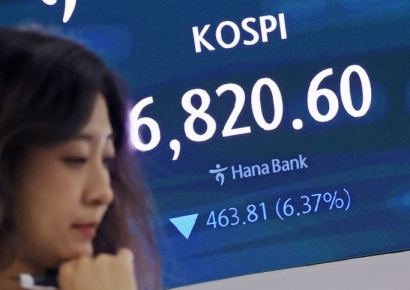 Securities Firms Reverse Course as KOSPI Falls Below 7,000... More Downgrade Reports Than Upgrades in July
- Turned on the Air Conditioner All Night and Woke Up with a Sore Throat... It's Not Just a Cold [Kok! Health]
- "Crisp and Stress-Relieving: K-Fruit Exports Hit KRW 130 Billion, Which New Star Is Rising in Japan?"
- "Spiders Crawling Across Faces While Sleeping"... Naju Apartment Complex Plagued by Spider Infestation
- Even Without Overdue Card Payments... Everyday Habits That Lower Office Workers' Credit Ratings
Meanwhile, the risk of the U.S. private credit market spreading to the Korean market is considered low. This is because Korean institutional investors have low exposure to overseas private credit. For example, the National Pension Service's outstanding private credit investment last year accounted for only 0.7% of its total assets under management, and Korea Investment Corporation (KIC) is also reported to have a private credit asset ratio of around 2-3%.
© The Asia Business Daily. All rights reserved. Unauthorized AI training and use prohibited.




![[Breaking] Coupang Apologizes for Incheon Logistics Center Fire…“Will Fully Cooperate With Authorities’ Investigation”](https://cwcontent.asiae.co.kr/asiaresize/307/2026071820375349810_1784374673.jpg)