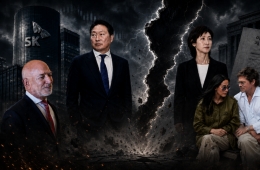
[Current Affairs Show] Why Has the Democratic Party's Approval Rating Fallen Behind the People Power Party?
Failed to Respond Promptly to Ballot Shortage Incident
Rising Stock Market Heightens Sense of Relative Deprivation
Disappointment Over President's Message to Pursue Special Prosecution for Dropping Charges
■ Broadcast: The Asia Business Daily 'So Jongseop's Current Affairs Show' (Mon~Fri, 4:00~5:00 PM)
■ Host: Political specialist So Jongseop ■ Director: Producer Park Sumin
■ Guest: Lee Taekyu, former Assemblyman of the People Power Party (June 15)
※ When quoting content from this article, please be sure to cite 'So Jongseop's Current Affairs Show.'
So Jongseop: Hello, everyone. This is So Jongseop, and welcome to the Current Affairs Show. Today, we will be discussing recent issues with former People Power Party Assemblyman Lee Taekyu. For the first time since the beginning of the Lee Jaemyung administration, the People Power Party's approval rating is 6.3 percentage points ahead of the Democratic Party. Such results have been reported. Realmeter, commissioned by Energy Economy News, conducted a survey of 1,002 people on June 11 and 12, and announced the findings on June 15. The survey was conducted using an automated wireless response method, with a sample error of plus or minus 2.0 percentage points at a 95% confidence level. For more details, please refer to the website of the National Election Survey Deliberation Commission. The People Power Party scored 44.3%, and the Democratic Party received 38.0%.
People Power Party 44.3%, Democratic Party 38.0%
Lee Taekyu: This is a highly unusual situation and requires more in-depth analysis. However, at the very least, the crossing or narrowing of approval ratings between the ruling and opposition parties appears to be closely related to the decline in the president's approval rating. As the president's approval declines, the approval rating for the main opposition party, the People Power Party, is rising proportionally. Why is this happening now?
First, regarding the recent ballot shortage incident, the public perceives this not simply as a problem with the National Election Commission, but as a national issue. In that regard, President Lee Jaemyung failed to respond promptly and responsibly. He tried to frame this merely as poor management, incompetence, or negligence on the part of the Election Commission. However, this incident constitutes a major democratic crisis, as it infringes upon constitutional rights. The president should have taken action.
The president should have met with party leaders and reached a consensus on how to resolve this issue. Alternatively, he could have made a special address earlier, outlining a plan for resolution, and should have taken responsibility for solving the issue. This should have included Election Commission reform and an investigation into the causes of poor management. The president failed to demonstrate such responsibility. As a result, many people are expressing disappointment in the president, alongside their criticism of the Election Commission.
There is also what can be called voter catharsis. Early in an administration, the public often feels the need to support the president and ruling party. In the past, this was called the honeymoon period. But now, with the election over, the public feels they have supported them enough. The opposition has also been held accountable. If voters have experienced catharsis, there is a possibility that passive supporters of President Lee Jaemyung and the ruling party may become disengaged.
So Jongseop: So, now that the honeymoon period is over, people are taking a colder, more objective view?
The President’s Ideological Messaging Seems Reflected in Negative Assessments
Lee Taekyu: That's right. I also believe voters are experiencing a wake-up call. After the impeachment and the start of the Lee Jaemyung administration, there was considerable trust and belief in the ruling party, but if you look closely, there hasn't been any tangible benefit for ordinary people. For example, the KOSPI hitting 8,000 points or a semiconductor supercycle has nothing to do with small businesses or the working class. What does it matter to young people struggling with housing costs? With the election over, voters are reflecting on their realities, and with high prices, high exchange rates, and high oil prices, everyday life is difficult. There are cases where some company employees receive annual bonuses that ordinary people could never earn in a lifetime, which creates a sense of deprivation for most people rather than satisfaction. I believe this is the reality check voters are experiencing now.
Moreover, since the middle and latter part of the local elections, I believe the negative perception of the president has increased greatly. The president insisted on pursuing the withdrawal of indictments and, even at the one-year inauguration press conference after the election, did not clarify his stance on giving up this pursuit. There was also the issue of excessive political exploitation when the Starbucks incident occurred. But what concerned me the most was the president's message encouraging voter turnout. While it's normal for a president to promote voting, the message displayed animosity toward the opposing camp. Seeing that, I felt the president had shifted from pragmatism to an ideological stance.
So Jongseop: So you don't believe the People Power Party's approval rating increased because of their own merits?
Lee Taekyu: That's correct. The party is benefiting from a backlash effect, not because they've achieved anything significant since the election. There hasn't been anything the People Power Party has clearly demonstrated to the public as a success. What we're seeing is a backlash effect, and now voters are beginning to observe things with a critical eye.
So Jongseop: According to a Korea Gallup poll, former Justice Minister Cho Kuk ranked first among the pan-ruling bloc as a preferred future leader. Overall, Oh Sehoon and Han Donghoon are in the lead, but among pan-ruling bloc candidates, former Justice Minister Cho Kuk is first, followed by Prime Minister Kim Minseok and policy chief Kang Hoonshik. The Korea Gallup poll was conducted nationwide from June 9 to 11 among 1,002 respondents aged 18 and over, asking who they think should lead Korea in the future. (The survey used randomized mobile phone numbers and interviewer-administered calls. Sampling error is plus or minus 3.1 percentage points at a 95% confidence level. For more details, refer to the website of the National Election Survey Deliberation Commission.)
※Click the video to watch the full program.
Cho Kuk Has a Certain Base in Honam, but Expansion Remains a Separate Issue
Lee Taekyu: This reflects both the issue of popularity and the fandom of former Justice Minister Cho Kuk. Historically, both Cho Kuk and the Cho Kuk Innovation Party have had a certain support base in Honam. I also noticed that support from Honam was much higher this time. In the recent leadership poll, Cho Kuk recorded 7% nationwide, but in Honam, he received 21%. Similarly, while the Cho Kuk Innovation Party has a 2% approval rating nationwide, it is about 11% in Honam.
There is indeed a support base in Honam. We must consider the unique political dynamics of Honam. It is often said that voters in Honam vote strategically; when they lack a prominent local candidate, they sometimes select candidates from other regions. In the absence of a strong local candidate, the personal fandom around Cho Kuk may have played a significant role, but whether this support will expand is a separate question.
One clear point is that leading politicians in the Democratic Party, including Representative Jeong Cheongrae, have lower public recognition compared to Cho Kuk. I believe this was reflected in the survey.
So Jongseop: Although former Prime Minister Kim Bu-gyeom lost in Daegu this time, he received a significant number of votes and showed a willingness to sacrifice himself for the election. From a narrative perspective, does he have a political future?
Kim Bu-gyeom May Be Brought Back If Uncertainties Remain
Lee Taekyu: If there is uncertainty among the current leading Democratic Party candidates, I believe Kim Bu-gyeom could be brought back. After all, Kim Bu-gyeom ran in Daegu, challenging regionalism, which has certain similarities with the legacy of former President Roh Moo-hyun. I don't think this should be underestimated. Although Kim Bu-gyeom may not be as passionate as President Roh Moo-hyun, he possesses many qualities that set him apart from typical Democratic Party politicians, even though he is a member of the party.
Hot Picks Today
 "Shocking Forecast" for Bitcoin: "Even After 100 Years, Only 0.6% Annual Return" Bubble Concerns Resurface
- "Insurance Covers It"—Unaware Patients at Risk as Repeated Extracorporeal Shock Wave Therapy May Lead to Loss of Indemnity Coverage
- "Interest Rates Up 400 Times in 2 Years"... Young Japanese on Edge over Potential Loan Bomb
- "Sold Out? Frenzy Ensues" Secondhand Trading Surges 473%... 100,000 Won Stickers Snapped Up
- "What About Those Who Paid 220,000 Won?"... Chinese Maotai Faces Major Setback and Plummeting Prices
He is relatively moderate and not abrasive, whereas many Democratic Party politicians tend to be more combative. In that sense, he has strengths that other Democratic Party politicians lack. In particular, he has consistently emphasized the importance of coexistence in politics, which is arguably the most needed value in today’s and tomorrow’s Korean politics. If the current Democratic Party candidates fail to provide clear answers, Kim Bu-gyeom could be brought back. Even though he lost this time, the Daegu mayoral election will be remembered by voters and the public as a powerful part of his narrative.
![[Current Affairs Show] Why Has the Democratic Party's Approval Rating Fallen Behind the People Power Party?](http://www.asiae.co.kr/news/img_view.htm?img=2026061615492611669_1781592566.jpg)
© The Asia Business Daily(www.asiae.co.kr). All rights reserved.