"Rebuilding Collapsed Power Grids"... Middle East 'Reconstruction Market' Emerges Amid Hopes for End of Hostilities
Restoration of Power Grids and Civil Infrastructure After the End of Hostilities
Order Opportunities for Power Equipment and Construction Machinery
High Expectations for Korean Companies With Middle East Construction Experience
As expectations for an end to hostilities between the United States and Iran grow, the domestic industrial sector is turning its attention to the postwar reconstruction market. There is rising anticipation that, if the restoration of war-damaged power grids, energy facilities, ports, roads, and other infrastructure begins in earnest, new business opportunities will open up for related industries such as power equipment, cables, construction machinery, and energy.
According to an overview of the power, construction, energy, and steel sectors on June 16, companies in these industries are closely monitoring both the potential normalization of existing Middle Eastern projects after a ceasefire and whether full-scale reconstruction demand will materialize. Fields where reconstruction demand is expected include: ▲power infrastructure (restoration of power plants, transmission and distribution networks, and transformers); ▲civil infrastructure (restoration of roads, bridges, and port hinterlands); ▲construction equipment (demand for excavation, transport, and concrete pouring machinery); ▲energy plants (maintenance of refineries, gas processing, storage tanks, and oil pipelines); and ▲water treatment (water supply, sewage, and wastewater facilities).
The sector expected to benefit first is power infrastructure. Postwar reconstruction projects do not simply restore damaged equipment; they may also extend to modernization of transmission and distribution networks, expansion of substation facilities, and interconnection of power grids across countries to accommodate increased power demand. If the restoration of power plants and substations, construction of ultra-high-voltage transmission grids, and maintenance of distribution networks are carried out simultaneously, power equipment companies specializing in transformers, circuit breakers, and distribution panels could see increased business opportunities. In particular, the industry anticipates reconstruction projects for war-damaged oil storage facilities and AI (artificial intelligence) cloud infrastructure.

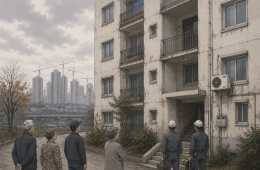
An apartment on the southern outskirts of Beirut, the capital of Lebanon, after an airstrike by the Israeli military. Photo by Yonhap News.
View original imageAn official from LS ELECTRIC said, "There will be reconstruction demand for facilities, such as Oracle data centers, that were perceived to be at risk of airstrikes," adding, "Since refineries and data center facilities generally take a long time to rebuild, power companies are expected to benefit directly."
An official from HD Hyundai Electric also commented, "There have been risks in carrying out project sites due to the Middle East war, but this ceasefire has greatly alleviated such risks, which is a positive development. Existing projects, such as infrastructure expansion related to NEOM City in Saudi Arabia, are now expected to proceed without hindrance." He further stated, "If Iran's postwar recovery projects begin in earnest due to the ceasefire, or if U.S. sanctions are lifted, additional reconstruction demand could arise. However, we still need to monitor the situation for now."
Cable manufacturers that supply ultra-high-voltage cables, submarine cables, and distribution cables for power grid restoration are also expected to benefit. Domestic cable companies such as LS Cable and Taihan Cable have previous experience handling large-scale national power grid projects in the Middle East, so the possibility of winning contracts is considered high. In 2020, LS Cable secured a turnkey contract worth 100 billion won for a submarine cable power grid project in Bahrain. Taihan Cable also continued to achieve contract wins, such as the 180.4 billion won turnkey contract for an ultra-high-voltage power grid project from Qatar General Electricity & Water Corporation last year.
An official from a cable company commented, "Because the Middle East has unique geographical and climatic conditions, a proven track record of actual construction is essential when bidding for power grid projects. While there is a tendency to favor local companies for postwar reconstruction, the technological prowess of domestic cable firms is so overwhelming that we can fully expect to benefit from these opportunities."
The construction machinery industry also expects large-scale contract opportunities if full-scale reconstruction demand arises after the ceasefire. The construction machinery sector is directly linked to the initial recovery equipment needed for reconstruction. As domestic companies have recently continued to secure major contracts in the Middle East, including Saudi Arabia and the UAE, they are likely to maintain a strong position in future reconstruction processes. An industry official explained, "Because it is crucial to rapidly restore damaged infrastructure and facilities, the key to reconstruction is speed. Equipment familiar to local workers offers advantages in operational efficiency and maintenance, so domestic companies are likely to be preferred."

However, some caution remains about discussing reconstruction contracts at this stage, as a ceasefire has not yet been confirmed. An official from HD Construction Equipment said, "Nothing regarding reconstruction contracts has materialized yet, and it is too early to discuss the possibility of winning such contracts. The scale of reconstruction demand can only be estimated in the future."
The energy sector is also keeping an eye on the possibility of long-term demand expansion. If postwar reconstruction gets underway in earnest, the restoration of industrial and residential infrastructure is expected to be accompanied by new demand for power generation infrastructure and maintenance of outdated power facilities.
For example, Doosan Enerbility is targeting the Middle Eastern power generation market by recently winning major power plant construction and steam turbine supply projects in Oman. A Doosan Enerbility official predicted, "The demand for power plant construction to supply electricity in the Middle East has continued for several years and is expected to keep expanding in the future." However, the official added, "Whether there will be any direct benefit from postwar recovery remains to be seen."
Hot Picks Today
 Once the World's Best, Now "Can't Survive Without Money" - BBC to Cut 2,000 Jobs
- "Admitted to Years of Ingredient Deception"... China Shocked by Street Vendor Who Built a Million-Yuan Success Story
- "Wallet Returned, but Cash Missing"... 420,000 Won Disappears from Police-Lost Property Storage
- "'So Beautiful': World Cup Bikini Beauty Causes a Stir...Was It AI All Along?"
- "Found a Girlfriend While Traveling in Japan"... Unexpected Hotspots on the Rise
The steel industry is maintaining a cautious stance, citing the pace of recovery in oil prices and exchange rates as key variables. An industry official said, "Depending on how quickly oil prices and exchange rates recover following stabilization in the Middle East, the situation may change. Given ongoing external uncertainties such as a sluggish global economy and delayed recovery in steel demand, continued monitoring will be necessary."
© The Asia Business Daily(www.asiae.co.kr). All rights reserved.