Korean Bentonite Targets Gout and Kidney Diseases... KIGAM Develops Next-Generation Biosensor [Reading Science]
Combination of Natural Clay Minerals and Carbon Nanotubes Enables Highly Sensitive Uric Acid Detection
Stable Performance Maintained for Over 60 Days;
Promising Prospects for Commercialization of Point-of-Care Medical Devices
A team of Korean researchers has developed a next-generation biosensor for diagnosing gout and kidney diseases by utilizing bentonite, a natural clay mineral. This achievement demonstrates the potential for using bentonite, previously regarded as a mineral resource, as an advanced medical device material.
The Korea Institute of Geoscience and Mineral Resources (KIGAM) announced on the 16th that Dr. Jaehwan Kim’s research team at the Pohang Georesource Demonstration Research Center, together with Professor Ki Kyung Kim’s group at the University of Calgary in Canada, has developed an electrochemical biosensor using bentonite, a natural clay mineral from the southeastern region of Korea.

Schematic diagram of the bentonite-multiwalled carbon nanotube biosensor fabrication process. Provided by the research team
View original imageUric acid is a key biomarker used in the diagnosis of gout and kidney diseases. Abnormally high levels of uric acid in the blood may indicate gout or impaired kidney function. Therefore, technology capable of measuring uric acid quickly and accurately is considered a core element in the development of point-of-care (POC) medical devices.
The research team created a nanocomposite by combining multi-walled carbon nanotubes (MWCNTs) with bentonite, which is typically unsuitable as a biosensor material due to its low conductivity. They then uniformly deposited the nanocomposite onto the electrode surface using an airbrush spraying process and immobilized uricase (uric acid-degrading enzyme) to construct the sensor.
Biosensor Made from Natural Minerals Enhances Accuracy and Durability
The developed sensor was found to detect a wide range of uric acid concentrations (10 to 2,000 micromoles (μM)), which is relevant for diagnosing gout and kidney diseases. It also maintained high accuracy in artificial serum environments, confirming its potential for application in real-world medical settings.
In particular, the sensor’s resistance to biofouling—a major obstacle in biosensor commercialization—was significantly improved. The signal reduction rate was lowered from the previous 27.6% to 10.0%, and the sensor was found to maintain stable performance for over 60 days.

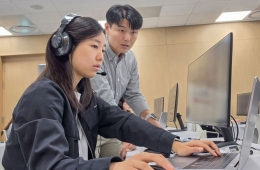
Dr. Jaehwan Kim is conducting an enzyme immobilization experiment using domestic clay minerals. Provided by KIGAM
View original imageThe research team expects that this technology can be applied not only to the diagnosis of gout and kidney diseases but also to the development of point-of-care medical devices for a wide variety of diseases in the future.
Dr. Jaehwan Kim stated, “This is a convergence research achievement that expands the scientific value of domestic natural minerals into the field of advanced medical technology,” adding, “We aim to lead the bio-healthcare and next-generation diagnostic device sectors by creating high value-added materials based on georesources.”
Hot Picks Today
![Selling Like Crazy Every Year... 30-Year-Old Hetbahn Takes on a New Challenge: Tastes Better Than "Mom's Home Cooking" [On-Site Report]](https://cwcontent.asiae.co.kr/asiaresize/93/2026102216175071025_1792653470.jpg) Selling Like Crazy Every Year... 30-Year-Old Hetbahn Takes on a New Challenge: Tastes Better Than "Mom's Home Cooking" [On-Site Report]
Selling Like Crazy Every Year... 30-Year-Old Hetbahn Takes on a New Challenge: Tastes Better Than "Mom's Home Cooking" [On-Site Report]
- "Please Pay Me at Least 3 Million Won a Month": More Than Half of Young People Today Prioritize "Working Conditions" Over Company Size
- A 12-Year-Old Girl Went to the Hospital After Her Blood Pressure Hit 225 and Was Stunned: "What Is This Coral Reef-Like Thing in Her Aorta?"
- "Hey, Lady, Teach Your Kids to Behave!" ... 300,000 Won in Cash and a Bodily Injury Claim Demanded Over Child's Door Ding
- Beachgoer Finds 'Plastic' That Turns Out to Be Perfume Ingredient Worth More Than Twice as Much as Gold
The results of this research have been published in Biosensors and Bioelectronics, an international journal in the biosensor field.
© The Asia Business Daily. All rights reserved. Unauthorized AI training and use prohibited.